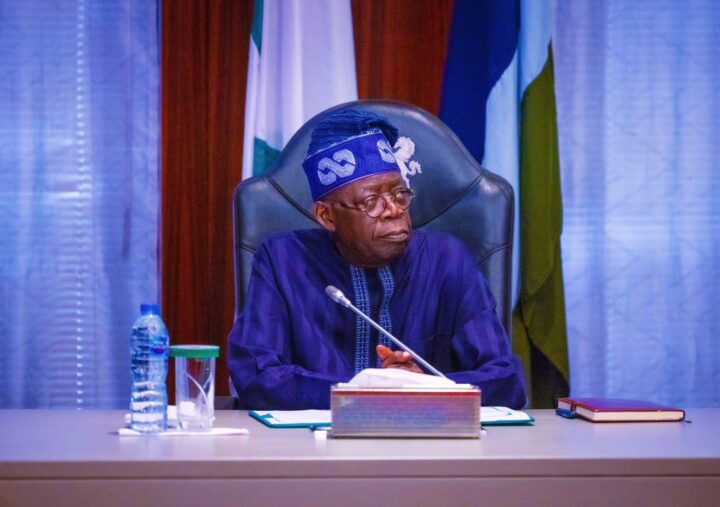
President Bola Tinubu has broken his silence on the sweeping executive order he signed on February 13, 2026, targeting the financial architecture of Nigeria’s oil and gas sector, saying the directive was driven by a determination to end what he described as decades of structural leakages that have denied Nigerians the full benefits of their hydrocarbon wealth.
In a personal address to Nigerians, Tinubu said the Presidential Executive Order No. 9 of 2026, formally titled the Presidential Executive Order to Safeguard Federation Oil and Gas Revenues and Provide Regulatory Clarity, 2026, was designed to restore constitutional compliance to a revenue system he said had been compromised by “excessive deductions, overlapping funds, and structural distortions.”
“For too long, revenues meant for federal, state, and local governments have been trapped in layers of charges and retention mechanisms,” Tinubu said. “Development suffers. That must end.”
The order, which has already been gazetted, represents the most direct presidential intervention in NNPC Limited’s financial operations since it was reconstituted as a commercial entity under the Petroleum Industry Act (PIA) of 2021.
What the order does
At the heart of Executive Order 9 is a directive that all government entitlements from Nigeria’s oil and gas operations, including Royalty Oil, Tax Oil, Profit Oil, Profit Gas, and any other government take under Production Sharing Contracts and related arrangements, must now be remitted directly into the Federation Account, bypassing existing retention structures within NNPC Limited.
Most significantly, the order scraps two deductions that have attracted considerable controversy within fiscal policy discussions. NNPC Limited will no longer retain a 30 per cent management fee on Profit Oil and Profit Gas, and the company will no longer manage a separate 30 per cent Frontier Exploration Fund drawn from profit oil and gas revenues. Both streams of income will now flow directly to the Federation Account for allocation among the three tiers of government.
The presidency also announced the formation of a joint project team to manage integrated upstream and midstream operations, with regulators serving as the primary interface with license holders, a structural shift that signals a recalibration of NNPC’s operational mandate.
To enforce the order, Tinubu has approved the establishment of a high-level implementation committee comprising the Minister of Finance, the Attorney-General of the Federation, the Minister of Budget and Economic Planning, the Minister of State for Petroleum, the Chairman of the Nigeria Revenue Service, the Director-General of the Budget Office, and other senior officials. The committee’s mandate is to ensure coordinated and effective execution of the order across all relevant agencies.
The PIA question
Beyond the immediate directives, Tinubu signalled a potentially far-reaching development by announcing plans to undertake a comprehensive review of the Petroleum Industry Act 2021, which governs Nigeria’s oil and gas sector.
He said the review would target “structural and fiscal anomalies that weaken national revenue” and would be conducted in consultation with industry stakeholders.
The PIA, which took years to pass and was hailed as a landmark reform at its enactment, has faced growing criticism from some quarters over provisions that critics argue have reduced government revenue in practice. A formal presidential review could open significant debates about the balance between investor incentives and national fiscal interest.
The executive order arrives at a moment of acute pressure on government finances.
Federation Account allocations to states and local governments have been a persistent source of tension, with many sub-national governments arguing that the amounts they receive fall short of what Nigeria’s oil production should generate.
The order is implicitly an acknowledgement that the current architecture of NNPC’s finances has contributed to that shortfall.
Tinubu framed the intervention in the language of constitutional duty. “Every legitimate naira due to the Federation must be protected,” he said, adding that NNPC Limited must now “operate strictly as a commercial enterprise, as intended under law.”