Nigeria’s food import surged to a four-year high in 2025, its highest level since 2022, mainly driven by the federal government’s import waiver policy.
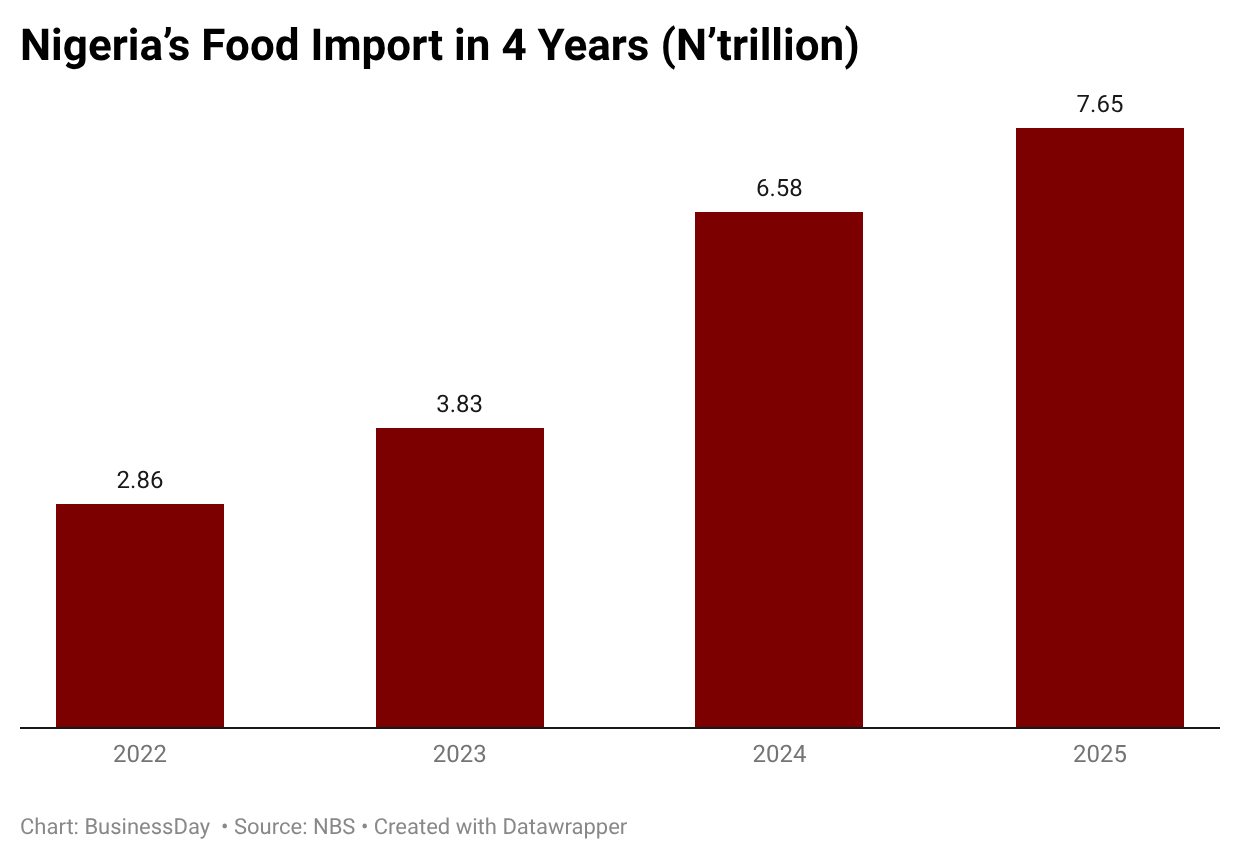
Data from the National Bureau of Statistics (NBS) shows that Africa’s most populous nation spent N7.65 trillion importing food and beverages from other nations in 2025, up 63 percent from N2.86 trillion in 2022.
The surge is driven by the 2024 import waiver policy implemented to ease soaring food prices.
Read also: How import waiver policy shaped agric sector in 2025
While the policy helped drive food inflation down from 40.8 in June 2024 to single-digit in January 2025, it caused losses for farmers.
“We need to look for more sustainable measures to increase food production because importation is not sustainable,” said Tunde Banjoko, Agric president of the Lagos Chamber of Commerce and Industry (LCCI), told BusinessDay in an interview.
“It also puts a lot of pressure on foreign exchange. So rather than importation, we should be talking about how to export,” Banjoko added.
In 2023, Nigeria spent N3.83 trillion on food imports, with the figure peaking in 2025 to mark the highest level within the period.
Of the imported food commodities in 2025, about N1.34 trillion was used for importing food for household consumption and roughly N2.09 trillion was spent importing food for industrial purposes. The 2025 household consumption bill is more than double the amount expended for the same purpose in 2022 – N529.4 billion.
According to experts, no nation can survive entirely on importation. Recent data from the United Nations Comtrade show that Nigeria spent roughly N51 billion on rice import in 2024, just when the import waiver policy was kicking off. Today, many rice mills have shut down due to inability to compete with rising costs of production and low market.
One miller who spoke to BusinessDay on the basis of anonymity said the market became saturated with imported rice, which was cheaper than locally produced rice, forcing millers to sell at a loss.
“It was a disaster. The cost of production is high, so there was no way we could sell at the same price as imported rice,” he said.
“We were forced to sell our rice at lower prices, thereby running into huge losses. Several mills have shut down and people have lost their jobs as a result,” the Anambra rice miller, said.
Read also: High manufacturing costs, logistics, fuel soaring drug prices despite import waiver
Further analysis of the NBS data highlights that Africa’s most populous nation expended over N4 trillion importing processed food in 2025, more than 100 percent surge when compared to only about N1.4 trillion spent for the same reason in 2022.
Across the country, farmers are still struggling to pay back loans collected from banks due to poor sales that left many with losses in millions of Naira. The Bank of Agriculture noted at a BusinessDay conference that over 70 percent of farmers are yet to repay loans acquired from the bank.
Ibrahim Kabiru, president of the Nigeria Agribusiness Group (NABG), said the policy was introduced without considering the purchasing power of Nigerians and how it will impact farmers.
“The reason we are seeing a rise in import is because of the import waiver policy. This allowed massive importation of food commodities without much thought of how it will affect farmers,” Kabiru said.
However, as a way forward, he said the Guaranteed Minimum Price scheme for farmers should be encouraged with full swing, as it will enable farmers ramp up production while also making profit.
The scheme, announced in October 2025, is a government-backed floor price policy designed to protect producers from price volatility, ensuring they sell key crops—such as maize, rice, and soy—above production costs, particularly during harvest gluts. It is a stabilisation tool aimed at curbing losses, encouraging continued cultivation, and ensuring food security.
He also urged for a state of emergency on farm inputs like fertilisers as prices have doubled in the last one year. “The government should put a state of emergency on inputs like fertiliser to avoid a repeat of what we are seeing today,” he said.
Similarly, Gideon Negedu, former executive secretary of the Fertiliser Producers Suppliers Association of Nigeria, emphasised that Africa’s most populous nation cannot remain dependent on food importation because it is not sustainable.
“The current food import policy will not be a sustainable solution to stabilise food prices because global food prices will surge,” he said in an interview with BusinessDay.
Feyishola Jaiyesimi
Feyishola Jaiyesimi covers agriculture and environment trends at BusinessDay, Nigeria’s leading daily newspaper focused on economy and finance. Her stories draw on investigative journalism, and she has been selected for professional training by the US Embassy, Lagos, and Dataphyte. Feyishola holds a bachelor’s degree in Zoology and Environmental Biology from Ekiti State University.