
Nigeria’s listed publishing houses continue to grapple with a deepening financial crisis as the projected first quarter of 2026 reveals a disconnect between top-line growth and bottom-line profitability. While revenue has shown an improvement, a surge in production costs and inflationary pressures have eroded the margins of the industry’s key players.
An analysis of Q1 2026 earnings reports for Learn Africa Plc and University Press Plc shows a combined projected loss after tax of N588 million for the period ended June 2026, an increase from the N533 million loss recorded during the same period in 2025. This downturn persists despite a combined revenue rise to N825 million, as the cost of sales continues to outpace earnings.
The cost of sales contraction
The primary driver of this fiscal decline is the rising cost of production. During the period under review, Learn Africa reported a staggering 63 percent increase in its cost of sales, while University Press Plc saw a 17 percent rise. These figures reflect the volatility of raw material prices in a high-inflation environment.
Read also: Nigeria’s oldest publishing houses battle for market share
Bucking the industry trend, Academy Press remains the sole profitable entity among the listed players, posting an after-tax profit of N409 million for the first quarter. However, for the broader sector, the “financial scorecard” remains grim, with the price of essential raw materials, specifically paper, doubling due to macroeconomic pressures and a heavy reliance on expensive imports.
Nigeria’s multi-trillion-naira paper dependency
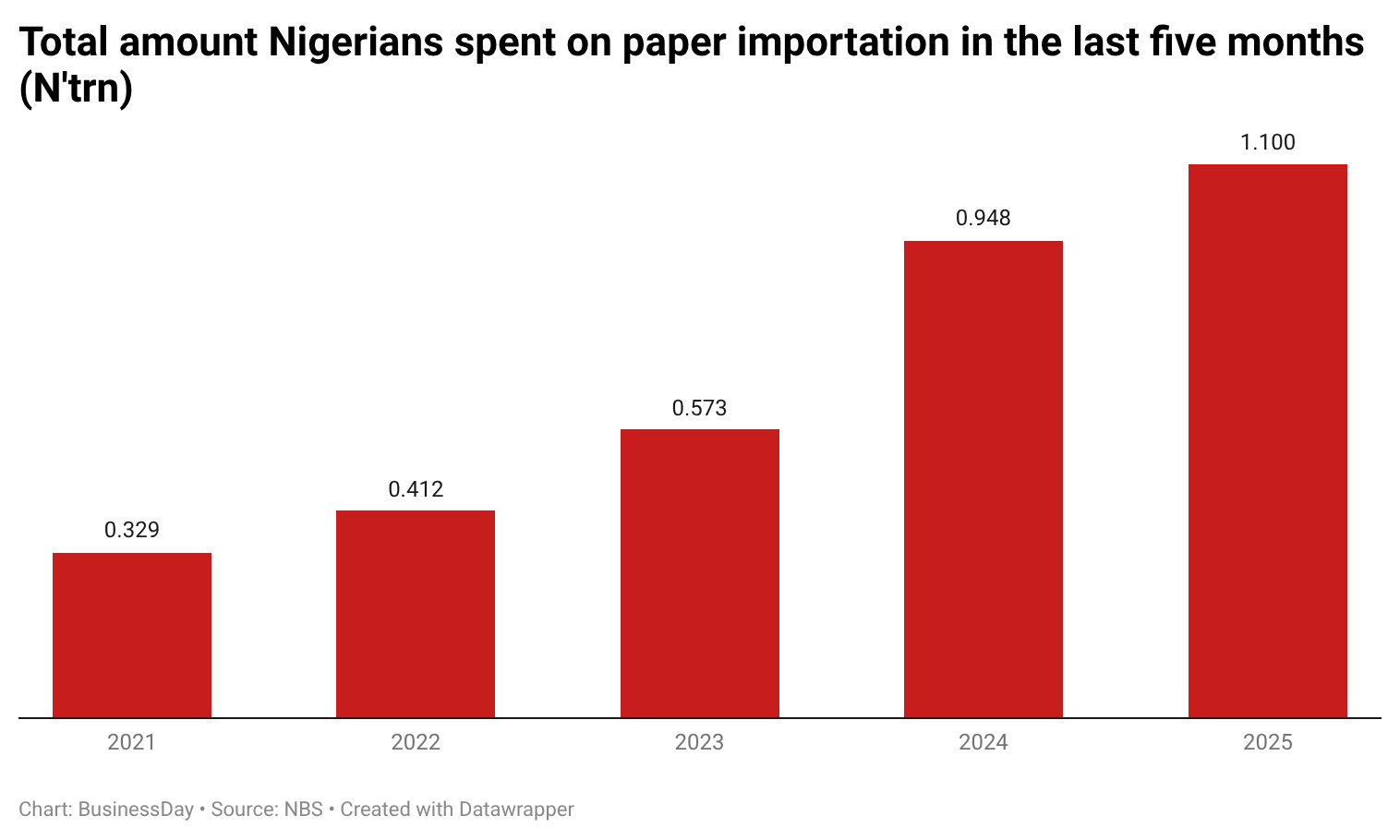
Data from the National Bureau of Statistics (NBS) underscores a chronic reliance on foreign paper products. Between 2021 and 2025, Nigeria spent N3.37 trillion on the importation of paper and allied products. In 2025 alone, import costs rose by 16 percent to N1.1 trillion, up from N948 billion in 2024.
Currently, Nigeria imports an estimated 90 percent to 95 percent of its white-grade paper demand. Industry experts estimate the annual drain on foreign reserves at over $5 billion. Stakeholders point to a lack of functional domestic infrastructure as the root cause; while a country like Egypt operates 25 paper mills, Nigeria possesses only “two and a half,” most of which focus on recycling rather than primary papermaking.
Policy gaps and the call for industrial revival
The struggling sector has looked toward the “Nigeria First Policy”—President Bola Tinubu’s initiative to prioritise locally made goods in public procurement—as a potential lifeline. However, stakeholders caution that the paper and publishing industry has yet to effectively implement the policy.
Read also: How Fu’ad Lawal is archiving Nigeria’s history on cloud
Manufacturers lament that they are “drowning” in cheap, substandard imports that dominate the local market. Without urgent government intervention to revitalise domestic mills and enforce local content policies, industry leaders warn that the sector will remain in a state of terminal decline, overshadowed by the state’s historical focus on the oil and gas industry.
Chinwe Michael
Chinwe Michael is a financial inclusion advocate and economy journalist who uses compelling storytelling to drive awareness. With a background in Banking and Finance and experience across accounting, media, and education, she applies sharp analysis and attention to detail to every piece. She simplifies complex financial and economy concepts into engaging content for Africa and global audience. Chinwe also doubles as a speaker with global recognition for her expertise.