

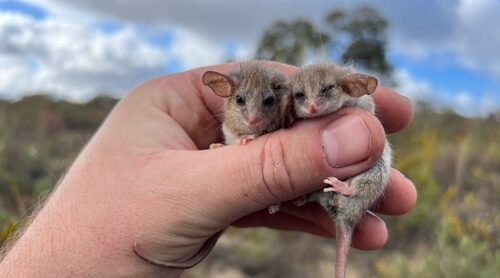
New evidence of the world’s smallest possum has emerged hundreds of kilometers from where it’s known to occur in southern Australia — a finding that potentially extends the range of this locally threatened species.
Pygmy possums are a group of tiny, mouse-sized marsupials that live in open woodlands, heathlands and scrub. They feed on nectar, pollen and insects, and play a crucial ecological role as pollinators. Yorke Peninsula in the state of South Australia is the traditional land of the Narungga people and was a known habitat for the western pygmy possum (Cercartetus concinnus). Now, a new study published in the journal Australian Zoologist suggests the rare and cryptic little pygmy possum (Cercartetus lepidus) may live there too.
Researchers revisited photographic data from wildlife surveys conducted between 2004 and 2011 in Dhilba Guuranda–Innes National Park, an important remnant patch of native vegetation at the tip of the peninsula. Among observations of more than 250 pygmy possums, two photographed in 2006 stood out: these possums were smaller, with distinctive gray belly fur. They were initially labeled as juvenile western pygmy possums because there were no existing records of other pygmy possum species in the area; the closest known population of little pygmy possums is on Kangaroo Island, which has been isolated from the Yorke Peninsula for 10,000 years.
However, the researchers hypothesized that the two observations were misidentified, so they compared the photos with specimens kept at the South Australian Museum. They concluded that these were indeed little pygmy possums.
“About 19 of 24 ground-dwelling mammals have become extinct on the Yorke Peninsula,” study first author Sophie Petit, from Adelaide University, told Mongabay by email. “It’s a big deal to find a new species that may have been there all along.”
Pat Hodgens, a fauna ecologist with the Australian Wildlife Conservancy, who wasn’t involved in the study, agreed the photograph in the paper could be that of a little pygmy possum. “It would be exciting if that could be confirmed through further studies such as recaptures and DNA analysis,” Hodgens told Mongabay by email.
Confirmation of a new population would be welcome news for the species, which is sensitive to habitat fragmentation and also likely vulnerable to burnt vegetation from bushfires and prescribed burns. Native vegetation has been cleared from much of the Yorke Peninsula; only 13% remains. The authors are trepidatious because the current population status of little pygmy possums on the Yorke Peninsula is unknown.
“It’s possible that this population has become [locally] extinct in the last 20 years, considering its rarity,” Petit said in a press release. “But it would be wonderful to discover it has survived. Adopting a precautionary approach to land management until the species’ status is verified would be the best course of action.”
Banner image: A pair of pygmy possums in South Australia. Image © Sam Gordon via iNaturalist (CC BY-NC-SA 4.0).
Credits


