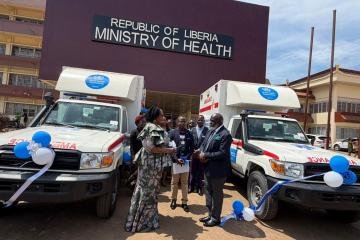
Monrovia—The World Health Organization (WHO) has handed over two fully fitted ambulances and essential medical supplies and equipment to the tune of US$ 600 000 to the Ministry of Health to strengthen emergency response and expand access to life-saving care for women and newborns in Liberia. The medical equipment includes infant ventilators, neonatal incubators, resuscitation equipment and portable ultrasound machines.
The support comes at a timely and strategic moment, as the Government of Liberia advances its recently launched “365-day action plan to reduce maternal and newborn mortality nationwide,” aimed at strengthening access to timely and quality care across the country. This donation forms part of WHO’s broader support to this initiative and its continued efforts to strengthen Liberia’s national health system.
Speaking at the ceremony, WHO Representative to Liberia, Dr Olushayo Olu, highlighted that the support is in fulfilment of one of the campaign promises of the WHO Regional Director for Africa, Dr. Mohamed Yakub Janabi. “We are pleased to hand over fully fitted ambulances, essential medical supplies and equipment, valued at an estimated USD 600,000,” Dr. Olu said. He highlighted that the ambulances are fully equipped to serve multiple purposes including mobile intensive care units, mobile clinics and general purposes transfer of very sick patients.
The Minister of Health, Hon. Dr Louise M. Kpoto, welcomed the support and expressed appreciation to WHO. “We extend our sincere appreciation to the World Health Organization for the donation of these medically fitted ambulances and essential medical supplies and equipment. This is the best donation we have received”, she said.
She further noted that the ambulances will support emergency response services, including through the central Emergency Medical Services at John F. Kennedy Medical Center in Monrovia, and improve care for critically ill patients.
WHO will also support the Ministry of Health with transportation, installation and training of health workers to ensure proper use and maintenance of the equipment. This support strengthens Liberia’s capacity to respond to emergencies and expands access to critical care services, particularly for women and newborns who need them most.