Justice Department says cyberattack allegedly orchestrated by Iranian government disrupted
A cyberattack allegedly organized by the Iranian government was disrupted, the Department of Justice said Thursday.
Law enforcement seized the domains of four websites – which were linked – and involved in “psychological operations targeting adversaries” of Iran’s regime, through violent postings and threats, federal officials said in a statement. Various activities conducted by the websites included hacking and the posting of sensitive data stolen during such hacks, often followed by public and private threats to journalists, Iranian expats and Jewish communities.
The websites called for the “killing of journalists, regime dissidents, and Israeli persons.” An FBI investigation found the domains were also used to send death threats and call for acts of violence.
“Terrorist propaganda online can incite real-world violence — thanks to our National Security Division and the U.S. Attorney’s Office for the District of Maryland, this network of Iranian-backed sites will no longer broadcast anti-American hate,” said Attorney General Pamela Bondi in a statement.
Iran’s semi-official news agency Tasnim — which is associated with Iranian Revolutionary Guards — last week listed several major U.S. tech giants, including Amazon, Microsoft and Oracle — as possible targets for retaliatory cyberattacks over the war.
Netanyahu says Iran’s current leadership structure is “not clear” after targeted killings
Israeli Prime Minister Benjamin Netanyahu said Iran’s current leadership structure is “not clear” after a series of targeted missile strikes have killed several prominent clerics and leaders during the war.
Top Iranian security official Ali Larijani and other senior leaders were killed in strikes earlier this week, dwindling the number of top officials in the regime still alive.
Mojtaba Khamenei, the new supreme leader and son of the late Supreme Leader Ayatollah Ali Khamenei, is believed to have been injured in the strike that killed his father at the beginning of the war.
“Mojtaba, the replacement ayatollah, has not shown his face,” Netanyahu told reporters during a news conference Thursday night, referring to Ayatollah Mojtaba Khamenei. “Have you seen him? We haven’t, and we can’t vouch exactly what is happening there. There is a cloud here that’s not clear.”
Netanyahu also speculated that the new supreme leader would not have the same influence as his father.
“I think the authority and the hold that Khamenei has had is not going to be translated to anyone,” Netanyahu said. “Not to Mojtaba, if he’s there, and not to anyone else.”
Qatari official says Iranian strikes on gas field caused $20 billion in annual lost revenue
The extensive damage caused by the Iranian missile strikes on Ras Laffan Industrial City — a liquefied natural gas export terminal in Qatar — will lead to an estimated $20 billion in annual revenue loss, Qatar’s energy chief said Thursday.
Saad Sherida al-Kaabi, Qatar’s energy minister, said the attack reduced Qatar’s liquefied natural gas capacity by 17%.
Officials expect the repairs to the two liquefied natural gas units struck Wednesday night to take at least five years and cause a major impact on supply to markets in Europe and Asia, al-Kaabi disclosed.
“The damage sustained by the LNG facilities will take between three to five years to repair. The impact is on China, South Korea, Italy and Belgium,” al-Kaabi said in a statement.
Netanyahu says Israel’s holding off on more attacks on key Iranian gas field
Israeli Prime Minister Benjamin Netanyahu said that his country’s military was holding off on additional attacks against a key Iranian gas field.
Netanyahu also said Israel acted alone in attacking Iran’s South Pars gas field.
“President Trump asked us to hold off on future attacks, and we’re holding,” the prime minister said during a news conference Thursday night.
Netanyahu addresses claims that Israel dragged U.S. into war
Israeli Prime Minister Benjamin Netanyahu addressed claims that Israel dragged the U.S. into the war.
“Does anyone really think that someone can tell President Trump what to do?” Netanyahu asked during televised remarks Thursday night. “Come on. President Trump always makes his decisions on what he thinks is good for America and, may I add, I think what is also good for future generations.”
Trump administration has no plan to restrict oil and gas exports, U.S. officials say
In statements posted to social media at the same time, Energy Secretary Chris Wright and Interior Secretary Doug Burgum said the Trump administration “has no plan to implement restrictions on oil and gas exports.”
“Thanks to @POTUS, the United States is the world’s top oil and natural gas producer,” the Cabinet members said. “We are also the largest natural gas exporter and a top oil exporter. To be clear, the Trump administration has no plan to implement restrictions on oil and gas exports.”
U.S. intel chief acknowledges differences in U.S., Israeli war aims
Director of National Intelligence Tulsi Gabbard said at a House hearing Thursday that President Trump’s objectives “are different” than those laid out by the Israeli government.
“We can see through the operations that the Israeli government has been focused on disabling the Iranian leadership and taking out several members, obviously beginning with the ayatollah, the supreme leader, and they continue to focus on that,” she said.
Democratic Rep. Joaquin Castro of Texas asked her how that differs from U.S. goals.
“The president has stated that his objectives are to destroy Iran’s ballistic missile launching capability, their ballistic missile production capability, and their navy, the IRGC navy, and mine-laying capability,” she responded.
When Castro asked whether Israel is supportive of Mr. Trump’s call to make a deal with Iran, Gabbard said she didn’t know Israel’s position. She also said she did not have an answer for why Israel decided to strike Iranian energy infrastructure despite Mr. Trump’s demand that those facilities be off limits.
Read more here.
U.S. didn’t tell allies about planned strikes because “we wanted surprise,” Trump says
President Trump, seated alongside Japanese Prime Minister Sanae Takaichi in the Oval Office, was asked by a Japanese reporter on Thursday why he didn’t inform U.S. allies like Japan about the strikes against Iran in advance. The reporter said the Japanese were “very confused” by that omission.
“Well one thing, you don’t want to signal too much, you know?” Mr. Trump responded. “When we go in, we went in very hard. And we didn’t tell anyone about it because we wanted surprise. Who knows better about surprise than Japan? Why didn’t you tell me about Pearl Harbor? Okay? Right?”
Young member of Iran’s national wrestling team executed, sources confirm
A young member of Iran’s national wrestling team was among three men who were executed in Iran on Thursday, two sources confirmed to CBS News.
The 19-year-old team member, Saleh Mohammadi, as well as Mehdi Ghasemi and Saeed Davoudi, were accused of killing two police officers during protests against the regime this winter. Sources say the men denied the allegations but eventually confessed under severe torture.
The HENGAW human rights organization, which has reliably reported on protests in Iran, said they were executed in Qom Central Prison.
The executions were carried out on charges of moharebeh, “waging war against God.” HENGAW also reports that they gave forced confessions under torture.
Read more here.
Gabbard: Iran “maintained” intention to rebuild nuclear enrichment capability
Director of National Intelligence Tulsi Gabbard said Thursday at a House hearing on global threats to the U.S. that Iran “maintained the intention to rebuild its infrastructure and nuclear enrichment capability and continued to refuse to comply with its nuclear obligations” with the International Atomic Energy Agency, “refusing them access to key facilities” after last year’s 12-Day War.
That differed slightly from her testimony to the Senate on Wednesday, when she said: “Prior to Operation Epic Fury, the IC assesses Iran was trying to recover from the severe damage to its nuclear infrastructure sustained during the 12-Day War and continued to refuse to comply with its nuclear obligations, with the IAEA refusing them access to key facilities.”
At Thursday’s hearing, Gabbard reiterated her earlier testimony that President Trump was responsible for determining whether Iran posed an “imminent threat” to the U.S. based on the intelligence community’s assessments.
Read more here.
U.S. military says it’s aware of reports F-35 made emergency landing after mission
The U.S. military is “aware of reports that a U.S. F-35 aircraft conducted an emergency landing at a regional U.S airbase after flying a combat mission over Iran,” a U.S. Central Command spokesperson said Thursday.
“The aircraft landed safely, and the pilot is in stable condition,” the spokesperson said. “This incident is under investigation.”
Trump says Pentagon budget request is for reasons “beyond” Iran
In an Oval Office meeting with the Japanese prime minister, CBS News asked President Trump why the Pentagon is going to ask Congress for an additional $200 billion, if the president says the war is almost over.
“Well, we’re asking for a lot,” the president responded. “Our reasons beyond even what we’re talking about in Iran. This is a very volatile world.”
Trump: “I’m not putting troops” in Iran but “if I were, I certainly wouldn’t tell you”
President Trump was asked in an Oval Office meeting on Thursday with Japan’s prime minister if he intends to potentially put more U.S. troops in the region.
“No, I’m not putting troops anywhere,” the president responded. “If I were, I certainly wouldn’t tell you. But I’m not putting troops.”
Israeli military says it hit targets in Caspian Sea for first time
Israel’s military said Thursday it struck “key” Iranian Navy infrastructure in the Caspian Sea a day before, describing it in a statement as one of the most significant strikes conducted by the IDF since Israel started its operation.
The military targeted Iranian Navy facilities where dozens of military vessels were stationed, according to the Israel Defense Forces.
“We have for the first time carried out strikes in northern Iran in the Caspian Sea,” military spokesman Lieutenant Colonel Nadav Shoshani said in a separate briefing, The Associated Press reported.
Qatar’s prime minister: Iran attack on gas hub has “significant repercussions for global energy supplies”
Qatar’s Prime Minister Sheikh Mohammed bin Abdulrahman Al Thani has condemned Iran’s attacks on the state’s main gas hub after Tehran sent waves of attacks against Gulf energy infrastructure a day earlier.
“This attack has significant repercussions for global energy supplies,” he said at a press conference following extensive damage to the Ras Laffan facility.
“Such attacks bring no direct benefit to any country, rather, they harm and directly impact populations,” he said.
Iraq also condemned recent strikes on oil and gas facilities in the Middle East.
“Recent attacks targeting energy facilities in several of Iraq’s neighboring countries and other brotherly nations in the region constitute a worrying escalation that threatens to undermine efforts to reduce tensions and jeopardize stability,” the foreign ministry said in a statement.
It also stressed the importance of “ensuring continuous supplies to global energy markets,” following the severe disruption to the Strait of Hormuz through which Iraq previously exported the majority of its oil.
Surging U.S. gas prices could erase bigger tax refunds, analysis finds
Higher U.S. gasoline prices stemming from the Iran war could effectively wipe out the fatter tax refunds many Americans are expected to collect this year, a new analysis found.
Economists from the Stanford Institute for Economic Policy Research estimate that the average U.S. household will spend an additional $740 on gas this year because of the jump in global oil prices following the attack on Iran.
If that estimate holds true, it would gobble up nearly all of the additional money people are slated to collect in tax refunds this year, according to the research.
Read more here.
Iran’s foreign minister: “ZERO restraint” if infrastructure struck again
Iran’s foreign minister said Thursday that the country will have “ZERO restraint” if the country’s infrastructure is hit again, seemingly referring to Israel’s attack the day before on Iran’s South Pars gas field.
“Our response to Israel’s attack on our infrastructure employed FRACTION of our power,” Abbas Araghchi said on X. “The ONLY reason for restraint was respect for requested de-escalation.”
The regime in Tehran stepped up its strikes on Gulf states early Thursday after the attack on South Pars. President Trump said Wednesday on Truth Social that Israel would not attack the gas field again, and warned that if Iran continued to attack Qatar’s liquid natural gas facilities, the U.S. will destroy the Iranian gas field.
Mr. Trump said the U.S. “knew nothing” about Israel’s attack and that Qatar was “in no way, shape, or form, involved with it.”
Smoke and fire rise near the South Pars gas field following an attack, amid the U.S.-Israeli conflict with Iran, in Bushehr Province, Iran, March 18, 2026, in this screengrab obtained from a social media video. Social Media/via REUTERS 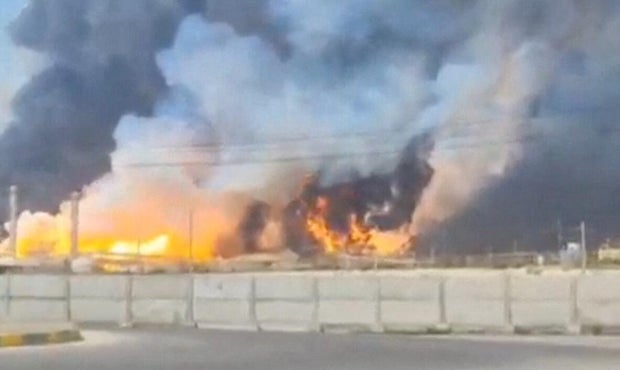

Hegseth on reported $200 billion for war: “It takes money to kill bad guys”
The Washington Post reported Wednesday that the Pentagon is asking for an additional $200 billion for the war. Defense Secretary Pete Hegseth was asked about that figure at a Pentagon briefing Thursday, and said “that number could move,” adding, “it takes money to kill bad guys.”
“We’re going back to Congress and our folks there to ensure that we’re properly funded for what’s been done, for what we have to in the future,” Hegseth said.
Read more here.
Palestinian officials say 4 killed by debris of intercepted Iranian missile in Israeli-occupied West Bank
The Palestinian Ministry of Health in the Israeli-occupied West Bank said Thursday that debris falling to the ground from a missile interception the previous day hit a beauty salon near the city of Hebron, killing four people.
Among those killed by the interception was Asil Samir Masalmeh, 32, whom the ministry said was six months pregnant.
A young girl was among several others wounded, the ministry said, describing her condition as serious but stable.
The statement did not say whether the debris came from an Iranian or Israeli missile, but Palestinian media, citing Red Crescent staff, reported that it was from an Israeli interceptor taking down an Iranian missile.
6 U.S. allies say they’re ready “to contribute to appropriate efforts” to open Strait of Hormuz
The leaders of the United Kingdom, France, Germany, Italy, the Netherlands and Japan voiced their “readiness to contribute to appropriate efforts to ensure safe passage through” the Strait of Hormuz in a joint statement issued Thursday.
The nations provided no details about what they were prepared to offer, after repeated demands from President Trump that they and other countries deploy military forces to help reopen the vital shipping lane.
“We welcome the commitment of nations who are engaging in preparatory planning,” the statement said, adding a “call for an immediate comprehensive moratorium on attacks on civilian infrastructure, including oil and gas installations.”
On Wednesday, CBS News’ Margaret Brennan reported that a team of military planners from the U.K. was working with the U.S. military on a plan to reopen the Strait of Hormuz.
The U.K. and other U.S. allies have been reluctant to join U.S. military operations during active combat operations against Iran, multiple officials told Brennan, adding that, after hostilities conclude, allies including the U.K. and Japan could consider sending assets such as mine detection equipment.
This issue may come up Thursday when Japanese Prime Minister Sanae Takaichi meets with Mr. Trump at the White House. Takaichi has publicly indicated that Japan’s constitution would not permit the use of its self-defense forces to operate in an offensive operation.
The six nations that signed the joint statement released on Thursday condemned the “attacks by Iran on unarmed commercial vessels in the Gulf, attacks on civilian infrastructure including oil and gas installations, and the de facto closure of the Strait of Hormuz by Iranian forces.”
Precision strikes conducted against more than 90 targets on Iran’s Kharg Island, Caine says
Joint Chiefs Chairman Dan Caine said Thursday that precision strikes were conducted last Friday against more than 90 targets on Iran’s Kharg Island – which for decades has served as the Islamic Republic’s main oil export terminal, historically handling 85–95% of the country’s crude exports.
President Trump previously said the U.S. military “totally obliterated” every military target on Kharg Island during large-scale precision strikes Friday, thrusting the small, strategic island into the global spotlight.
Caine said the strikes “included all of their military only-infrastructure, which included air defenses, naval base, mine storage and deployment facilities.”
“We continue to strike against Iran’s defense industrial base and will continue to do so,” he said.
Tankers load up on Kharg Island, which is about 20 miles from Iran’s coast in the Persian Gulf, before heading through the Strait of Hormuz and into the Arabian Sea and beyond. If the island’s loading facilities were knocked out, Iran’s ability to export oil would collapse almost immediately.
Thursday will be “largest strike package yet,” as U.S. attacks deeper into Iranian territory, officials say
Defense Secretary Pete Hegseth said at a Pentagon briefing that Thursday will “be the largest strike package yet, just like yesterday was.”
He noted that the U.S. has struck over 7,000 targets across Iran, including many parts of the regime’s military infrastructure.
The U.S. is continuing to attack “deeper into Iranian territory,” Joint Chiefs Chairman Dan Caine said at the briefing.
He said the military is targeting mine storage facilities and naval ammunition depots and assets, “and the pressure will continue.”
“We’re flying further to the east now and penetrating deeper into Iranian airspace,” Caine said.
The military is also targeting “fast attack watercraft” in the Strait of Hormuz, he said.
Read more here.
U.S. striking Iranian-backed militia groups in Iraq, Caine says
U.S. AH-64 attack helicopters have been striking Iran-backed militia groups in Iraq, Joint Chiefs Chairman Dan Caine said at a Pentagon briefing Thursday.
He said the U.S. has been attacking “to make sure that we suppress any threat in Iraq against U.S. forces or U.S. interests.”
“We remain focused on pursuit of any platform that Iran could field to harm Americans or our partners,” he said.
Satellite company curbs access to Mideast imagery over concern it could be used “by adversarial actors”
In a marked shift, commercial satellite companies that provide open-source data used widely by journalists and researchers have restricted access to images showing the Middle East, including areas where there are U.S. military sites that have been targeted by Iran.
Planet Labs, which regularly provides imagery used by news organizations including CBS News, said earlier this month that it was delaying the release of all new imagery of Iran, the Persian Gulf, U.S.-allied bases, and “existing conflict zones” for 14 days.
In a note to customers sent on March 9 and shared with CBS News by a spokesperson, Planet Labs said there were “genuine concerns of use of Planet data over Iran, as well as an extended window of risk for recent imagery.”
The company “has decided to take additional, proactive measures to ensure our imagery is not tactically leveraged by adversarial actors to target allied and NATO-partner personnel and civilians,” it said.
Such satellite imagery has been vital for journalists covering conflicts for years, notably amid Russia’s full-scale invasion of Ukraine and during the Israel-Hamas war in Gaza. The images taken from space have provided evidence for investigations into widespread destruction, population movements, and even massacres, especially in places that are remote or inaccessible due to fighting on the ground.
Read more here.
USS Gerald R. Ford heads to Greece for repairs with sailors reportedly sleeping on floors due to fire damage
The USS Gerald R. Ford aircraft carrier was headed on Thursday to a U.S. Navy port on the Greek island of Crete for repairs weeks after the toilet system broke down and about a week after a fire broke out on board.
Sailors had to be treated for smoke inhalation and, according to multiple reports, the damage caused by the fire has left hundreds of crew members sleeping on floors.
The U.S. Navy’s 5th Fleet said two sailors were treated for non-life-threatening injuries from the fire in the ship’s main laundry space, and that the cause of the fire wasn’t combat-related.
The USS Gerald R. Ford aircraft carrier arrives at Souda Bay off the island of Crete, Greece, in a Feb. 23, 2026 file photo. Reuters/Stelios Misinas 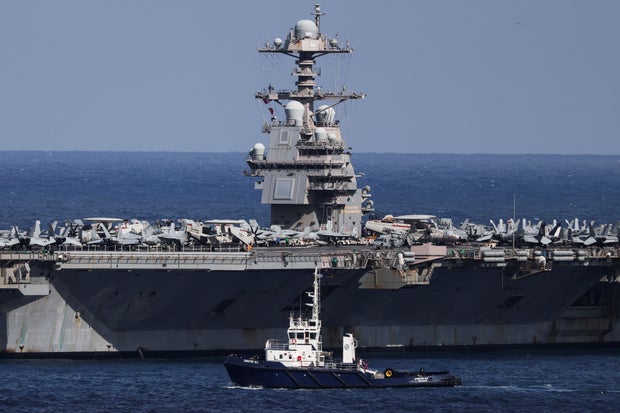

Officials told CBS News on Thursday that the carrier would dock in Crete for repairs and some much-needed down time for the sailors on board. According to the U.S. Naval Institute, the Ford has been deployed for 268 days as of Thursday. If it remains deployed for another month, it will break the record for the longest U.S. aircraft deployment since the Vietnam War, which, according to the Naval Institute, is currently the 294-day deployment of the USS Abraham Lincoln in 2020.
Both carriers have been deployed in support of ongoing U.S. operations in the Middle East, with the Ford operating most recently in the Red Sea and the Lincoln in the Arabian Sea and Gulf of Oman.
UAE says 7 missiles, 15 Iranian drones intercepted today
The United Arab Emirates said its air defenses had intercepted seven Iranian missiles and 15 drones on Thursday, as Iran unleashed waves of strikes on Gulf states.
The UAE Ministry of Defense said, since the war began, it had intercepted a total of 349 Iranian missiles and over 1,700 drones.
Crude oil and natural gas prices surge in early Thursday trading
Global oil and natural gas prices soared Thursday as Iran attacked a key natural gas facility in Qatar that can supply one-fifth of the world’s gas, as well as two oil refineries in Kuwait.
Brent crude, the international benchmark, rose to $116.38 per barrel, up from under $73 per barrel on the eve of the war. The European TTF benchmark for natural gas prices traded 24% higher on Thursday.
The Iranian attack hit the Ras Laffan terminal for shipping out liquefied natural gas in Qatar. Qatar normally supplies some 20% of the world’s consumption of LNG, which can be carried by ship. The facility shut down after a drone attack. The closure of the Strait of Hormuz to most tanker traffic also left the gas with nowhere to go.
If the disruptions from Iran’s attacks on its Gulf Arab neighbors’ energy infrastructure keep oil and gas prices high for long, they could create a debilitating wave of inflation for the global economy.
U.S. benchmark crude oil gained 1.1% to $96.45 a barrel early Thursday, while the Henry Hub future contract, the benchmark for U.S. natural gas, gained 5.1%.
As oil and gas prices spiked, world shares retreated and U.S. futures edged 0.2% lower.
Germany’s DAX lost 2.1% to 23,015.40 and the CAC 40 in Paris fell 1.5% to 7,848.88. Britain’s FTSE 100 shed 1.7% to 10,134.02.
A NATO ally is developing an advanced anti-drone system: “You need it as soon as possible”
The war in Iran has highlighted the threat relatively cheap drones pose to both human life and crucial infrastructure. It has also highlighted a seeming unreadiness to counter the weapons among the militaries of the U.S. and some of its major allies in the Middle East.
As President Trump criticizes America’s longtime NATO allies in Europe, they are moving quickly to take the lead in anti-drone warfare capabilities, taking advantage of technology and skills honed over four years of warfare in Ukraine.
Poland, for instance, is developing an advanced, robust anti-drone system to protect its territory, and people behind the initiative tell CBS News they’re getting a lot of calls from around the world as other nations look to address one of the biggest threats on the modern battlefield.
Read more here.
Iran’s parliament considers measure to require other countries using Strait of Hormuz to “pay tolls and taxes”
Iranian lawmakers are considering a measure that would require other countries that wish to have their vessels transit through the Strait of Hormuz to “pay tolls and taxes,” Iran’s official state news agency ISNA said Thursday.
“In Parliament, we are pursuing a proposal according to which, if the Strait of Hormuz is used as a safe route for ship transit, energy passage, and ensuring food security, countries will be required to pay tolls and taxes to the Islamic Republic of Iran,” ISNA quoted a member of parliament as saying.
Iran has paralyzed the vital shipping lane with incessant missile and drone attacks on commercial vessels since the U.S. and Israel launched their war on the country on Feb. 28.
President Trump has vowed to reopen the strait to shipping traffic, but his demands for other countries to deploy military forces to help do that have thus far drawn only vague commitments by NATO allies to work on a viable international plan.
The ongoing closure of the strait has sent global oil and gas prices soaring.
Oman condemns Iran’s attacks on Gulf neighbors, calls for diplomacy
Oman’s Ministry of Foreign Affairs condemned Iran’s ongoing attacks on energy facilities in the neighboring Gulf states of the United Arab Emirates, Qatar and Saudi Arabia on Wednesday and issued a call for diplomacy to end the U.S.-Israeli war with Iran.
“Oman emphasizes the necessity of adhering to international laws and norms, refraining from targeting civilian infrastructure and global energy supplies, and calls for de-escalation, cessation of military actions, and prioritizing diplomatic solutions to resolve disputes in a way that preserves security and stability and protects the interests of the region and the world,” the ministry said in its statement.
Oman’s government stressed “that addressing the root causes of the conflict through dialogue is the best way to find solutions and achieve lasting stability in the region.”
Iran foreign minister says Americans can thank “Netanyahu and his lackeys in Congress” for war’s spiraling cost
Iran’s top diplomat said Thursday that the American public could thank Israeli leader Benjamin Netanyahu “and his lackeys in [the U.S.] Congress” for the soaring costs to the U.S. of the war launched against his country on Feb. 28.
Foreign Minister Abbas Araghchi shared a story from the Washington Post, which CBS News has not confirmed, saying the U.S. Defense Department would seek $200 billion in funding for the Iran war, and calling it the “tip of the iceberg.”
“We’re only three weeks into this war of choice, imposed on both Iranians and Americans,” Foreign Minister Abbas Araghchi said in his social media post. “This $200b is the tip of the iceberg. Ordinary Americans can thank Benjamin Netanyahu and his lackeys in Congress for the trillion-dollar ‘Israel First tax’ that’s about to hit U.S. economy.”
So far the Trump administration has not said how much the war will cost the U.S., but a week ago, military officials told members of Congress in a briefing that the first week alone had cost around $11.3 billion, according to sources familiar with the meeting.
On Wednesday, House Speaker Mike Johnson, asked about the estimated cost of the war, told reporters “I don’t think it could be calculated yet,” as operations were continuing.
Gulf states say any trust in Iran “shattered” as drones hit oil and gas infrastructure in Kuwait, UAE
Saudi Arabia said a drone hit the country’s SAMREF refinery Thursday in the port city of Yanbu on the Red Sea. The Saudi Defense Ministry said damage assessment was underway, without elaborating.
A June 2002 file photo shows the Saudi Aramco Mobil Refinery unit in the industrial city of Janbu, north of Jeddah, Saudi Arabia. Yves GELLIE/Gamma-Rapho/Getty 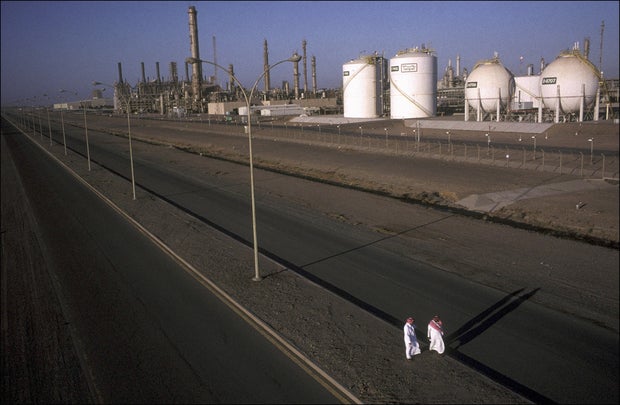

An earlier drone attack on Kuwait’s Mina Al-Ahmadi refinery sparked a fire but caused no injuries, the state-run KUNA news agency reported Thursday. The refinery is one of the biggest in the Middle East, with a petroleum production capacity of 730,000 barrels per day. Shortly after, a drone attack set ablaze the nearby Mina Abdullah refinery, authorities said.
Authorities in Abu Dhabi said they were forced to shut down operations at its Habshan gas facility and Bab field, calling Iranian overnight attacks on the sites a “dangerous escalation.”
Missile alert sirens sounded in multiple other areas around the Gulf, and Israel warned of incoming Iranian fire.
Qatar, Saudi Arabia and the United Arab Emirates all denounced the Iranian attacks, with Saudi Arabia’s top diplomat saying assaults on the kingdom meant “what little trust there was before has completely been shattered.”
CBS/AP
Stocks slide and oil prices spike as Israeli strike hits “plumbing of the global energy system”
Stock prices were down early Thursday and oil prices rose sharply as the U.S.-Israeli war on Iran escalated.
Israel’s Wednesday strike on Iran’s South Pars gas field, which is shared with Qatar, and President Trump’s threat to destroy the vast reserve if Iran retaliates by striking Qatari infrastructure, have hit markets hard.
The Reuters news agency said U.S. crude futures rose above $97 per barrel early Thursday, while natural gas was up 3% and Brent crude futures rose to $111.87 a barrel, up 4% on the day.
Japan’s Nikkei stock index was down over 3%, South Korean equities fell 2.8% and European futures were down more than 1.5% ahead of the continent’s markets opening.
“This latest escalation feels like a turning point for markets because the conflict is no longer just about military headlines or Strait of Hormuz closure,” Charu Chanana, chief investment strategist at Saxo in Singapore, told Reuters. “It is now hitting the plumbing of the global energy system. What is unsettling markets now is the growing stagflation risk… It means this is no longer just a geopolitical story but a macro one.”
Iran launches deadly new wave of missile attacks on Israel
Iran launched at least six waves of missiles at Israel overnight, including new attacks using cluster bombs.
Air defenses intercepted most of the weapons, but debris and bomblets from the cluster munitions fell in several places, including in Tel Aviv where an elderly man was lightly injured in an apartment building, according to medics.
The inside of an apartment destroyed by an Iranian missile strike is seen, with the Tel Aviv skyline visible in the background, following an overnight Iranian attack on March 19, 2026. Ilia YEFIMOVICH/AFP/Getty 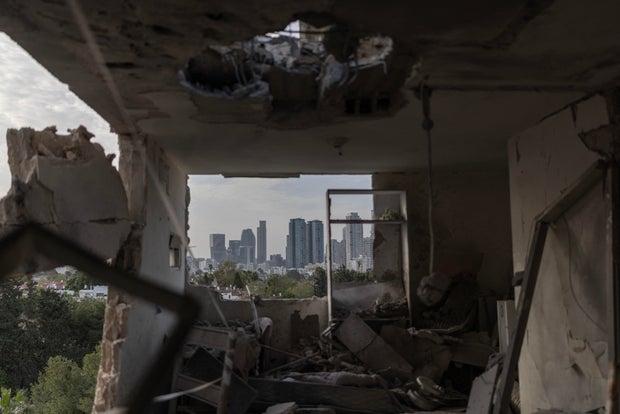

One cluster bomb struck the agricultural community of Adanim in central Israel’s Sharon area, killing a Thai agricultural worker, according to medics, while another hit a home in Jaljulia, an Arab town also in central Israel, but caused no reported injuries.
There was also a direct hit in the Palestinian town of Bayt Awwa, in the Israeli-occupied West Bank, which Palestinian media reports said had caused some fatalities. There was no immediate confirmation of the casualties there.
Vessel “hit by unknown projectile” just off Qatar’s coast
The U.K. military’s Maritime Trade Operations Center said early Thursday that it had received a report of a vessel being “hit by an unknown projectile” just off the coast of Qatar’s Ras Laffan petroleum industry area.
UKMTO did not identify the vessel or provide any further information about what might have hit it, but it said all crew members were reportedly safe and well.
Iran has attacked commercial vessels in the Gulf region for almost three weeks in retaliation for ongoing U.S.-Israeli strikes, paralyzing marine traffic through the Strait of Hormuz, a vital shipping lane for global oil supplies.
Fewer such attacks had been reported this week, but following Israel’s strike on the Iranian South Pars gas field, the regime in Tehran stepped up its strikes on Gulf states early Thursday.
QatarEnergy says Iran struck several liquefied natural gas facilities
QatarEnergy said that in addition to Iran’s Wednesday missile attack on Ras Laffan Industrial City, which it said caused “extensive damage to the Pearl GTL (Gas-to-Liquids) facility,” several other facilities were targeted in later attacks early Thursday morning local time.
QatarEnergy said the attacks caused “sizeable fires and extensive further damage” at multiple LNG facilities. No casualties were initially reported, QatarEnergy said.
Trump says “NO MORE ATTACKS WILL BE MADE BY ISRAEL” on South Pars gas field
President Trump said Wednesday on Truth Social that Israel would not attack Iran’s South Pars gas field again, but added a warning that if Iran continues to attack Qatar’s liquid natural gas facilities, the U.S. will destroy the Iranian gas field.
Mr. Trump wrote that the United States “knew nothing” about Israel’s attack on the South Pars field and that Qatar was “in no way, shape, or form, involved with it.”
Mr. Trump said Iran then “unjustifiably and unfairly” struck Qatar’s Ras Laffan gas facility in response.
The president declared that “NO MORE ATTACKS WILL BE MADE BY ISRAEL” on the South Pars field, “unless Iran unwisely decides to attack a very innocent, in this case, Qatar – In which instance the United States of America, with or without the help or consent of Israel, will massively blow up the entirety of the South Pars Gas Field at an amount of strength and power that Iran has never seen or witnessed before.”
Israeli officials have not commented on the South Pars strike or Mr. Trump’s remarks about it.
U.K. military planners working with U.S. on plan to reopen Strait of Hormuz
A team of military planners from the United Kingdom is working with the U.S. military to reopen the Strait of Hormuz, CBS News has learned.
The relatively small team is at U.S. Central Command — which manages U.S. military operations in the Middle East — working on options to reopen the strait. A U.K. official told CBS News that this is an enhancement to the U.K. planning staff already assigned to CENTCOM, which is headquartered in MacDill Air Force Base near Tampa, Florida.
The news was first reported by Radio Free Europe.
The U.K. and other U.S. allies have been reluctant to join U.S. military operations during active combat operations by the U.S. and Israel against Iran, according to multiple diplomats.
After hostilities conclude, allies like the U.K. and Japan may consider sending assets like mine detection materials, according to multiple officials familiar with the ongoing diplomacy.
This issue is likely to be raised Thursday when Japanese Prime Minister Sanae Takaichi meets with President Trump at the White House. Takaichi has already publicly indicated that Japan’s constitution would not permit the use of its self-defense forces to operate in an offensive operation.