

Howdy.☀️
If you have ever argued yourself in circles about a life decision, a career move, or something deeply unhinged you saw on the timeline, Zikoko’s new show is a support group for you.
In the pilot episode of Overthinkers Anonymous, co-hosts Deji Osikoya and Osato Edokpayi sit down with Seye Bandele, co-founder and chief executive officer of Nigerian HR-tech startup PaidHR, for the kind of conversation that goes everywhere at once.
Bandele recalls a moment in 2020 when an HR director looked at what he and his co-founder were building and passed. They kept going anyway, for five more months, until someone paid them ₦4 million ($10,000 at the time) to use the product.
Click here to watch the episode.
A new edition of Francophone Weekly drops today; subscribe below to get it in your email inbox.
Government
Kenya appoints Adan Mohamed as new tax chief at KRA
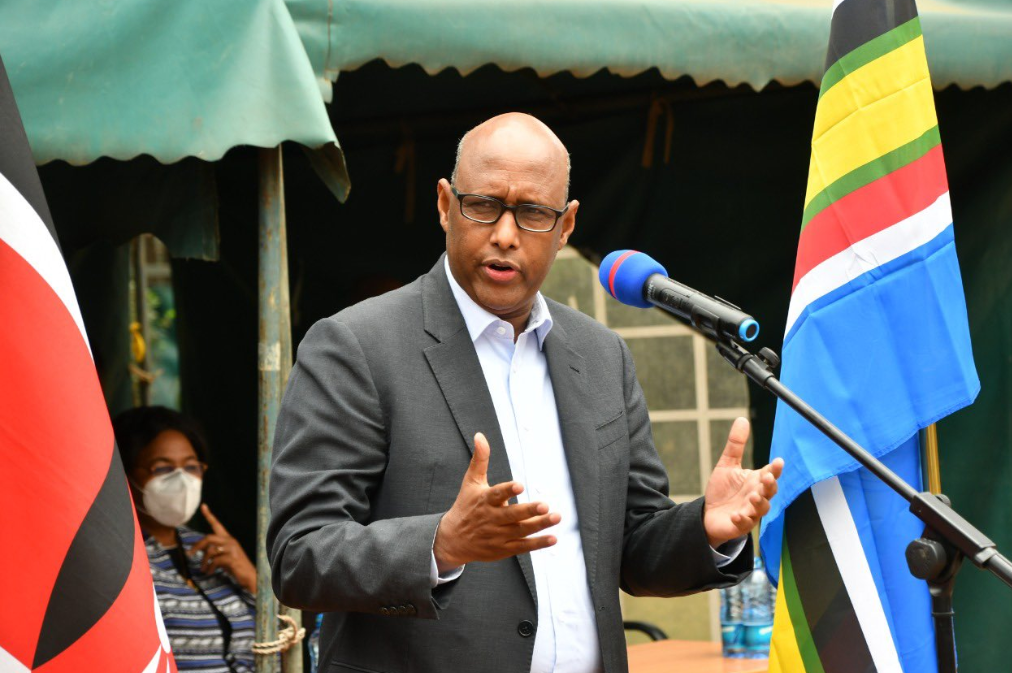

There’s a new tax sheriff in Kenya, and here’s an inside secret: it was not who we predicted. I gave a knowing nod to my senior colleague, Adonijah Ndege, our East Africa correspondent. But, only a small blow to our pride, it was still an “insider” as we said in this TC Daily edition.
According to a government gazette, Cabinet Secretary John Mbadi appointed Adan Abdulla Mohamed as Commissioner General of the Kenya Revenue Authority (KRA), the country’s tax authority, for a three-year tenure, effective May 18.
The new tax chief has a packed résumé: He was the former chief executive officer of Barclays Kenya, where he first applied for the KRA Commissioner General role in 2012 but lost out, Bloomberg reported, and also served as Chief Administrative Officer of Barclays Africa.
He was Kenya’s Cabinet Secretary for Industry, Trade & Cooperatives between 2013 and 2018, then Cabinet Secretary for East African Community (EAC) & Regional Development from 2018 to 2022, before stepping down to run for Mandera County governor, losing to Mohamed Adan Khalif. He is a known face in Kenya’s government and financial circles, which may be precisely the point.
Mohamed’s appointment ends weeks of speculation about who would get the tough job of steering Kenya toward higher tax compliance. President William Ruto’s administration is under serious fiscal pressure. KRA has collected KES 2.038 trillion ($15.7 billion) in the nine months to March 2026, but still has a KES 932 billion ($7.2 billion) gap to close before the current fiscal year ends.
His predecessor, Humphrey Wattanga, was pushed out after 31 months, reportedly for missing revenue targets and moving too slowly on digital tax systems. Wattanga has since been moved to Pretoria as High Commissioner to South Africa.
Mohamed inherits a tax agency that needs to collect more, digitise faster, and do both without further alienating an already stretched taxpaying public. No pressure.
Fintech
Fawry files for cross-border remittance licence, reshuffles leadership in its subsidiary


In 2025, Egypt’s remittances hit an all-time high of $41.5 billion, making it one of the world’s top five remittance recipient markets. Almost all of that money flows through banks and licenced exchange houses.
Fawry, the country’s second-largest publicly listed fintech, wants in. According to local publication EnterpriseAM, Ashraf Sabry, the company’s chief executive officer, said it was awaiting final approval from the Central Bank of Egypt (CBE), after filing for a licence that will enable it to receive inbound cross-border remittances.
Fawry already handles the last mile of remittances; it disburses cash through its 250,000-outlet network on behalf of banks that receive the transfers. What it cannot do is receive the inbound transfer itself. The new licence would change that, letting Fawry sit at the top of the corridor rather than just the bottom, becoming, as Sabry noted, the first non-banking financial institution to plug directly into Egypt’s expat pipeline.
Between the lines: The CBE’s new payment services licencing framework, which came into effect in June 2025 with a 12-month transition window ending this month, was specifically designed to open regulated corridors to non-bank fintechs. Fawry’s application is the first real test of whether that opening is genuine. With 35 million users and a physical presence in virtually every Egyptian neighbourhood, Fawry has the distribution. The licence gives the company the right to use it.
Fawry also announced two leadership changes: longtime Group chief financial officer (CFO) Abdelmeguid Afifi has been named CEO of Fawry Plus, and corporate banking veteran Mohamed Hosny has been appointed CEO of Fawry MSME Finance. Restructuring leadership across subsidiaries while waiting on a remittance licence suggests Fawry is positioning each arm of the business to operate at a different scale than it does today.
Emerging Tech
Ethiopia’s national cloud project could go live within two years


Ethiopia, like many African countries, dreams of a future where all of its data is hosted within its shores.
At its National Summit on Statistical Sovereignty and Integrated Development Management on Monday, the country’s Prime Minister Abiy Ahmed shared details around Ethiopia’s planned National Cloud infrastructure, a government-backed system expected to connect information from the agricultural, trade and investment, media, and other sectors. He said the project could go live within the next 12-24 months.
What is a national cloud? The project will operate as one large storage system that will store critical information across different key sectors. If Ethiopia pulls this off, other African countries that have been incessantly talking about the need for data sovereignty could come learn a thing or two from the country.
Yet, what will logistics look like? It is easy to celebrate an initiative before it manifests; it’s always like putting the cart before the horse. When a country says it wants to do something as daring as build a national cloud project, you ask questions about the land it needs to do this, the local know-how, the energy source, and even the follow-through.
Ethiopia’s infrastructure realities make the ambition harder to ignore. At 21.3%, the country ranks among the world’s lowest in Internet penetration, with connectivity concentrated in Addis Ababa while rural areas remain largely offline.
Power supply is another question mark: data centers are energy-hungry, and Ethiopia’s grid, despite the promise of the Grand Ethiopian Renaissance Dam, still struggles with reliability. Then there is the talent gap. Building and maintaining a national cloud requires engineers, cloud architects, and cybersecurity specialists that the country will need to either train rapidly or attract from the diaspora.
None of this is insurmountable, but it is a lot to solve in 12 to 24 months.