

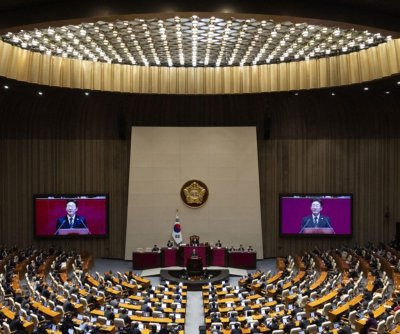
South Korean President Lee Jae Myung (C) gives a speech on the government’s first supplementary budget bill of 2026 at the National Assembly in Seoul, South Korea, 02 April 2026. The government has proposed a 26.2 trillion won (17.3 billion USD) emergency budget to mitigate the economic fallout from the Middle East crisis. Photo by JEON HEON-KYUN / EPA
April 12 (Asia Today) — South Korea’s national debt is projected to rise by an average of 121 trillion won ($90 billion) annually, with the debt-to-GDP ratio expected to approach 60% by 2030, raising concerns over fiscal stability.
According to the government’s 2025 fiscal settlement report released Sunday, national debt reached a provisional 1,304.5 trillion won ($970 billion) last year, up 129.4 trillion won ($96 billion) from a year earlier.
National debt refers to liabilities for which the government bears direct repayment responsibility, including central government debt and net local government debt. Final figures will be confirmed after local government accounts are completed in August.
The annual increase represents a growth rate of about 11%, the highest level in four years since 2021, when the rate reached 14.7%. It also marks the third year – following 2020 and 2021 – in which debt rose by more than 100 trillion won in a single year.
As debt expanded, the ratio to gross domestic product also climbed sharply. The debt-to-GDP ratio rose from 46.0% in 2024 to 49.0% last year, an increase of 3 percentage points and the largest jump since 2020, when the COVID-19 pandemic drove a 5.7 percentage point rise.
Government projections suggest that annual increases exceeding 100 trillion won may become routine. Under the national fiscal management plan for 2025 to 2029, submitted to the National Assembly last September, debt is expected to continue rising steadily.
The debt-to-GDP ratio is projected to reach 51.6% this year, 53.8% in 2027, 56.2% in 2028 and 58.0% in 2029, approaching 60% by 2030.
— Reported by Asia Today; translated by UPI
© Asia Today. Unauthorized reproduction or redistribution prohibited.
Original Korean report: https://www.asiatoday.co.kr/kn/view.php?key=20260412010003483


