



Image: Mark Hachman / Foundry
Summary created by Smart Answers AI
In summary:
- BuyPerUnit.com is a new storage shopping site that helps users find the best deals by organizing products based on price per gigabyte rather than total cost.
- PCWorld reports the site currently lists 332 hard drives/SSDs, 108 SD cards, and 79 USB drives with filters for size and form factor.
- The platform scrapes data from major retailers like Best Buy and Amazon, allowing users to sort by price per unit and link directly to purchase sites.
If you buy storage like the way you buy bottled water — by getting the most for your money regardless of brand — a new site called BuyPerUnit.com might be worth watching.
Established by former Microsoft and Docusign exec Jon Levesque, the origin of BuyPerUnit came when he was trying to buy hard drives in bulk. Instead of focusing on the end price (as we do), the site simply organizes SSDs and hard drives by the amount you’ll pay per gigabyte or terabyte.
Right now, Levesque notes that the site is in its early stages — “a rough V1,” as he puts it. Instead of paying for API access, BuyPerUnit has been scraping sites like Best Buy and Amazon for the best prices, which isn’t always the most efficient way of proceeding.
Still, the site favors a barebones approach, simply offering a list of filters for various products (at press time: 332 hard drives and SSDs, 108 SD cards, and 79 USB drives) by size, form factor, and other criteria. You can sort by price per terabyte or price per gigabyte, see what you’ll pay in bulk, and then link back to the site to make the purchase. One thing that the site has taught me already is that a refurbished SSD might actually be the best bet in keeping costs low, if you’re shopping aggressively for bulk storage.

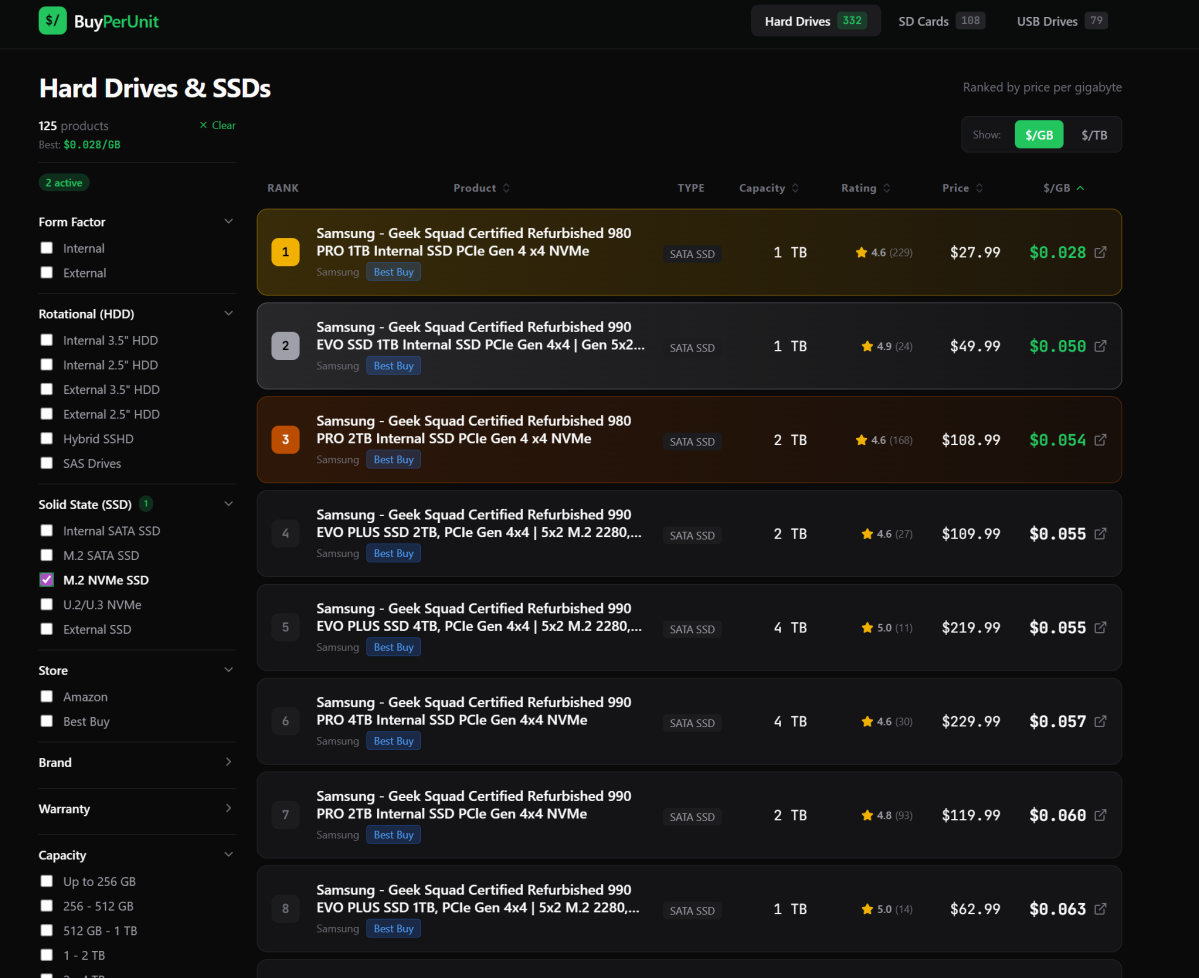
BuyPerUnit.com performs a useful service to counter the ongoing storage shortages that currently plague the PC industry. Still, the site doesn’t (currently) make any provisions for criteria that enthusiasts might find useful such as read/write performance or just which interface an external USB drive uses, beyond USB-A or USB-C. You’ll have to perform such research yourself.
As commenters point out, there are other competing sites to check out such as the extremely-responsive DiskPrices.com, which updates prices every four hours, but seems to exclusively pull from Amazon alone. Levesque says that he’s soliciting advice, so here’s mine: separate “hard drives” into separate categories for SSDs and rotating drives, and consider expanding the site into memory modules. Performance should be measured. Levesque has a roadmap in store, though, so presumably those features will arrive some day.
Either way, BuyPerUnit just came online within the last few days. It already looks like something to bookmark if you’re in the market for additional storage.
Author: Mark Hachman, Senior Editor, PCWorld


Mark has written for PCWorld for the last decade, with 30 years of experience covering technology. He has authored over 3,500 articles for PCWorld alone, covering PC microprocessors, peripherals, and Microsoft Windows, among other topics. Mark has written for publications including PC Magazine, Byte, eWEEK, Popular Science and Electronic Buyers’ News, where he shared a Jesse H. Neal Award for breaking news. He recently handed over a collection of several dozen Thunderbolt docks and USB-C hubs because his office simply has no more room.