
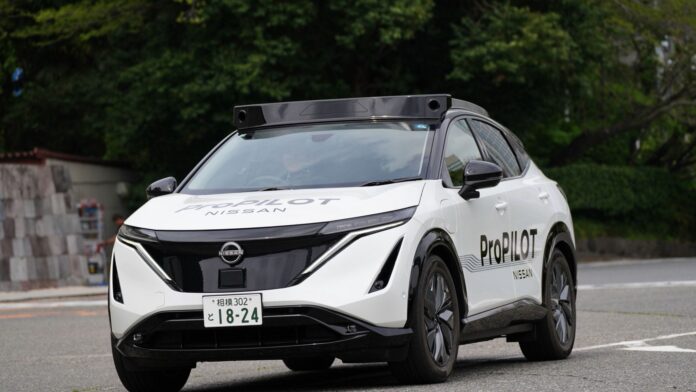


Testing self driving in Nissan Ariya in Tokyo traffic.
Riding in a Self-Driving Nissan Ariya
To get a sense of the latest ProPilot in action, we took a 40-minute ride through the center of Tokyo, from the Prince Hotel, under the Shimbashi overpass, past the Imperial hotel, and through the famous, and famously busy Ginza 4-Chome Crossing before returning to the hotel. Nissan said its approach was to design a system that could handle the most complicated areas like the Ginza Crossing, making it easier to then expand anywhere.
Serving as host and safety monitor was Tetsuya Iijima, executive chief engineer of Nissan’s AD/ADAS advanced technology engineering department. Iijima entered the destination on the navigation screen and off we went, with the system updating location and surroundings data every 100 milliseconds.
The route was chock full of pedestrians, traffic, and confusing intersections. The automated Ariya maneuvered around trucks, buses, and motorcycles. The car was patient in intersections, where throngs of pedestrians made it hard to advance. It navigated around cones in construction areas reduced to a single lane with trucks and equipment blocking a lane. It followed and finally got past a garbage truck making multiple stops. It did it all with the same mix of patience and aggression a normal driver would employ. It was never hesitant; there were no incidents or sudden braking.
Iijima never had to touch a wheel or pedal to intervene. The roads we traveled on were in good shape—no potholes—but the car is trained to avoid any road’s pitfalls when it sees them. Our weather was also perfect, but the system is designed to drive in fog, rain, snow, or other adverse conditions. If the cameras become covered, the system will deactivate. For robotaxis, self-cleaning cameras will be necessary. At the end of the ride, the Ariya parked itself at the end of the drive, albeit it chose a spot further from the entrance than necessary.
Like Tesla’s FSD, the Nissan system will offer varying levels of driving aggression, from conservative to those who want the car to exceed the speed limit.
As an added safety feature, if the driver fails to keep their eyes on the road for two seconds, the system will issue a warning and if it isn’t heeded, it will slow the vehicle and bring it to a safe stop.
Iijima told us that he has a deep trust in the system. He thinks within a month most people would be completely confident in it. He has seldom had to touch the wheel in all his hours and miles of testing.