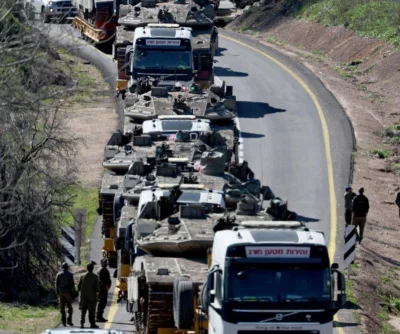
Heavy transport trucks carry Israeli tanks along a road near the Lebanon border in Upper Galilee, northern Israel, on Thursday. The Israeli military said it is conducting strikes across Lebanon targeting Hezbollah infrastructure and personnel. Photo by Atef Safadi/EPA
BEIRUT, Lebanon, March 5 (UPI) — The Israeli Army on Thursday ordered a mass evacuation of Beirut’s southern suburbs — a main stronghold of Iran-backed Hezbollah — in an unprecedented warning ahead of massive strikes, causing widespread panic among fleeing residents and heavy traffic jams in the capital.
Army Arabic spokesman Lt. Col. Avichay Adraee issued the warning for entire densely populated neighborhoods in the southern suburbs — citing Bourj al-Barajneh, Hadath, Haret Hreik and Chiyah — and calling on their residents to immediately leave their homes ahead of potential strikes to save their lives.
Adraee designated where fleeing people should go, saying the inhabitants of Burj al-Barajneh and Hadath should move east toward Mount Lebanon, while residents of Haret Hreik and Chiyah were instructed to head north.
The panicked residents — estimated at 50,000 — immediately started to flee on foot or in their cars, causing heavy traffic with many roads and main intersections in Beirut totally blocked.
Palestinian refugees in nearby shantytowns also started to flee, a local radio station reported.
The city’s sports stadium and more schools in Beirut opened for the newly displaced, joining thousands of others who fled their villages in southern Lebanon, which Israeli strikes have targeted since Monday.
Israeli English-language websites quoted Israeli defense officials as saying that the warning precedes what is expected to be a large-scale strike in the area, describing the planned operation as one of the most dramatic developments so far in the fighting along the northern front.
The officials said such evacuation warnings increase internal pressure on Hezbollah, as they force large civilian populations in its strongholds to flee ahead of Israeli strikes.
U.N. Special Coordinator for Lebanon Jeanine Hennis-Plasschaert commented on the Israeli evacuation order in a post on X that Lebanon “is again living in nightmare,” adding that “neither side can strike their way to a lasting solution.”
Lebanese President Jospeh Aoun asked French President Emmanel Macron by phone to intervene with Israel to avoid targeting the southern suburbs of Beirut and secure a cease-fire as quickly as possible.
Macron, who also spoke with Prime Minister Nawaf Salam and House Speaker Nabih Berri — Hezbollah’s main ally — as well as Israeli Prime Minister Benjamin Netanyahu, said in a post on X that “everything must be done to prevent” Lebanon from once again being drawn into war.
He reiterated the need for Hezbollah to immediately cease its attacks against Israel and urged Netanyahu to preserve Lebanon’s territorial integrity and to refrain from a ground offensive.”
“This strategy of escalation is a major fault that is jeopardizing the entire region. … It is important that the parties return to the cease-fire agreement,” he said.
Macron said Lebanese authorities “have given their commitment to take control of the positions held by Hezbollah and to fully assume responsibility for security across the entire national territory.”
Earlier Thursday, the Lebanese government ordered the security and military services to investigate whether any members of Iran’s Revolutionary Guard are present in Lebanon, immediately prevent any of their military and security activities, and arrest them for deportation.
Information Minister Paul Morcos said the decision was adopted unanimously, although some ministers objected to it — apparently referring to two ministers representing Hezbollah in the government.
Morcos said the government also decided to reinstate a visa requirement for Iranian citizens entering Lebanon.
Prime Minister Nawaf Salam denounced Hezbollah for “dragging Lebanon into adventures … without questioning its catastrophic implications on the country and its people, serving foreign interests.”
On Wednesday, Hezbollah leader Naim Qassem said that his group has resumed fighting to compel Israel to halt its aggression and withdraw from occupied Lebanese territories. He argued that the move was not tied to the U.S.‑led war on Iran and vowed to resist regardless of the sacrifices.
It was Qassem’s first speech since Hezbollah fired missiles and drones into northern Israel early Monday — less than two days since the assassination of Iran’s Supreme leader Ayatollah Ali Khamenei — triggering retaliatory Israeli strikes on Beirut’s southern suburbs and other areas that have so far killed 102 people, injured 638 and caused displacement of at least 300,000.
Also Wednesday, Israel said that it had assassinated Wasim Atallah Ali, a Hamas commander and head of training and drills in the organization’s military wing in Lebanon, in a naval strike in northern Lebanon.