This is a rush transcript. Copy may not be in its final form.
AMY GOODMAN: This is Democracy Now!, democracynow.org. I’m Amy Goodman.
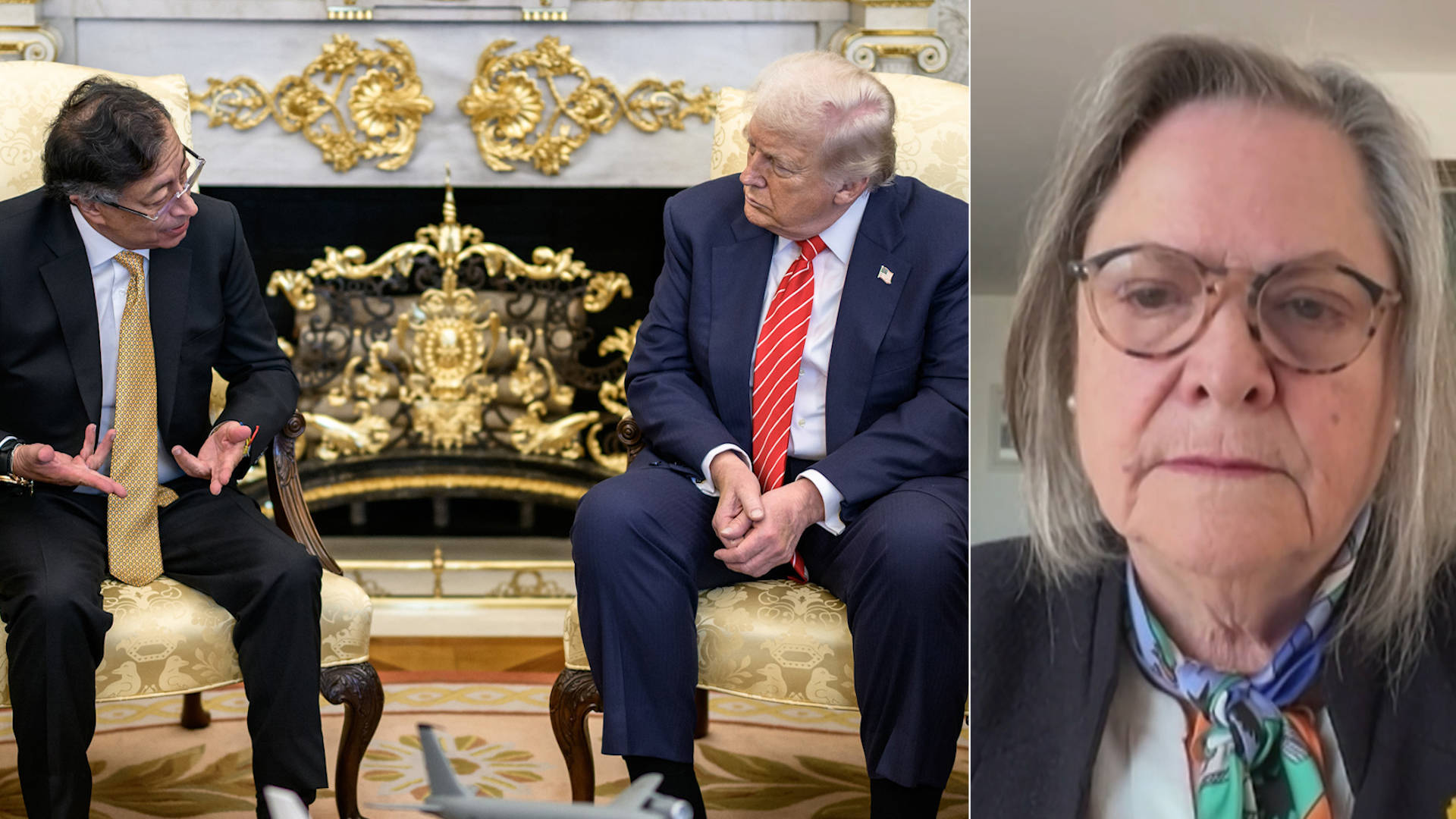
Colombian President Gustavo Petro sat down with President Trump in a closed-door meeting that lasted approximately two hours at the White House Tuesday, the first face-to-face encounter between the two leaders following months of tension and heated exchanges over the Trump administration’s military strikes on civilian boats in the Caribbean and the Pacific Ocean. Their talks also came a month after the U.S. attack on Venezuela and the abduction of Venezuelan President Nicolás Maduro and his wife in early January. Petro has urged for Maduro’s release and return to Venezuela.
After the White House meeting, Petro shared a photo on social media with a note, apparently handwritten by Trump, that said, quote, “Gustavo–A great honor–I love Colombia,” unquote, with a photograph of the two leaders shaking hands and smiling. Trump took on a drastically different tone after he previously insulted Petro, falsely accusing him of being a drug trafficker, threatening Colombia with U.S. military action. Petro spoke after the meeting on Tuesday.
PRESIDENT GUSTAVO PETRO: [translated] I told him that between free people, one cannot act under blackmail: “Do this, or else this happens.” No, we do not act under blackmail. And I think the photos and the atmosphere of the meeting show a meeting between equals who think differently — yes, with different powers, obviously, but capable of finding common paths. That’s it, nothing personal. He did not speak to me about his businesses, nor I about mine, which I do not have.
AMY GOODMAN: And this is President Trump in the Oval Office responding to questions about his meeting with Petro yesterday.
REPORTER: Mr. President, how was your meeting with Gustavo Petro earlier today? And did you come to any agreement on counternarcotic efforts?
PRESIDENT DONALD TRUMP: Yeah, we did. We worked on it, and we got along very well. He and I weren’t exactly the best of friends, but I wasn’t insulted, because I never met him. I didn’t know him at all. And we got along very well. And we are — we’re working on that. We’re working on some other things, too, including sanctions. And yeah, we had a very good meeting.
AMY GOODMAN: Colombian President Petro traveled to Washington, D.C., on a special visa after the Trump administration revoked his previous one in September, when Petro joined a pro-Palestine rally outside the United Nations headquarters in New York and urged U.S. soldiers to disobey Trump. The Trump administration also issued sanctions against Petro and his family in October.
For more, we go to Bogotá, Colombia, where we’re joined by the Colombian Senator Clara López Obregón. She is a presidential candidate in the upcoming elections in Colombia scheduled for May. She was acting mayor of Bogotá in 2011 and served as the minister of labor after that.
We welcome you to Democracy Now!, Senator. If you can start off by talking about what you understand took place yesterday in the Oval Office? It was a closed-door meeting. You had President Trump viciously attacking Petro. You had Petro demanding the release and return of the Venezuelan President Maduro before this meeting. And then it was all smiles afterwards. We almost thought it was a replay of President Trump meeting with the New York City Mayor Zohran Mamdani.
SEN. CLARA LÓPEZ OBREGÓN: Well, what I see is a very important repositioning of coercion and diplomacy in the Latin American context. I think President Petro was able to reframe, precisely with that quote that you just passed, regarding our common commitment to liberty, to freedom, from which he could establish a common language to establish very controversial issues which definitely separate us, like climate, like migration, like Venezuela, like sanctions. So, I think that in a very asymmetrical position, President Petro was able to elevate, through moral principles, through force of character also and an ethical stance, a more equal interchange with President Trump in his — in his Oval Office, which is obviously the center of power not only of the United States, but of the world.
AMY GOODMAN: What do you think, Senator Clara López Obregón, is the path forward on issues like drug trafficking, energy trade, military intervention, the U.S. strikes in the Caribbean and the Pacific, and continuing to detain the Venezuelan president, not far from where we are right now, in a Brooklyn detention center, both Maduro and his wife?
SEN. CLARA LÓPEZ OBREGÓN: Yes, this is a reedition of the Monroe Doctrine, but not as an ideological cover for intervention in our countries, but as an instrument for coercion, depending on how good the alignment is of each country with the United States’ interests.
Our response has to be getting together. Latin America, unfortunately, has been unable to structure meaningful and permanent instruments of collective action, so each country has to negotiate on its own from a position of weakness. And I think that what we have to construct, in view of all of these new coercive actions and violence, international violence through military intervention and sanctions that the United States has recovered as a exercise of control, the only — the only alternative that we have is what we call the geopolitics of the weak, getting together, coordinating our diplomatic actions and using international law in a strategic way. I think that we have to recover the moral narrative of international law, with connection with Europe, with the United States, with all the progressive sectors of society everywhere, because what is happening in Latin America is not just Latin America’s problem, as what is happening in Gaza is not just a Middle Eastern problem. They are all connected. And it has to do with the United States losing hegemony internationally with the rise of China, of India, of Russia. And I think that the only way forward has to be to resist, but also to act and create resilience through common interests that we can discover, like energy and like migration.
AMY GOODMAN: Senator Clara López Obregón, we have to leave it there, but we’re going to do this interview in Spanish and post online at democracynow.org/es. Yes. Colombian Senator Clara López Obregón, speaking to us from Bogotá.
That does it for our show. A very happy birthday to Hugh Gran! I’ll be in Santa Barbara this weekend at the International Film Festival. Hope to see people there Friday and Saturday.
The original content of this program is licensed under a Creative Commons Attribution-Noncommercial-No Derivative Works 3.0 United States License. Please attribute legal copies of this work to democracynow.org. Some of the work(s) that this program incorporates, however, may be separately licensed. For further information or additional permissions, contact us.