Fiona Kelly McGregor’s The Trap follows her successful novel Iris (2022), set in the criminal underworld of Sydney during the Great Depression.
In the previous novel, Iris Webber flees the prison of rural poverty for the dubious opportunities of the metropolis. She becomes a prostitute, but gains a measure of independence. Her irascible charm and plucky passion provide the necessary picaresque armour. Beneath this, her basic worth is never allowed to fully collapse, even as she lives hand-to-mouth and at the mercy of the powerful.
Review: The Trap – Fiona Kelly McGregor (Picador)
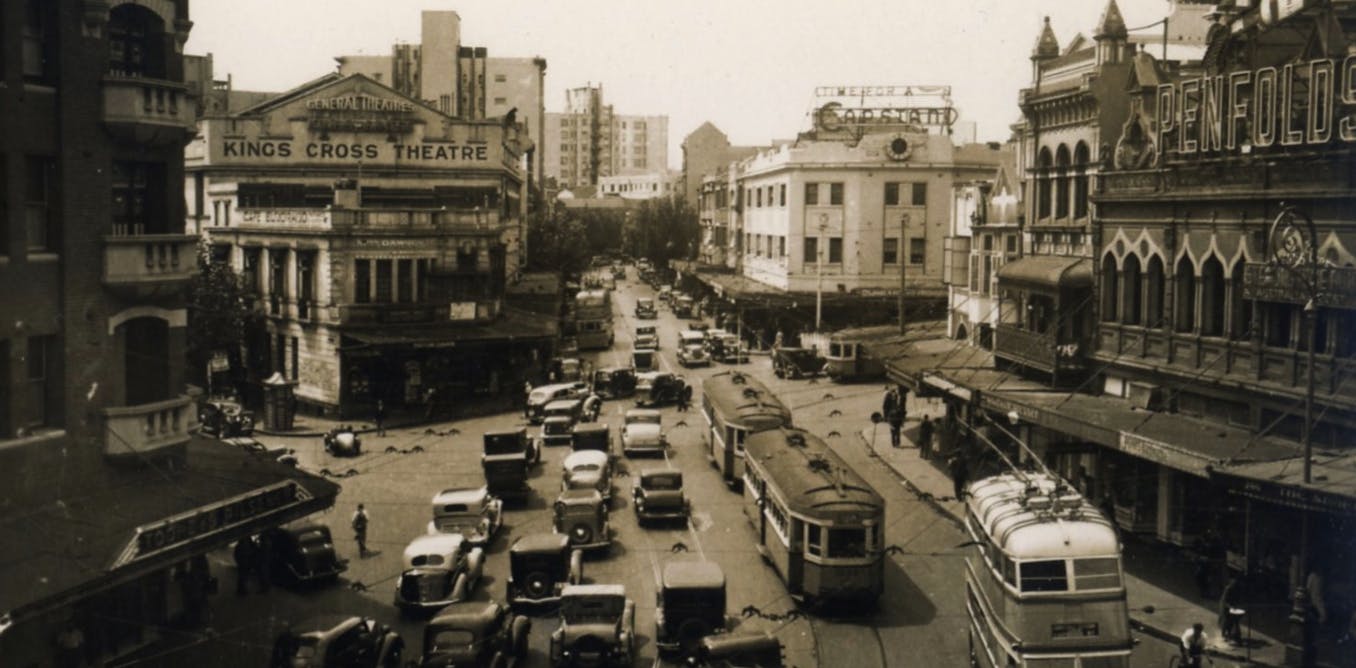
In The Trap, we stay in this same historical universe, composed with admirable fidelity to the colour of the historical record. But we have moved forward a decade to 1942. The generalised poverty of the Depression is now inflected with the restrictions brought about by war in the Pacific.
Brownouts and curfews, sly grog and black markets, along with an influx of American military personnel, evoke an atmosphere of Sydney under low-level siege. But what offends the convenience of Sydney’s moneyed stratum is less of a problem to the underclass:
most back streets in Darlo and Surro had always been unlit and business
for many was pretty much as usual, in fact it was positively booming, brothels
and groggeries buzzing with life till the early hours.
McGregor’s novel delights in this Dickensian world of grifters and chancers, crooked cops and witty hookers. It is a world where street wisdom and schemes prevail over public civility and social policy.
Twisted righteousness
The Trap begins by following Ray Sayles, one of the more memorable side-characters from Iris. In the 1930s, he had gained notoriety for performing as “Ada” in the underground club Black Ada’s. Born in Uganda, then part of British East Africa, Ray’s blackness makes him a striking figure in the white Australia of the time. The beauty of a novel, however, is we do not have to immediately see Ray’s blackness. This allows it to emerge unobtrusively through his encounters.


The police (“Vice”) had shut down Black Ada’s in 1940, though Ray admits the venue had probably run its course. In fact, all the colourful characters from Iris have gone somewhat to seed. The years have not been kind. We come to understand that
being 40 years old in 1940 was a rather different proposition than in the age-defying bubble of the current moment.
Ray is plagued by a gammy knee. When he enlists for military service, he is only fit for kitchen work. At one point, he bumps into Iris, whom he has not seen in years. He barely recognises her ragged and emaciated form, but she has kept the gleam in her eye and her drawling sardonic wit.
The opening movement concludes with Ray’s arrest by undercover policemen while
using a public toilet in the Domain. Though he had entered the restroom musing about the possibility of an erotic encounter, he had not in fact pursued this, partly because everyone else had noticed the cops closing in.
At this point, the novel swings its focus from the interior life of Ray to that of Thomas Carney, an embittered detective, who has decided “that ridding the city of perverts was a top priority”. It is into this “trap” that Ray has fallen.
Carney and his partner William Grigg have found the best method to prosecute their campaign against homosexuality is to entrap men in public toilets. The younger, handsomer Grigg serves as the bait, while Carney corroborates the “facts” that will substantiate the charge.
Carney’s clumsy repressions and twisted righteousness become the novel’s key thread; his interior musings become central to the narrative. Indeed, the novel’s method encourages identification with the garish positions of this world. The narration slides seamlessly into the thoughts of the characters and ventriloquises them:
The best time to catch perverts was dusk onwards, at the end of the week.
They were like cockroaches: they came out when it was dark, increasing in
number as the weather warmed, scuttling away when you frightened them.
They replicated like vermin too, returning to their nests if you left them
undisturbed too long.
The actual dialogue is also intriguingly rendered, with neither quotation marks nor line breaks to frame it as exterior speech. Instead, it drifts directly into the narrative. Yet because of the caricatured quality of the villains, each with their own battery of preferred slurs, we never feel especially lost.
Carney and Grigg’s scheme to rid the city of “perverts” seems to work all too well. Their impressive stream of arrests and convictions wins the cautious approval of the top brass. Carney starts to believe that his long sought promotion might at last be at hand.
In addition to his official success, he gets to indulge his penchant for sadistically beating those he has arrested while they are remanded. And he spins a tidy profit from the kickbacks he gets by sending them to his solicitor friend.
The train is derailed when Carney and Grigg arrest Clarrie McNulty.
Unbeknown to them, McNulty is the editor-in-chief of Frank Packer’s Daily
Telegraph. Packer has the option of cutting McNulty loose to minimise scandal, but decides to back his editor and fight the charges. The police find themselves under unexpected scrutiny.


Jamie James/Pan Macmillan
Plaintively horny
Many of the figures and situations in The Trap, including the the spectacular arrest of McNulty, come directly from the historical record. But this is the kind of historical novel that is based on the enjoyment of an epoch imagined as both more repressive and more sinful than it probably was in reality.
Susan Sheridan noted in her review of Iris that the novel belongs in a literary tradition depicting the lives of the knockabout Sydney poor – a tradition that includes Ruth Park, Kylie Tennant, Catherine Edwards and Dymphna Cusack, as well as Christina Stead and Louis Stone.
The main difference in The Trap is that we are approaching the situation historically, which is to say on the condition of it taking place in a lost past.
What does this past bring us? It must be something we feel to be missing in the present. The curfewed wartime Sydney of The Trap bears some resemblance to the aseptic lockdowns of the Covid era and must draw to some degree on this experience.
But the restrictions of this historicised past come garnished with picturesque historical grime. More than this, what we seem to seek in these dirty pasts are the very things we pride ourselves on having surpassed: daily mortal danger and rampant oppression.
It may seem perverse and counterintuitive, but novels like The Trap are clear
on this point. The promotional tagline of this sophisticated work is: “Brutality wore the badge. Bigotry wrote the law.”
In announcing this, the novel is true to the structure of its pleasure, which is powered by this splendid, monstrous persecution. Without the obscene threat posed by Carney and his ilk, the illicit sex in toilets would simply happen. The sensuous excitement of this world, its frisson of fatal excitement, depends entirely on the threat of arrest.
This – and we are speaking about a novel, of course – brings everything up to the requisite pitch. We are told “fear was an aphrodisiac” that “became everyone’s intoxicant”. Everyone was plaintively horny, it seems, because “every night could be your last”. Over and again, we are instructed that the threat is integral to the desire. As the novel puts it:
The fear was always there, sometimes becoming part of the attraction: what
must I overcome today, what might I get away with, what will I have to
navigate on my descent into the underworld?
It is a strangely exciting world of generalised criminality. Much like the noir universe, minus the paranoia and the femmes fatale. Or like Mad Men, where the awful misogyny and endless scotch and cigarettes simper with mid-century glamour. Aren’t we glad we don’t live there anymore?