

HomeLifestyleBeauty & HealthEthiopia digitalizes and modernizes its health emergency information systems

Ethiopia digitalizes and modernizes its health emergency information systems

Published on

spot_img

The World Health Organization Ethiopia (WHO) country office continues to support the Government of Ethiopia in advancing the digitalization and modernization of its public health emergency systems, helping ensure timely data-driven decisions for preparedness and response.

Through strong collaboration with the Ethiopian Public Health Institute (EPHI), WHO has supported the implementation of three interoperable digital platforms — the Electronic Public Health Emergency Management (ePHEM) system, the District Health Information System 2 (DHIS2), and the Epidemic Intelligence from Open Sources (EIOS) — providing an end-to-end digital solution that creates a unified ecosystem for emergency data management and coordination.

The ePHEM system lies at the center of this transformation. Developed jointly by WHO and EPHI, ePHEM provides a digital backbone for alert management, incident coordination, and resource tracking. It is now fully operational at the national level and has been effectively used during recent emergency responses, including the Mpox outbreak, to streamline reporting and strengthen coordination. In 2025, WHO supported conduct of five national level training rounds, reaching 320 users alongside 70 staff from the Amhara Region, with regional cascading already underway to expand system use nationwide.

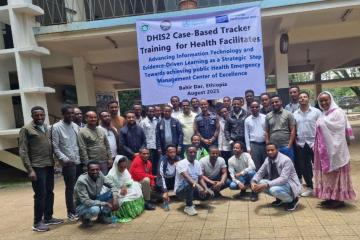
WHO is also supporting the nationwide implementation of the DHIS2 to strengthen surveillance and routine health data management across all levels of the health system. To date, over 2,975 EPHI staff from national, regional, and woreda levels have been trained, enhancing their capacity to collect, analyze, and use data for evidence-based decision-making. The DHIS2 platform now covers 72% of districts nationwide, with expansion plans underway to extend its use to health facilities—enabling real-time data capture, rapid analysis, and faster response to emerging public health threats.

To enhance mortality monitoring and early warning capacities, WHO also supported the training of 390 EPHI staff on all-cause mortality surveillance and the DHIS2 tracker. Mortality reporting is now fully integrated into the DHIS2 routine surveillance system, improving the country’s ability to detect unusual death patterns and trigger timely investigations.

In parallel, WHO has supported the implementation of the Epidemic Intelligence from Open Sources (EIOS) platform, which strengthens event-based surveillance by capturing and analyzing health threat information from publicly available online sources. EIOS has enabled EPHI to detect, verify, and respond to emerging events more rapidly and complement indicator-based surveillance systems.

Through these digital innovations, WHO is supporting EPHI in building a resilient, real-time and integrated public health information system that supports timely decision-making and coordinated emergency response. By linking surveillance, early warning, and response operational data under a single ecosystem, Ethiopia is advancing toward a modern, digital public health emergency system that protects lives and strengthens national health security.

Latest articles

Porsche’s Not Playing: The Swoopy 2026 Cayenne Coupe Electric Offers Up to 1,139 hp

Although other automakers have somewhat taken their foot off the, er, gas on their electric vehicle plans, Porsche has kept the pedal firmly to the floor. As a second act to the 2026 Porsche Cayenne Electric SUV, which dazzled with physics-breaking performance in our First Drive review, the German automaker now introduces a style-forward coupe

Things We Hate and Love About the Acura ADX

Great: Remote Engine Start Here in Southern California, there’s no real need to remote start the ADX’s engine. I still do anyway. I like to know it’s warmer than if I otherwise fired it up and immediately zipped away, but an actual benefit is how it can simultaneously precondition the cabin. Using the AcuraLink mobile

Canada Just Cracked Cleaner Lithium—Can the U.S. Keep Up?

Mangrove’s Delta facility is a best-case scenario thanks to British Columbia’s high percentage of clean hydroelectricity. 59–73% Lower Carbon Footprint Simply by eliminating the need to mine and transport chemical reagents and their inevitable waste byproducts, the Mangrove process reduces the carbon footprint of battery-grade lithium production by a lot—especially when refining from hard rock.

Clint Eastwood Loved Norton Motorcycles, and They’re Coming Back With a 206-HP Surprise

Steve McQueen and Marlon Brando rode Triumphs. But Clint Eastwood was a Norton guy. When not cruising his thumping two-cylinder Norton Commando along the winding roads through the pines and redwoods near his beloved Carmel-by-the-Sea, California, Eastwood used machines from the storied British motorcycle manufacturer while on location for movies such as Where Eagles Dare

More like this

Porsche’s Not Playing: The Swoopy 2026 Cayenne Coupe Electric Offers Up to 1,139 hp

Although other automakers have somewhat taken their foot off the, er, gas on their electric vehicle plans, Porsche has kept the pedal firmly to the floor. As a second act to the 2026 Porsche Cayenne Electric SUV, which dazzled with physics-breaking performance in our First Drive review, the German automaker now introduces a style-forward coupe

Things We Hate and Love About the Acura ADX

Great: Remote Engine Start Here in Southern California, there’s no real need to remote start the ADX’s engine. I still do anyway. I like to know it’s warmer than if I otherwise fired it up and immediately zipped away, but an actual benefit is how it can simultaneously precondition the cabin. Using the AcuraLink mobile

Canada Just Cracked Cleaner Lithium—Can the U.S. Keep Up?

Mangrove’s Delta facility is a best-case scenario thanks to British Columbia’s high percentage of clean hydroelectricity. 59–73% Lower Carbon Footprint Simply by eliminating the need to mine and transport chemical reagents and their inevitable waste byproducts, the Mangrove process reduces the carbon footprint of battery-grade lithium production by a lot—especially when refining from hard rock.