
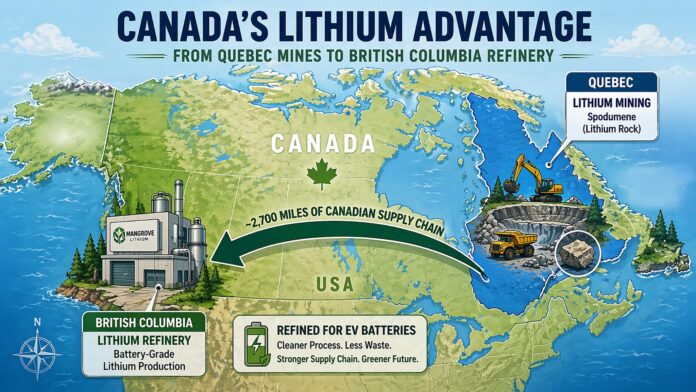


Mangrove’s Delta facility is a best-case scenario thanks to British Columbia’s high percentage of clean hydroelectricity.
59–73% Lower Carbon Footprint
Simply by eliminating the need to mine and transport chemical reagents and their inevitable waste byproducts, the Mangrove process reduces the carbon footprint of battery-grade lithium production by a lot—especially when refining from hard rock. Carbon use is considerably lower when refining lithium from brines, and of course the overall carbon footprint is dependent on the source of the electricity used in the electrodialysis process.
Cost-Competitive Without Legislation
In an era when our government seems less concerned about emissions, one might wonder how ripe the market is for a new low-waste lithium processing idea. Well, Mangrove Lithium’s CEO Saad Dara told MotorTrend, “We’re not relying on regulations to commercialize the technology.” Rather, he reckons refining companies looking to build a new plant will ask themselves, “Do we want to invest the capital to treat the waste, or do we want to invest the same amount of capital in doubling our capacity of lithium production while also eliminating the waste?” He also noted that the electrochemical process remains cost competitive with electricity pricing as high as 12 cents/kWh. (The 2025 average U.S. industrial electricity average price was $0.08–0.09/kWh.)
Well-Traveled Lithium
For now, Mangrove’s Delta facility has signed a memorandum of understanding with Élévra to secure spodumene (lithium rock) feedstock from the North American Lithium (NAL) mine in Quebec, creating a clear pathway toward Canada’s first mine-to-cathode lithium supply chain—a 2,700-mile-long chain.
Refine It Where You Mine It
Clearly, any sustainable long-term solution to on-shoring the battery supply chain for the U.S.’s million-plus annual electric vehicle production would involve locating larger facilities nearer to promising lithium sources like Nevada’s Clayton Valley brine mines or Thacker Pass clays, the Smackover brines in the Arkansas/Texas area, the spodumene in North Carolina, or the geothermal brines of the Salton Sea in California. (California’s electricity grid costs might suggest hauling those brines across a state line, but the rest should be fine.)
The good news is that since none of those sources is producing much output yet, there’s no existing facility refining via the old waste-heavy way, so as they come up to speed, it will make sense to install Mangrove Lithium’s system. Note, this system can also be used to refine the “black mass” that will one day flow out of battery recycling facilities like Redwood Materials, Li-Cycle, Ascend Elements, and Green Li-ion.