
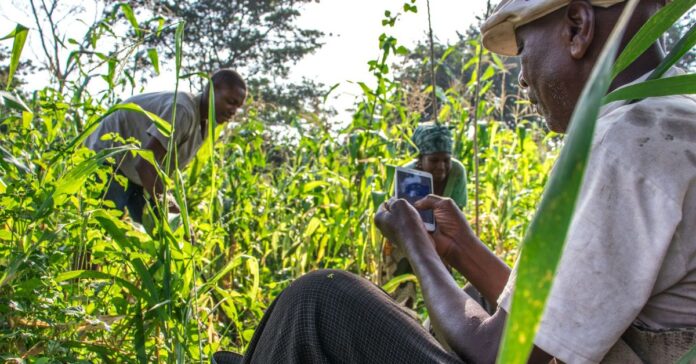


Brastorne Enterprises, a Botswana-based startup that transforms feature phones into Internet-enabled devices for rural Africans, plans to begin operations in Côte d’Ivoire by the end of the first quarter of 2026 as it rolls out a lightweight web platform designed for farmers using entry-level smartphones, the company told TechCabal.
The expansion will be done through a partnership with mobile network operator Orange, a long-time partner of the company, as it continues to scale services aimed at users without reliable internet access or high-end devices.
Brastorne’s expansion comes as agritech platforms across Africa increasingly adopt hybrid models that combine USSD services with web and smartphone platforms in response to uneven connectivity across the continent. Smartphone adoption in Sub-Saharan Africa remains below 55%, with gaps most pronounced in rural areas where the majority of smallholder farmers live.
Platforms such as Kenya’s DigiFarm, M-Kulima, and Farm.io have built services around USSD and SMS to reach farmers using basic phones while gradually introducing online platforms as internet access improves, reflecting a broader shift in African agritech toward moving users online while maintaining access for farmers who still depend on low-bandwidth channels for information, market access, and advisory services.
Founded in 2013 by Martin Stimela and Naledi Magowe, Brastorne operates in Botswana, the Democratic Republic of Congo, Cameroon, Guinea, and Zambia, with nearly six million users. The company targets Africans without smartphones or reliable internet access, a population it estimates at about 760 million, and has partnered with organisations including Heifer International in Zambia as well as mobile operators Orange, Mascom, and MTN across its markets.
The platform currently runs three core services: mAgri, which provides farmers with market information, trading opportunities, and agricultural advice; Mpotsa, an interactive voice and SMS service delivering localised content on health, education, and employment; and Vuka, a social communication service designed for feature-phone users.
Brastorne co-founder Naledi Magowe said the company will keep its USSD services for feature-phone users even as it introduces a lightweight web platform for smartphone users as connectivity improves.
“We chose a web app instead of an app because when we look at the farmers that we’re reaching, they do have smartphones, but entry-level smartphones where space becomes an issue,” Magowe said. “If you’re coming with an application, it’s going to be uninstalled very quickly because they want to save space.”
The new web platform will allow farmers to ask questions in local languages through text, voice, or images, with responses generated by an AI system trained on agricultural data, weather information, and market intelligence. If the system cannot resolve a query, it escalates the request to a human agronomist.
“We want the farmer to be able to, for example, if they’re noticing some kind of pest or disease on their plants, just take a picture, upload it on the web app, and the AI gives diagnostic information and links them to an expert,” Magowe said.
According to the company, the platform integrates live weather data, pest and disease surveillance, and market pricing information to provide context-specific recommendations. It will also include training modules, certification programmes through university partnerships, farmer-to-farmer video content, and a digital marketplace where users can list and view products.
Magowe said artificial intelligence (AI) will increasingly be used to personalise user experiences and improve efficiency, although the company is still building technical capacity.
“We’re still looking for talent that can help us solidify our AI operation,” she said, noting that specialised AI expertise remains limited across the continent.
Brastorne also plans to introduce financial services such as credit and insurance for smallholder farmers through partnerships with mobile money platforms, including Orange Money and MTN MoMo.
Magowe said localisation will be central to the Côte d’Ivoire launch, a factor she described as key to Brastorne’s success across multiple African markets.
“Every country is very unique. What’s being farmed is different, the climate is different, even livestock priorities are different,” she said. “We work with local content partners to ensure the right translations, the right content, and that our products are tailored to the needs of farmers in each market.”
While partnerships with mobile network operators have enabled scale, they have also slowed expansion timelines, a challenge the company is trying to mitigate.
“Just to get things situated in Botswana, it took us about three years. And then the next market we went into was DRC. That took almost two years. Then the next market took about a year,” Magowe said. “So it does reduce over time. However, it’s not as fast as we need it to be because we’re also a business and we need to grow and we have a team and we still have to operate.”
Despite the challenge, the company is proceeding with its Côte d’Ivoire launch as it accelerates its shift from USSD to AI-driven platforms across new markets.
As Brastorne prepares to enter Côte d’Ivoire, it is also exploring expansion into Burkina Faso, Benin, Sierra Leone, and Ghana, with the long-term goal of operating in at least 19 African countries and reaching over 45 million users, helping to narrow the continent’s connectivity gap.