

HomeWorld NewsSouth Korea pushes looser rules for high-tech sectors

South Korea pushes looser rules for high-tech sectors

Published on

spot_img

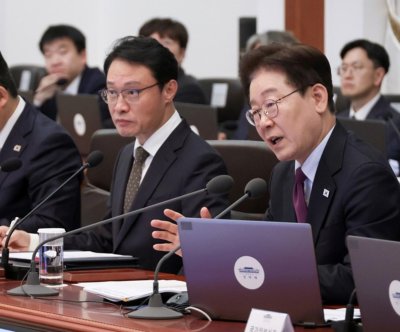
South Korean President Lee Jae Myung (R) speaks during a meeting with his senior secretaries at the presidential office Cheong Wa Dae in Seoul, South Korea, 09 April 2026. Photo by YONHAP / EPA

April 15 (Asia Today) — Lee Jae-myung said Tuesday that South Korea should shift to a “negative regulation” system in advanced technology sectors to strengthen global competitiveness and revive economic growth.

Speaking at the first plenary session of the Regulatory Rationalization Committee at the presidential office, Lee said the country must enhance its competitiveness amid intensifying global economic competition.

He identified restoring growth potential as a key national priority and said competitiveness ultimately depends on strengthening individuals, companies and industries.

“To achieve that, we must remove unnecessary or inefficient regulations and align them with international standards,” Lee said. “In advanced technology and high-tech industries, we need to move toward a negative regulation system.”

Under a negative regulatory framework, activities are allowed unless they are explicitly prohibited by law or policy.

Lee acknowledged concerns about the risks of loosening regulations but stressed the need for speed and flexibility.

“I feel anxious as well – what if something goes wrong?” he said. “But we must trust the system. If problems arise, we must respond immediately, either by banning or controlling them.”

The president also emphasized the importance of balanced regional development in regulatory reform, calling it essential for long-term national survival rather than a matter of policy preference.

He proposed creating large-scale regional regulatory zones to encourage innovation and urged officials to consider what kinds of activities could be permitted within such areas.

— Reported by Asia Today; translated by UPI

© Asia Today. Unauthorized reproduction or redistribution prohibited.

Original Korean report: https://www.asiatoday.co.kr/kn/view.php?key=20260415010004617

Latest articles

Snap Inc., Snapchat parent company, slashes workforce, turns to artificial intelligence

1 of 3 | Traders work on the floor at the New York Stock Exchange in 2017 as Snap's initial public offering debuts in New York City. The parent company of Snapchat announced Wednesday that it's cutting about 16% of its workforce in favor of artificial intelligence tools. File Photo by Monika Graff/UPI | License

OP-ED: Korean American nominee for U.S. envoy to S. Korea draws attention

1 of 2 | Michelle Park Steel, then a Republican member of the U.S. House of Representatives, speaks at a North Korea Freedom Week event in front of the U.S. Capitol in Washington, D.C. File. Photo by Asia Today April 15 (Asia Today) -- This commentary is the Asia Today Editor's Op-Ed. The administration of

Iran threatens U.S. shipping in Red Sea over blockade as Trump says talks with Iran likely to restart

1 of 2 | A container ship sails on the Strait of Hormuz, as seen in June 2025 from Ras Al Khaimah, United Arab Emirates. The strait lies between Oman and Iran and links the gulf to the Arabian Sea. On Wednesday, Iran threatened shipping in the Red Sea, the Gulf of Oman and the

More like this

Snap Inc., Snapchat parent company, slashes workforce, turns to artificial intelligence

1 of 3 | Traders work on the floor at the New York Stock Exchange in 2017 as Snap's initial public offering debuts in New York City. The parent company of Snapchat announced Wednesday that it's cutting about 16% of its workforce in favor of artificial intelligence tools. File Photo by Monika Graff/UPI | License

OP-ED: Korean American nominee for U.S. envoy to S. Korea draws attention

1 of 2 | Michelle Park Steel, then a Republican member of the U.S. House of Representatives, speaks at a North Korea Freedom Week event in front of the U.S. Capitol in Washington, D.C. File. Photo by Asia Today April 15 (Asia Today) -- This commentary is the Asia Today Editor's Op-Ed. The administration of

Iran threatens U.S. shipping in Red Sea over blockade as Trump says talks with Iran likely to restart

1 of 2 | A container ship sails on the Strait of Hormuz, as seen in June 2025 from Ras Al Khaimah, United Arab Emirates. The strait lies between Oman and Iran and links the gulf to the Arabian Sea. On Wednesday, Iran threatened shipping in the Red Sea, the Gulf of Oman and the