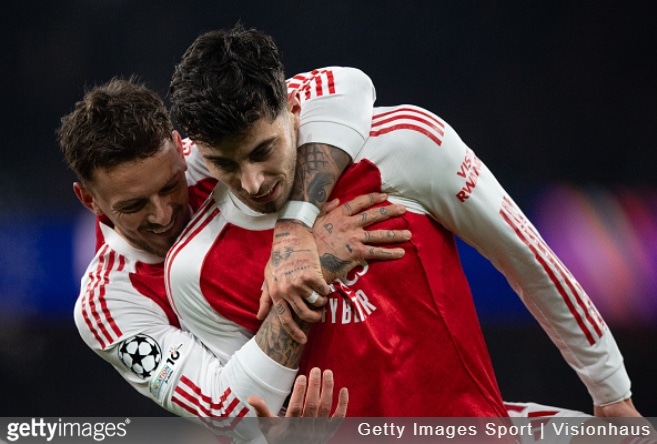
On nights like these, when Europe’s lesser lights drift into London and a rotated Arsenal side strolls to victory, it is tempting to dismiss the occasion as little more than glorified conditioning. But football rarely works in straight lines, and Arsenal’s win over Kairat Almaty offered more than the sterile comfort of a routine triumph. It gave the clearest indication yet that Kai Havertz—after a year scarred by injuries, form dips, and constant questions—may finally be ready to reclaim a starring role in Mikel Arteta’s plans.
For Havertz, this was not merely a productive performance. It was a re‑emergence, a re‑centering, a quiet declaration that he remains capable of shaping Arsenal’s season. A goal and his involvement in two more were the tangible contributions; the intangible ones—confidence, sharpness, rhythm—were what mattered most.
And with Arsenal navigating four competitions and an increasingly volatile front line, Havertz’s revival does not just arrive at a convenient moment. It arrives at a necessary one.
A Year to Forget Meets an Opportunity to Seize
Havertz’s Arsenal story has been punctuated by interruptions. A dazzling spell followed by a setback, a stretch of influence undone by another injury, a position mastered only for the team to reshuffle again. In this match, though, there was none of the heaviness that had hovered over him for months. His movements were assured, his touches decisive, and his instincts sharper than at any point since last spring.
Given 45 minutes from the start, Havertz needed to do more than simply participate—he needed to imprint himself on the game. He did exactly that. The slide‑rule pass for Viktor Gyökeres’ opener showed vision. The rifled finish, cutting inside before finding the far corner, showed conviction. The unselfish assist‑before‑the‑assist, squaring to Gyökeres instead of taking on the shot himself, showed awareness and leadership.
This mattered because Arteta needed it to matter. Arsenal are entering a stretch that will define their season: a trip to Elland Road, a Carabao Cup semifinal, and the layered demands of a title push. A fit, confident Havertz does not just expand Arsenal’s options—he changes the geometry of the team.
And after a year in which much of his momentum was lost to stop‑start fitness struggles, he finally looks ready to answer that call.
Gyökeres and the Striker Equation
If Havertz’s revival was one storyline, the ongoing puzzle of Arsenal’s No. 9 situation was another. Viktor Gyökeres remains a paradox: a striker capable of bullying defenders, scoring with power, and creating his own chances—but also one whose erratic finishing can derail Arsenal’s control.
He thumped home a smart goal here, but he also missed chances that should have sealed the game long before the final whistle. The wild miscue a few yards from goal, the heavy touch from Havertz’s pass, the chip cleared off the line—these were the moments that remind supporters why Arteta has been forced to diversify Arsenal’s goal‑scoring burden.
Gabriel Jesus, when introduced, offered a familiar duality. He created chaos with his movement yet wasted one chance and finished another only to be caught offside. Arteta is right to rotate, right to protect his only fit striker, and right to extract meaningful minutes from Havertz as a central presence.
For a manager who wants unpredictability, who wants attackers who swap roles fluidly, Havertz is not a luxury—he is a key.
A Managerial Milestone and an Academy Statement
Lost beneath the narrative layers was a milestone of quiet significance: Arteta’s 200th win as Arsenal manager. It took him 326 matches to get there, and the symbolism of the night aligned with the trajectory of his tenure. Again he promoted youth. Again he trusted his academy. Again, Arsenal became the first team to complete the league phase of this European format with a perfect record.
Introducing Brando Bailey‑Joseph and Ife Ibrahim, the 18th and 19th academy graduates to debut under him, Arteta reinforced one of his defining principles: the project at Arsenal is built on development as much as on ambition.
But, as he admitted afterward, the sterner tests are coming. A demanding Elland Road. A cup semifinal against a resurgent Chelsea. The Premier League summit within reach but not yet in hand. Nights like this one matter because they allow experiments, rest, and recalibration—but they do not resemble the challenges that lie ahead.
A Performance Worth More Than Its Context
Yes, the opposition was weak. Yes, the match at times felt closer to a training exercise than a competitive contest. But dismissing the significance of Arsenal’s performance would miss the larger point.
This team has looked anxious in recent weeks: rigid in possession, narrow in chance creation, overly dependent on Bukayo Saka and Martin Ødegaard for invention. With Saka rested and Martin Zubimendi likewise given a rare breather, Arsenal needed others to assert themselves. Havertz did. Martinelli did. Szoboszlai did.
They needed rhythm, and they found it. They needed variety, and this game offered it. They needed confidence, and victory brought it.
Even the concessions—the early penalty Jorginho dispatched and the late consolation goal—served an unintended benefit. Arsenal were reminded that vulnerability still lurks. That lapses of concentration still matter. That defensive discipline cannot be switched on and off like a tap.
If anything, those moments reinforced the urgency of the coming fixtures.
A Glimpse of What Arsenal Could Become
It is tempting to view Havertz’s resurgence and Arsenal’s collective poise as isolated events—just another European win over an overmatched opponent. But Arsenal’s season has hovered at a crossroads. Too many injuries. Too much inconsistency. Too much pressure on their brightest stars. They need catalysts, secondary engines, alternate routes to goal.
Havertz can be that. Gyökeres can be that. Martinelli, Jesus, Szoboszlai—they all can be that.
The difference between a title challenger and a title winner often rests on moments like these, when squad players become starters, when form replaces hope, when fragility gives way to certainty.
Havertz looked certain again. Arsenal looked balanced again. And Arteta, who has spent months juggling absences and underperformance, walked off the pitch looking more assured than he has since autumn.
The Road Ahead: Serious Tests, Serious Expectations
Arsenal have positioned themselves well across competitions, but nights of comfort will soon give way to nights of consequence. The visit to Elland Road, the semifinal against Chelsea, the grinding winter fixtures—all demand intensity. They demand precision. They demand execution.
And they demand players like Havertz, who can tilt games and stitch attacks together, who can offer both physical presence and creative clarity, who can relieve the pressure on Saka, who can give Arteta tactical range.
The Havertz who played against Kairat Almaty is the player Arsenal thought they were getting. The one capable of scoring, assisting, linking, leading. The one who elevates those around him. The one whose injuries obscured his importance but could not erase his talent.
If this is Havertz’s turning point, Arsenal’s season might pivot with him.
A Performance That Meant More Than Three Points
Arsenal have produced bigger wins, more emotional wins, more important wins. But this one mattered because of what it hinted at. It suggested that Havertz is back—not just fit, but sharp; not just involved, but central. It suggested that Arsenal’s depth is beginning to function again. It suggested that Arteta’s plan still has life, still has legs, still has a future.
No one will remember this night for the scoreline or the opponent. But Arsenal might remember it for something else entirely: the moment their season rediscovered one of its most important pieces.
If Kai Havertz truly is ready to lead again, Arsenal’s ambitions across four competitions suddenly look far less distant.