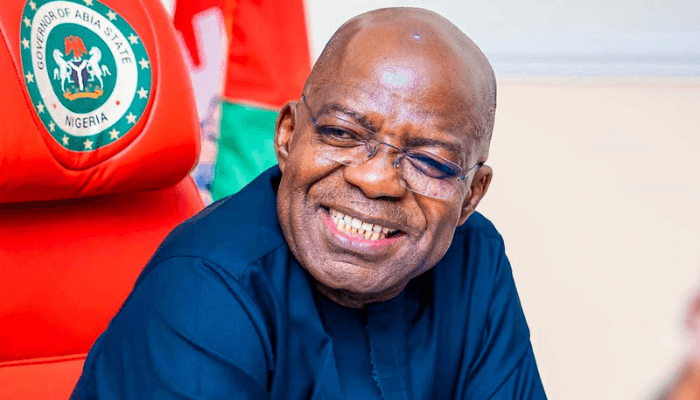
Alex Otti, governor of Abia state, has sought to dampen speculation that he could follow other opposition governors into Nigeria’s ruling All Progressives Congress, saying he remains a member of the Labour Party, while conceding that political loyalties are rarely permanent.
Speaking during a monthly media briefing on Thursday, Otti said he was still committed to the Labour Party, which carried him to victory in the 2023 elections, despite an intensifying leadership crisis within the party and a wave of defections that has weakened the opposition ahead of the next electoral cycle.
“I am still in the Labour Party,” the former banker said. “If an election were held today, we would still contest on that platform. But nobody knows tomorrow.”
His comments come at a delicate moment for the Labour Party, which has been embroiled in a prolonged internal dispute over its national leadership. The crisis has split the party into rival factions and raised questions about its organisational coherence following its surprise gains in the 2023 general elections.
At the centre of the dispute is Julius Abure, the party’s former national chairman, whose tenure Otti and his allies argue has expired. The Abia governor said his faction had taken the matter to court to resolve what he described as a constitutional breach.
“We have maintained that Abure’s tenure has expired,” Otti said. “The court has now affirmed that position and advised all parties to respect judicial decisions.”
Last week, a federal high court in Abuja ruled that the Nenadi Usman-led national caretaker committee is the legitimate leadership of the Labour Party. The court also directed Nigeria’s electoral umpire, the Independent National Electoral Commission (INEC), to recognise the caretaker committee, a decision seen as a significant boost for the faction aligned with Otti.
The rival Abure-led group has rejected the ruling and said it would appeal, prolonging uncertainty over the party’s leadership structure.
Otti’s carefully worded remarks reflect the broader fluidity of Nigerian politics, where party allegiance is often shaped by calculations of electoral viability rather than ideology. Since President Bola Tinubu took office, several governors elected on opposition platforms have defected to the APC, consolidating the ruling party’s dominance across much of the country.
For now, Otti appears keen to project stability in Abia while avoiding a definitive commitment about the future. “We are not in an election period,” he said, signalling that immediate governance, rather than partisan manoeuvring, remains his priority.
Yet his acknowledgement that “nobody knows tomorrow” underscores the fragility of Nigeria’s opposition landscape — and the unresolved question of whether the Labour Party can hold together long enough to remain a credible national force.
Obidike Okafor
Obidike Okafor is an award winning, seasoned journalist and content consultant. Obidike has left his mark on the global stage, writing for prestigious publications in Nigeria, the UK, South Africa, Kenya, Germany, and Senegal. He also has experience as an editor, research analyst and podcaster.