


Prediction
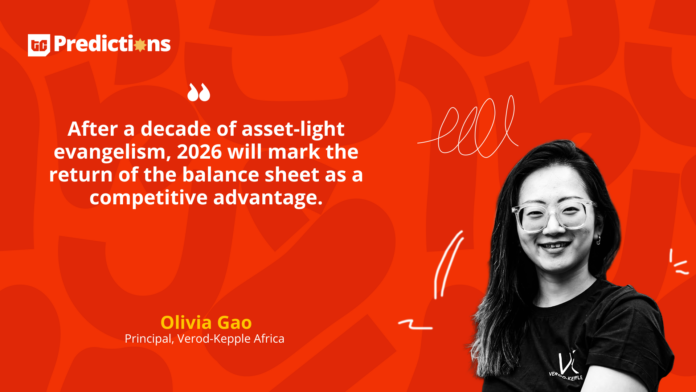
After a decade of asset-light evangelism, 2026 will mark the return of the balance sheet as a competitive advantage. Startups that own or finance productive assets—vehicles, devices, and equipment—will outcompete pure marketplaces by controlling supply, monetising financing margins, and unlocking private credit partnerships.
Traditional VC wisdom favoured asset-light models for faster scaling. But the post-2023 funding environment and renewed pressure for profitability are pushing founders toward business models with durable cash flows. Productive asset financing—from smartphones and refrigerators to motorbikes and commercial vehicles—is emerging as one of the most compelling paths, as it offers predictable cash flows, collateral-protected downside, and a faster path to achieve profitability.
This shift is underpinned by structural asset gaps across emerging markets. Massive unmet demand exists for mobility, energy access, appliances, logistics capacity, and agricultural equipment. Asset financing, therefore, becomes the product itself, not just an add-on to a platform. Moreover, compared to developed markets where such assets are abundant, their relative scarcity in emerging markets drives higher utilisation and stronger returns—making these models intrinsically more attractive than comparable asset-financing businesses in developed economies.
One caveat, though: scale in this context will resemble bank loan-book growth more than user-growth curves – and Africa’s banking sector has already demonstrated how large such balance sheets can become. As a result, valuing these businesses will require a balance-sheet–led approach rather than traditional revenue-multiple frameworks.
Supporting Evidence
2025 has already shown accelerating momentum in debt financing across Africa’s startup ecosystem. In Kenya and Egypt, more than half of total startup funding now comes through debt instruments. Several of the continent’s largest funding rounds this year—including M-Kopa, Sun King, d.light, and Spiro—were predominantly debt-financed.
This signals that both founders and capital providers are becoming comfortable with asset-backed venture structures at scale. We also see a growing volume of asset-financing business models emerging in our investment pipeline—they are increasingly becoming a partner for mobility or logistics platforms, which are looking for anchored supply partners.
Risk Factor
Unexpected default rates due to poorly managed collection or repossession processes could challenge investment confidence in asset financing models. While the model is attractive in theory, its success depends on disciplined execution and deep operational expertise in credit underwriting, debt structuring, and risk management—capabilities that remain scarce in many early-stage startups.
Who is Olivia Gao?
Olivia Gao is a principal at Verod-Kepple Africa Ventures (VKAV), a pan-African venture capital firm backing tech-enabled, growth-stage companies across the continent. At VKAV, Gao is involved in sourcing and evaluating investment opportunities, conducting due diligence, and supporting portfolio companies as they scale. Her role spans engagement with founders and helping shape investment strategy within the firm’s broader focus on supporting post-revenue startups with global growth potential.
Before joining VKAV, she gained investment experience as an associate and analyst at firms including SouthBridge Group and Future Hub Africa and worked on renewable energy and development finance initiatives during a research internship with Climate Finance Advisors, as well as with the United Nations Development Programme.