


Commentary
I recently bid farewell to every single food delivery app on my phone. My overall well-being thanked me
Published
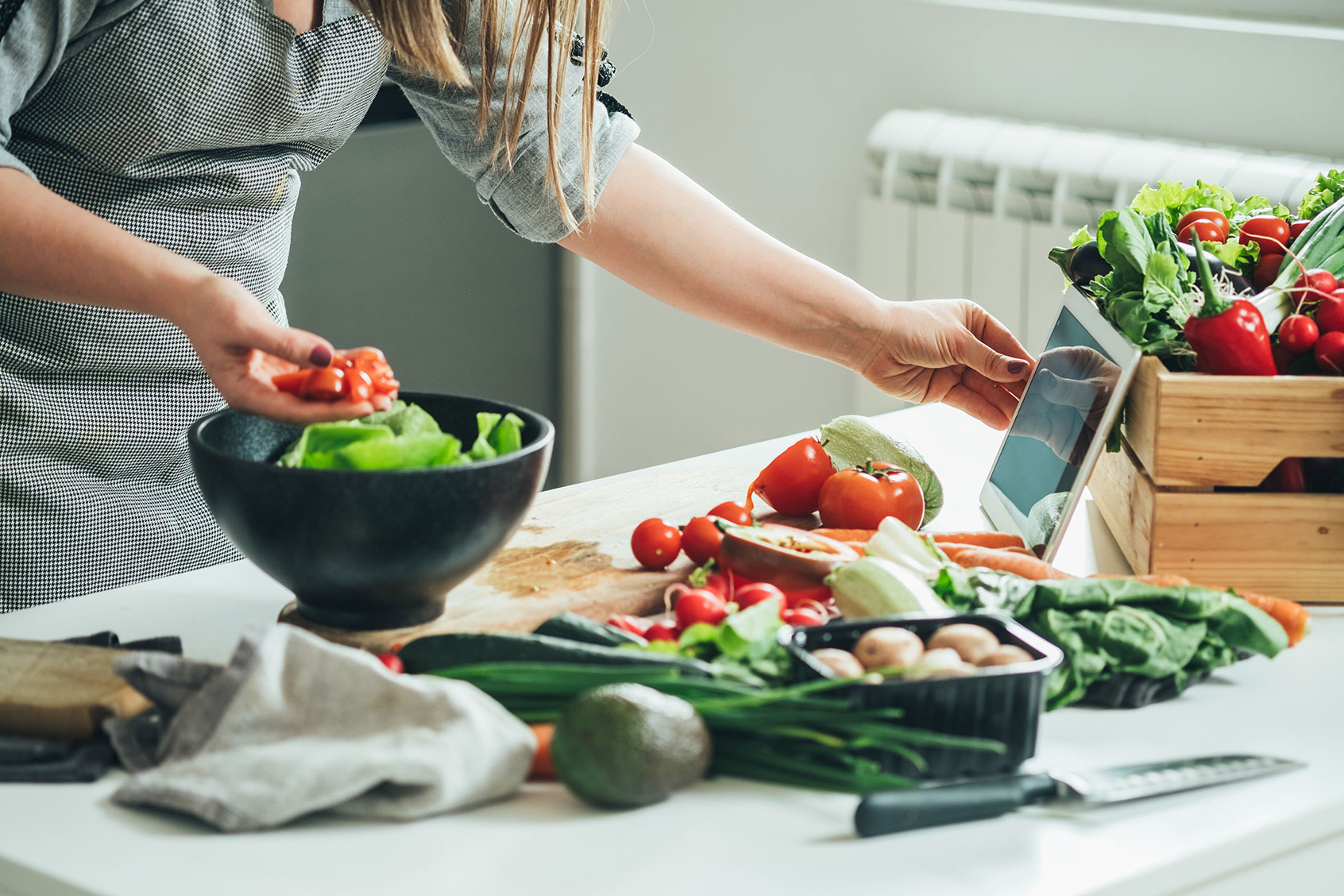
Woman utilizing tablet in the kitchen while cooking (Getty Images/Tijana Simic)
It’s 8 pm on a Thursday and my stomach is growling for food.
After hours of staring at my laptop screen, the glow of my microwave clock providing an extra bit of light in an otherwise dimly-lit apartment, I finally gather the motivation to step into my kitchen. My refrigerator is stocked with a few ingredients (kumato tomatoes, lemons, mini pears, apples, a box of arugula and a carton of eggs) and my pantry holds the usual (pasta, rice, beans). I’m hungry but can’t decide what to eat. And because I waited until the very last moment to feed myself, I’m running low on energy to actually cook. Instinctively, I grab my phone, open Uber Eats and order food from my go-to neighborhood restaurant. I’m relieved, yet hit with a pang of guilt.
For years, I’ve been stuck in a love-hate relationship with third-party food delivery apps, including DoorDash and Grubhub. They’re always available when I need nourishment and comfort. They’re enticing, luring me in with the promise that my strongest cravings (perhaps, even, the best meal I’ve ever eaten) are just a few clicks away. But the apps have also become a default setting I struggled to override. They’re habit-forming. Takeout for dinner leads to takeout for breakfast the following morning, then takeout for lunch, and maybe more takeout for dinner again. They’re expensive and unsustainable. Soulless and unfulfilling. It’s gotten to the point where I’ve finally asked myself, “Should I delete my food delivery apps for good?”
Food delivery, which saw a significant surge in usage during the pandemic, remains high in demand, especially among younger consumers. In 2024, nearly three of every four restaurant orders were not eaten in a restaurant, according to data from the National Restaurant Association. In a survey conducted by the group last year, 37 percent of adults said they order delivery once a week. That statistic was higher among Gen Zs and millennials, with 41 percent saying they rely heavily on food delivery.
As dining and social habits shift, more restaurant operators are being encouraged to offer delivery services via mobile apps.
“The surge in usage among these younger adults is largely attributed to the increased availability and use of mobile apps,” says Dr. Chad Moutray, the National Restaurant Association’s Senior Vice President and Chief Economist. “We all know that smartphones are as essential as food and oxygen to younger customers, and the convenience those restaurant apps provide integrate into their lifestyles. So, if operators want to tap into that market, they must be available through mobile apps.”
But emotions surrounding food delivery services remain mixed. In a January report, The New York Times surveyed almost 900 readers on how they use the apps. Many were cognizant of both the benefits and drawbacks of regular food delivery. Perks include more freedom, more time, an abundance of choices, more socialization, and even less socialization for those who only want to stay at home. On the flip side, there’s impulsive spending (some readers said they’ve ordered a single item for delivery), more food waste, guilt and costly credit card bills.
Food delivery apps aren’t inherently bad, per se. For those with chronic disabilities or mobility issues, the apps are necessary. But they can certainly be overused by casual consumers — so much so that the apps become a bad habit.
In navigating my own relationship with food delivery apps, I’ve realized that ditching the apps was the best thing I could do for my health, wallet and home kitchen. It was after tallying my December spending that I finally deleted them cold turkey in January.
Here are the factors that ultimately influenced my decision:
The hyper-convenience
In an age of widespread digitization and innovation, where technology permeates nearly every aspect of daily life, food delivery apps flourish because they provide convenience.
The convenience of modern life is “seductive,” writes Dr. Alex Curmi, a psychiatrist and trainee psychotherapist, for The Guardian. However, that doesn’t mean it’s beneficial in the long term.
“Modern hyper-convenience is a kind of deal with the devil. It is seductive because it appeals to our instincts, but it surreptitiously depletes us,” Curmi states. “It has made it easier to get by, but in many ways harder to truly succeed. Human flourishing and happiness is not just about subsistence, but also depends on growth, dynamic problem-solving, and solidarity through hardship.”
Indeed, food delivery gives us instant gratification. Yet, it prevents us from connecting with the foods we eat. Increased use of food delivery apps means less time in grocery stores, choosing and understanding specific ingredients. It also results in less time spent cooking. According to a 2025 study by Yash Babar, a professor at the Wisconsin School of Business, people living in counties where food delivery platforms were introduced spent an average of nine percent less time cooking daily than before.
I felt that nine percent in my own kitchen — in the dust gathering on my Dutch oven. After a week of ordering health bowls for lunch, I had forgotten what it felt like to truly know the food on my plate. What variety of tomatoes was used in my bowl? What was used to marinate the chicken? How long did it take to cook the rice? What individual ingredients made up this dressing? And how long did it even take to put everything together?
The high cost
The biggest consequence of using the apps was the financial strain. Service fees, delivery fees, tax and tips, combined with the astronomically high cost of food in New York City, made regular food delivery unfeasible.
As I review receipts from past orders, I’m haunted by several. There’s an order from my local taqueria: a small bag of chips, a small plastic cup of guacamole, and two medium-sized burritos totaled $52.18. I don’t even remember if the burritos were good. There’s another from my favorite bagel shop: a lox sandwich came to $26. And there’s the time I was craving Italian food: two orders of rigatoni ragu totaled $63.18.
Food delivery persists even as food inflation remains high and many families nationwide struggle to afford groceries. While overall food prices continue to climb, groceries rose even faster than restaurant food in early 2026, according to data from the United States Department of Agriculture (USDA). The Consumer Price Index (CPI) for food-away-from-home (which includes restaurant foods and other food service purchases) increased 0.1 percent during that same period, while food-at-home (which includes groceries) increased 0.6 percent.
It’s no secret that food delivery prices are outrageously high. “Up to 91% More Expensive: How Delivery Apps Eat Up Your Budget,” reads a 2020 headline from The New York Times. “The Year Food-Delivery Prices Went Insane,” reads a 2023 headline from Intelligencer. “Food deliveries are getting more expensive — but we can’t stop ordering,” reads a 2024 headline from Business Insider.
The National Restaurant Association’s 2025 survey also found that a majority of consumers would take advantage of off-premise dining options, including delivery, takeout and drive-thru ordering, more often if they could better afford it.
The ethics
Unbeknownst to most consumers, high commission fees, delivery fees and payment processing fees enforced by food delivery apps are hurting restaurant profit margins, forcing some to shut down.
“These platforms do not only connect consumers to restaurants — they fundamentally alter the nature of competition in the marketplace,” says Manav Raj, a Professor of Management at The Wharton School, who is an author of a 2025 study looking into how food delivery apps affect the national restaurant industry.
According to NYU Stern Dean J.P. Eggers, who co-authored the study, their research found that “digital delivery platforms disproportionately impact younger, less established restaurants.”
“This poses a long-term risk to industry dynamism, potentially stifling innovation and leading to stagnation,” Eggers continues, adding that “in high-cost urban areas, the intensified competition and margin pressures from these platforms could result in a proliferation of vacant storefronts in once-vibrant, high-traffic neighborhoods.”
Food delivery drivers are struggling too. Many face dangerous work conditions, especially in major cities, often working long hours without proper access to public restrooms, the New York Times reported in 2020. Because delivery drivers are independent contractors, they aren’t guaranteed minimum wage nationwide or additional benefits. In New York City — where there are around 60,000 restaurant and grocery delivery workers, according to the Department of Consumer and Worker Protection — a landmark minimum pay law requires third-party food delivery apps to pay workers a minimum of $21.44 an hour, not including tips. The legislation also requires apps to offer an option to give at least a 10 percent tip before or during checkout.
Before the new rules went into effect on Jan. 26, Uber and DoorDash filed a joint federal lawsuit in the Southern District of New York, alleging that the laws on how they display tipping options violate the First Amendment. A recent report from the Department of Consumer and Worker Protection found that since Uber and DoorDash changed their tip options to appear after customers place their orders, their delivery drivers have lost over $550 million in tips.
In the end, there’s no clear “winner” within the food delivery ecosystem. And it also doesn’t seem like food delivery apps are retiring anytime soon. For those who are attempting to quit the apps for good, our biggest act of rebellion, now, is returning to our home kitchens. Cooking. Revelling in the labor. And savoring our hard work.
Tonight, at 8 p.m., I’m roasting those kumato tomatoes and scrambling the eggs. It’s not revolutionary. But it’s mine.
Related Topics
——————————————
Related Articles
