
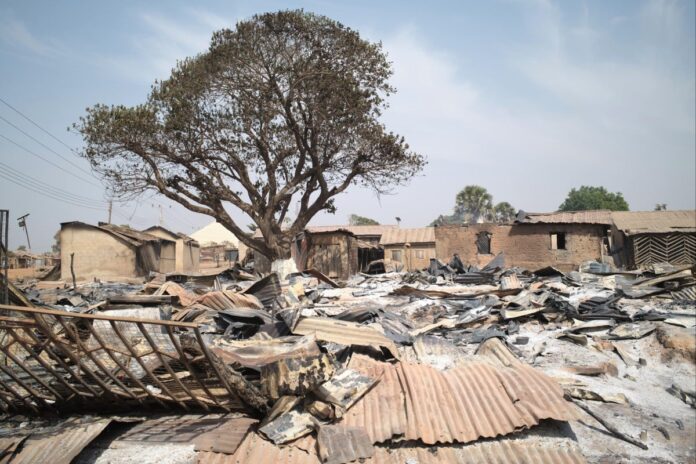


Residents of Woro, a farming community in Kwara State’s Kaiama Local Government Area, went to bed last Tuesday night expecting an ordinary morning. What they woke up to instead were mass graves, and the realisation that the danger had come not just from outside, but from within.
At dusk, life in Woro looked unremarkable. Farmers drifted home from their fields. Shop owners exchanged the day’s small talk. Families prepared dinner. By dawn, the village had been reduced to ashes, grief and an eerie silence. Armed jihadists had swept through, killing at will and burning homes, shops and offices.
The scale of the devastation was overwhelming. Bodies were buried in mass graves. Others were recovered days later from nearby bushes and gutted buildings. A tightly knit community was emptied almost overnight. By Wednesday afternoon, officials told Vanguard that at least 162 people had been killed, with many still missing and dozens abducted.
Omar Muazu, the Emir of Kaiama, said informants within communities were deepening the security crisis and called for a permanent military base around Woro. He warned that the death toll was likely to rise as more bodies were recovered.
Two days after the attack, Woro remained largely deserted. Those who escaped had yet to return. Charred buildings marked where family homes once stood. The streets were silent, watched over by soldiers and forest guards.
Residents say the attackers were not strangers. Locals who spoke on condition of anonymity said the group had visited the community before, presenting themselves as preachers and urging residents to abandon Nigeria’s constitution in favour of their own ideology.
Early last month, the group reportedly sent a letter to Umar Saliu Tanko, the village head, announcing plans to return for another sermon and asking that residents be assembled. Uneasy about previous encounters, the village head alerted security agencies.
On the appointed day, soldiers reportedly positioned themselves at the venue, hoping to question the visitors. When the armed group spotted security personnel from a distance, they withdrew. Residents believe that moment marked the point of no return.
Soon after, the group allegedly sent a voice message to the village head, accusing him of attempting to have them arrested and vowing revenge. The message was reported to security agencies. No date was mentioned. No additional security followed.
The attack came the following Tuesday evening.
According to residents, more than 50 armed men entered Woro around 5pm, moving methodically from street to street. People were shot in the open. Others were killed inside their homes. Houses and shops were set on fire, some with occupants trapped inside.
The state government has officially confirmed 75 deaths, based on bodies physically counted. Locals say that figure barely scratches the surface. Many victims were killed while fleeing into nearby bushes; others were burnt beyond recognition.
“We are still finding bodies,” a resident said on Thursday afternoon. “Even after the mass burial on Wednesday, more corpses are being recovered.”
The attackers reportedly returned in the early hours of the following day, ambushing residents on their way to early morning prayers at the mosque. Grave diggers worked through tears, burying neighbours, friends and family members.
When AbdulRahman AbdulRazaq , the governor of Kwara, returned from an official trip and visited Kaiama, local officials struggled to put words to what they had seen. TAbubakar Abdullahi Danladi, the local government chairman, described the scene as “like a horror film”.
“There were still corpses in the bushes,” he said. “They went straight to the house of the village head, killed his children and used his car to abduct his wife and other family members.”
Vigilantes attempted to resist but were badly outmatched. “I am a medical professional,” the chairman added, “but I have never seen bodies in this condition.”
Civil society groups have also condemned the attack as evidence of a widening security breakdown across northern Nigeria. The Arewa Discussion Group described recent truces with armed groups as “naive concessions to anarchy” and called for a complete overhaul of security strategy.
For Woro, those debates offer little comfort. The village was not simply overrun. It was exposed, mapped and given up.
Obidike Okafor
Obidike Okafor is an award winning, seasoned journalist and content consultant. Obidike has left his mark on the global stage, writing for prestigious publications in Nigeria, the UK, South Africa, Kenya, Germany, and Senegal. He also has experience as an editor, research analyst and podcaster.
