


- A 650-km (400-mi) railway corridor is being built that will link the iron ore mine in eastern Guinea to the country’s Atlantic port of Moribaya.
- Its route crosses forests that are home to some of the last populations of forest elephants and western chimpanzees in the country, with NGOs warning of disruptions and fragmentation of vital habitat, putting several species at risk of local extinction.
- Villagers along the route also complain that dust and pollution have impacted their livelihoods, and that compensation has been delayed or incomplete.
- Experts and civil society actors are calling for a strategic environmental study and better implementation of environmental and social management plans.
BOMBIA, Guinea — As day breaks over the green hills around the town of Bombia, the raucous cries of chimpanzees echo through the forests of the Kankouyah mountain range. Recently, the sounds of the wild have been mingled with the distant growling of bulldozers. The air, once laden with the aromatic scent of damp leaves and wood, is now thick with dust and diesel fumes.
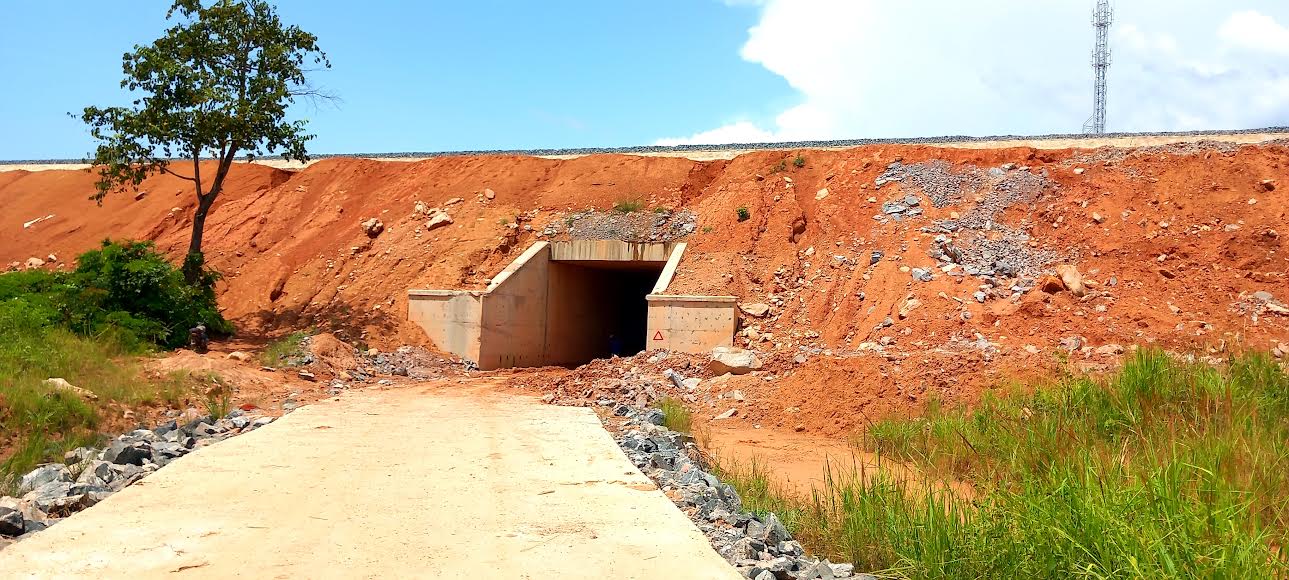
A few kilometers south of the village, a ribbon of red earth cuts through the vegetation: the railway corridor for the Simandou project. This mining megaproject is intended to connect the iron ore deposits of Simandou to the deepwater port currently under construction at Moribaya in on the Atlantic coast of Guinea. This is an economic lifeline for the country, but an open wound for biodiversity.
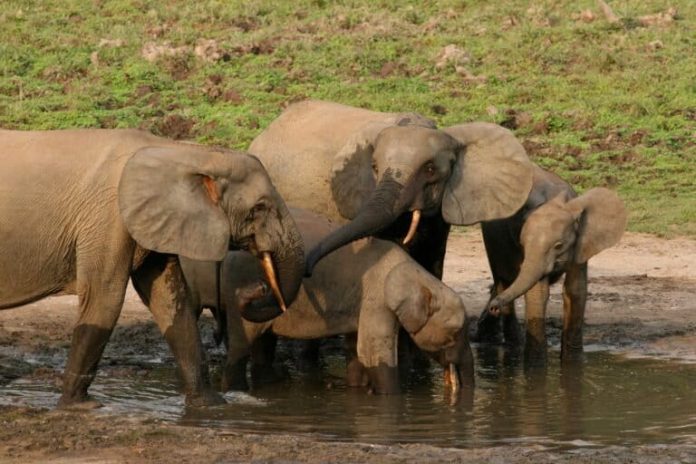
The railway corridor, which runs more than 650 kilometers (400 miles), crosses several vulnerable areas, home to some of the last remaining populations of forest elephants (Loxodonta cyclotis) and western chimpanzees (Pan troglodytes verus) in Guinea. According to experts from the Guinean Office of National Parks and Wildlife Reserves (OGPNRF), these elephants’ ancestral migratory routes pass through wetlands now fragmented by the railway corridor.
“Guinea is home to more than 5,000 chimpanzees in the Moyen-Bafing region alone,” Mamadi Tounkara, head of the OGPNRF’S legal and litigation department, tells Mongabay. “But the passage of earthmoving equipment, the noise of explosives, and the fragmentation of the vegetation cover all disrupt their migration routes.”
Tounkara says economic development should not be built on the destruction of nature. “You cannot develop a country whose biodiversity is completely lost. Mining destroys everything in its path: forests, wildlife and natural habitats. Elephants, chimpanzees, lions and monkeys are particularly vulnerable to these activities. The noise of a train, for example, can be enough to scare elephants away.”
He says a carefully considered strategy is needed to ensure that mineral exploitation doesn’t come at the expense of biodiversity. “Every mining project must be subject to an environmental and social impact assessment, combined with an environmental and social management plan, and mitigation measures.”

Natural habitat disrupted
In Sékhoussoria, Amara Camara is the coordinator of a monitoring committee for people affected by the Simandou project. He points to Gnèguèyah Hill, once a refuge for many chimpanzee families, now in ruins. “Before the railway corridor construction, the chimpanzees lived here. But the blasting — directly linked to the construction of an 11-kilometer [7-mi] tunnel — drove them out. They fled into the depths of the forest. It is only recently that they have begun to timidly return.”
According to Camara, besides chimpanzees, these forests harbor Campbell’s mona monkey (Cercopithecus campbelli), red-fronted gazelles (Eudorcas rufifrons) and elephants, as well as small mammals like greater cane rats (Thryonomys swinderianus). The destruction of their habitat leads the animals to encroach on agricultural areas more frequently, where they have ravaged fields of rice and groundnuts.
“These animals can no longer find enough to eat in the forest,” Camara says. “So they turn to crops. This is a direct consequence of the disturbance of their ecosystems.”
Guinea is home to the largest chimpanzee population in West Africa. The Wild Chimpanzee Foundation, an organization established in Germany in 2000 to safeguard the long-term survival of wild chimpanzee populations and their forest habitats, works to protect the primates in collaboration with the OGPNRF and local communities.
In a 2024 report, WCF said construction of the railway poses a major threat to wildlife, fragmenting habitat and blocking the animals’ movement. The foundation said it had urged the mine and railway developers, Winning Consortium Simandou and Rio Tinto, to significantly increase their investments in mitigating and offsetting the negative impacts of the railway.
The forests bisected by the railway corridor are also home to some of the last forest elephants left in West Africa. A publication by the Elephant Protection Initiative (EPI), an intergovernmental coalition, estimates Guinea’s elephant population at between 64 and 138 individuals, confined to a few isolated fragments of forest, primarily in the southeastern region affected by the Simandou project.
A 2016 report from the African Elephant Specialist Group at the IUCN, the global wildlife conservation authority, underlines the urgent need for rigorous conservation measures, especially in the face of expanding mining and infrastructure activities that are exacerbating the fragmentation of habitats essential to the survival of Guinea’s last wild elephants.

Farmers caught in a trap
Along the corridor’s route, once-productive fields are now yellowed, covered in red dust and reeking of diesel.
In Bombia, Alhassane Sylla acknowledges that the project has brought the community some benefits, such as newly drilled boreholes for water, and bridges and tunnels on the road network. Farmers have also been paid compensation for damaged fields, but Sylla says he’s concerned about the lasting impacts on agricultural production. “Several fields have been affected by the red mud from the construction work. This pollution renders our land infertile and jeopardizes our harvests,” he says.
In Sékhoussoria district, complaints are multiplying. Amara Camara ticks off the names of several farmers he knows — Fodé Lansana Camara, Karamoko Yaya Cissé, Mamadou Samba Bah — whose fields have been wrecked by contaminated waterways.
“Water carrying red mud continues to flood the fields. Many farmers have had to abandon their land while waiting for compensation. Some have been compensated, but about 15 are still waiting for payment,” he says. The amounts paid vary between 50 million and 100 million Guinean francs, about $5,700-$11,500, depending on the damage, he adds.

Mamadou Samba Bah, a 32-year-old father of five from Sékhoussoria, recounts his distress: “I was working our family land, but mud dumped by one of the subcontractors, CRC16, is preventing us from farming. I’d bought fertilizer and farm equipment, but all for nothing. Now, I have no livelihood. I am demanding compensation of 150 million Guinean francs,” or about $17,200.
Mongabay tried to contact the managers of Winning Consortium Simandou, the Singapore- and Chinese-backed joint venture building the railway, but without success. As the tracks advance toward the coast, conservation NGOs are trying to salvage what they can. A civil society actor, who spoke on condition of anonymity, says the economic pressure surrounding Simandou is enormous.
“This is a vital project for Guinea, but we must also prevent it from becoming an ecological disaster,” they say. “We have requested the implementation of an environmental and social management plan, but its implementation in the field remains difficult to verify.”
While the Simandou project symbolizes a major economic opportunity for Guinea, it also illustrates the environmental and social dilemmas arising from poorly managed development.
Banner image: Forest elephants have thinner, straighter, and pinker tusks than savannah elephants. Image courtesy of Richard Ruggiero/USFWS via Wikimedia Commons (CC BY 2.0).
This story was first published here in French on Nov. 4, 2025.
Rare new Guinean flower is ‘canary in a coal mine’ — but in an actual iron mine
A rush for ‘green’ iron is on in Guinea. Will chimpanzees be a casualty?
FEEDBACK: Use this form to send a message to the author of this post. If you want to post a public comment, you can do that at the bottom of the page.
Credits
