


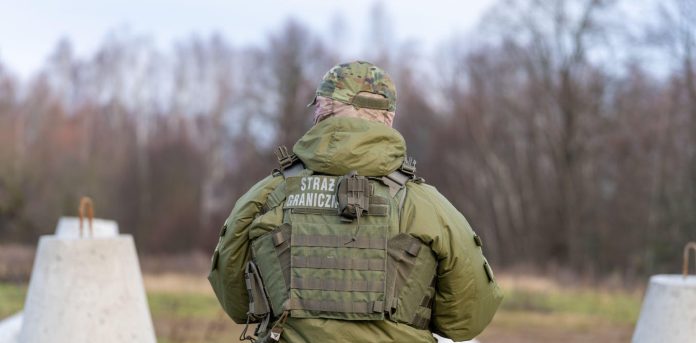


In 1946, Winston Churchill announced an “iron curtain” had descended across Europe “from Stettin in the Baltic, to Trieste in the Adriatic”. This time it is the west that is building the barriers.
Every European nation bordering Russia and its ally Belarus is accelerating plans to construct hundreds of miles of fortified border to defend against possible Russian aggression.
The reasons are clear. The post-cold war European security framework – which relied on strengthening international institutions and trade, Nato expansion and US military guarantees – is being eroded.
Finland
Sharing an 832-mile border with Russia, Finland proposed building a wall in 2023 that would cover about 15% of its border, costing over US$400 million (£297 million) and with hopes that it will be completed by 2026.
Motivated in part by Russia’s invasion of Ukraine in 2022, but also due to a rise of Russians fleeing to Finland to escape conscription. Finland’s government passed a law in July 2023 to build stronger and taller fences, as the previous wooden fences were designed only to prevent livestock from crossing. Eight border posts were erected (including north of the Arctic Circle) alongside greater obstacles in the southernmost strip of the country.
There are even defences being erected in remote areas of north-eastern Finland, where in the not-too-distant past, a steady flow of Russian and Finns would regularly come and go across the border to buy groceries.
Estonia, Latvia, Lithuania and Poland
And Finland is not the first. In August 2015, Estonia announced that it would build a fence along its eastern border with Russia, after Moscow’s 2014 annexation of Crimea.
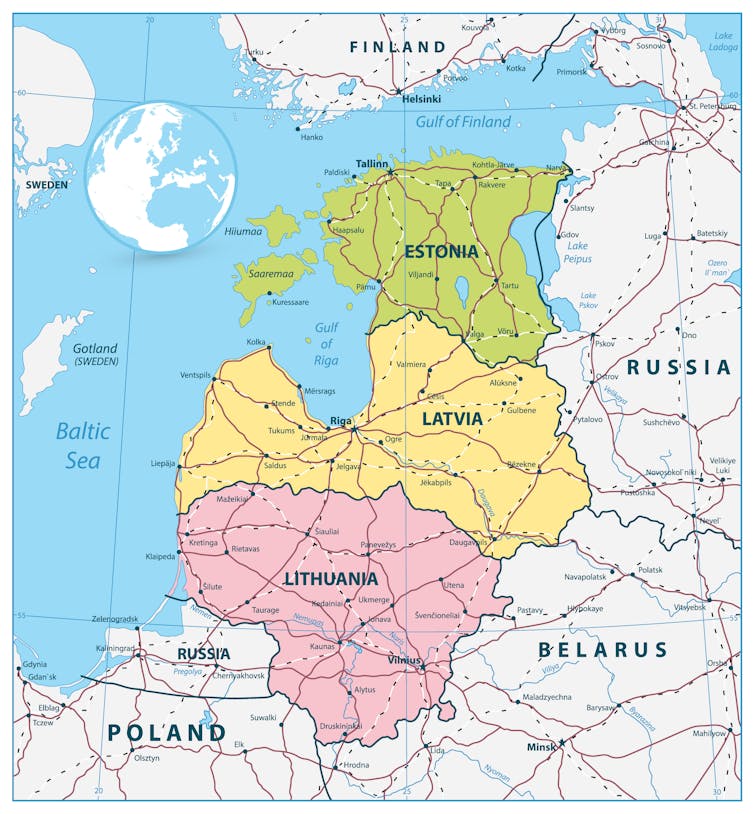
In 2024, the Baltic states and Poland proposed to further fortify their borders with a defensive wall. It would cover 434 miles, costing over £2 billion. Plans and construction are now speeding up as leaders of the Baltic states worry that the prospects of a ceasefire between Ukraine and Russia could mean Moscow redirects its military towards them.


Shutterstock
Latvia will invest about US$350 million over the next few years to reinforce its 240-mile border with Russia, while Lithuania is planning a 30-mile defence line against a possible Russian invasion. Poland has started building a permanent fence on its border with Belarus as part of its defence against Moscow’s potential allies.
These walls will also be accompanied by other physical barriers such as antitank ditches, 15-tonne concrete dragon’s teeth (which can stop Russian tanks advancing), massive concrete blocks and pyramids, roadblocks, massive metal gates, mined fields and blocked bridgeheads.
Lithuania is planning up to 30 miles of reclamation ditches, bridges prepared for bombing and trees designated to fall on roads when necessary.
The Baltic states are also building more than 1,000 bunkers, ammunition depots and supply shelters to further protect the 600 miles of territory that borders Russia. Bunkers are expected to be about 377 square feet, capable of housing up to ten soldiers and being able to withstand artillery strikes from Russia.
The Baltic nations plus Finland and Poland also all announced in 2025 that they would withdraw from the 1997 international treaty banning antipersonnel landmines, while Lithuania revoked its pledge to a cluster bomb treaty. Poland announced in June 2025 that it had added minefields to its “East Shield” border plans.
Building a drone wall
These border defences will be using the latest technology and early warning systems and artillery units. Lithuania Latvia, Estonia, Poland, Finland and Norway met in Riga in 2024 to begin plans to build a 1,850-mile “drone wall” to protect their borders.
This drone wall will have a sensor network, consisting of radars and electronic warfare tools to identify and destroy Russian drones. Within seconds of detecting a target crossing the border, there would be a system of close reconnaissance of drones.
This project will require a great deal of cooperation among participating states. Estonian companies are already designing drones that can both detect and neutralise threats along complex terrain in lakes, swamps and forests that blanket Russia’s border with the Baltic countries.
Historical parallels
Both cooperation from all countries that border Russia in Europe and an understanding of the terrain is critical to avoid the failures of the Maginot Line, part of a set of defensive barriers that France built along its borders in the 1930s, and which failed to prevent a German invasion in the second world war. In that case, it was assumed that the Germans could not pass through the Ardennes forest in Belgium.
While the Maginot Line fortifications did cause the Germans to rethink their plan of attack, Belgium was left vulnerable. Today, European nations are aware that they cannot fully prevent a Russian attack, but they can, possibly, shape the nature of a Russian invasion. The goal of these barriers is both deterrence and to try to control the location of any invasion.
If a ceasefire between Ukraine and Russia is announced, the leaders of the Baltic nations fear the Kremlin could redeploy troops to their borders.
Countries neighbouring Russia are trying to be as prepared as possible for whatever Vladimir Putin might do next.