


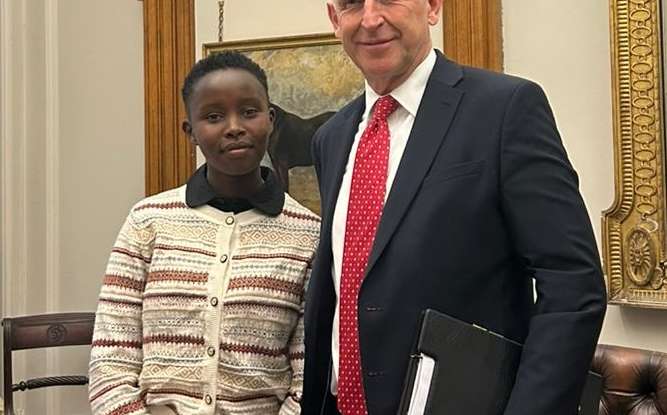



Thirteen years and more than 6,000 miles from where Agnes Wanjiru was allegedly killed by a British soldier, her niece, Esther Njoki, sits in a wooden-panelled committee room in the Houses of Parliament. Portraits of long-dead dignitaries glower from the red, green and gold walls, as she addresses MPs, lawyers, journalists and campaigners for military justice. Her message for the British Army is clear: it must change its culture, so no more families suffer as hers has done.
“If we can change the culture of the army, we can protect future generations of women and girls,” she insists. “We can’t bring Agnes back. But we can protect other women.”
Wanjiru was 21 when she disappeared after leaving a hotel bar frequented by British soldiers based at the British Army Training Unit Kenya (BATUK), near the city of Nanyuki, in 2012. It would be nearly three months before her family discovered her body in a septic tank. Seven years later, a Kenyan inquest ruled that a British soldier had unlawfully killed her.
“She was an innocent,” Njoki tells openDemocracy, when we meet in law firm Leigh Day’s offices the day after her Parliamentary appearance. “He killed an innocent girl.”
Get our free Daily Email
Get one whole story, direct to your inbox every weekday.
Wanjiru, an aspiring hairdresser, left behind an infant daughter and a family devastated by grief. Njoki, who was eight at the time of her aunt’s death, treasures the memories she has of her. “She was an extrovert, she used to make jokes,” she says. “She was always fun. We keep her memory alive for her daughter. The joyful things.”
On the night Wanjiru died, nine British soldiers had checked into the hotel where she was last seen. Weeks after her body was found, Kenyan police asked the UK Ministry of Defence (MoD) for interviews with the men and DNA samples from them. Interviews were never conducted and samples never sent, with the MoD later claiming it didn’t receive the request. Without either, the Kenyan investigation collapsed, leading to accusations of a cover-up by the British Army.
In 2021, the Sunday Times revealed that the suspect’s identity is widely known in the army, quoting one soldier who said their colleague had admitted to killing Wanjiru and shown him and others her body. The paper also found Facebook posts where soldiers, including the alleged killer, joked about the young woman’s death. More toxic “banter” about the killing was uncovered on a notorious squaddies forum, where men “joked” that one way to manage “shagging the locals” was to “kill them and shove their body in a septic tank.”
“We felt bad because it was like Agnes was not a human being,” Njoki says. “Why would you joke about a dead person?”
Njoki believes her aunt’s death and the subsequent reaction from members of the British Army reflect long-standing colonial attitudes towards Black Kenyan women by white British soldiers. “It shows that we are still in the colonial times, even though we are independent,” she explains to openDemocracy. “This army is of the coloniser. That’s why they feel entitled.”
While the suspect in Wanjiru’s murder was finally charged by the Kenyan authorities in September this year, it may be many more years before he faces trial – if ever. The UK government must first approve an extradition request from Kenya to try the soldier in the country’s courts, a process that Barrister Ben Keith, who spoke alongside Njoki at the parliamentary event, warned can take more than two years. Even if the extradition request is approved, the suspect can appeal the decision, leading to further delays.
An MOD spokesperson said: “Our thoughts remain with the family of Agnes Wanjiru and we remain committed to helping them secure justice and offering our full support to the Kenyan authorities.”
A demand for change
The story of white British soldiers victimising local women predates Wanjiru’s death. Such violence was rooted in Britain’s colonial rule of Kenya, when sexual violence was used against women and men who took part in the Mau Mau uprising in the 1950s. After independence, the Kenyan and UK governments agreed that the British Army could use BATUK to train its soldiers, but accusations of sexual abuse committed by men on the base continued to surface. In 2003, the human rights NGO Amnesty International recorded 650 allegations of rape of Kenyan women by soldiers stationed at BATUK across three decades.
This prompted a three-year investigation by the Ministry of Defence (MoD), which in 2007 issued a report to say there was no reliable evidence to support charges that members of the British military had raped hundreds of women in the East African country. The report was criticised by Kenyan women’s groups and MPs.
Five years later, Agnes Wanjiru was killed. Since then, more and more allegations of sexual violence have emerged, including reports published by this website (as well as ITV and The Nation) of Kenyan women and teenage girls being harassed and abused by soldiers stationed at BATUK.
Sex workers are among those who say they have been abused by troops. openDemocracy last year revealed that no British soldiers had been sanctioned for violating an MoD ban on “transactional sex” that was introduced in November 2022, despite women telling us that army men are still paying them for sex.
Earlier this year, an internal service inquiry commissioned by the MoD identified 35 allegations of troops stationed at BATUK engaging in transactional sex between July 2022 and March 2025. Nine of these alleged incidents took place after the ban came into effect. However, this is likely an underestimate, with sex workers’ rights advocates telling openDemocracy that British army personnel are paying for sex “day in, day out.”.
The historic and ongoing abuse is why Njoki is determined to fight for justice for all victims of British atrocities. She wants to see systemic change in the British armed forces so that no more women and girls are victimised by men stationed at BATUK or exploited by British military men looking for sex.
“We should be empowering women, and telling soldiers that they cannot take advantage of vulnerable people,” Njoki says. “Since Agnes, we have uncovered so many things and so many cases have come to light.”
At 21, Njoki is now the same age her aunt was when she was killed. “I should be enjoying my youth for sure, but the government has turned me into an activist,” she says. “What keeps me going is Agnes’ daughter, because she is not someone who can speak up or say what happened. Even in my family and with other victims of the British atrocities, I know they can feel intimidated or shy but I can use my voice. I don’t have a colonised mind. I have to make things right, so that I can make change for the future.
“We have been keeping our heads high to ensure that this thing will not be repeated to any other family, so no other girl has to go through what Agnes went through and my family went through. And that’s why I’m here. To change the culture of the army and to make sure that the systems of justice will be smooth for the victims in the future.”