
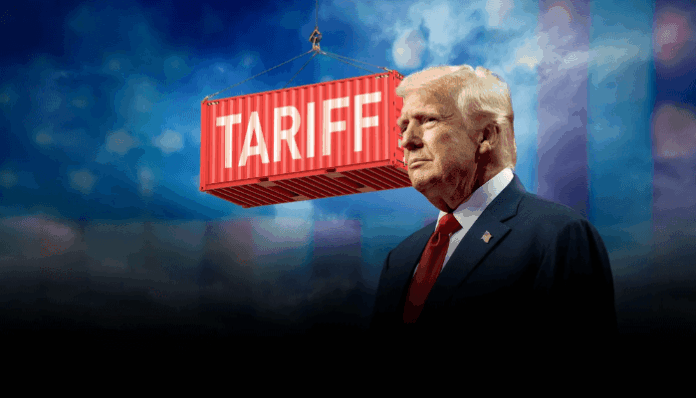


A United States federal trade court has struck down President Donald Trump’s latest attempt to impose sweeping global tariffs, dealing another setback to a trade strategy that has faced mounting legal resistance and prolonged uncertainty for businesses and global markets.
In a two-to-one ruling delivered on Thursday, the US Court of International Trade said the administration’s blanket ten percent tariffs on imports were not authorised under Section 122 of the Trade Act of 1974, the law cited by the White House to justify the duties.
Read also: WORLD IN BRIEF: Hormuz ceasefire strains, Trump escalates EU tariff threat, Zimbabwe to return seized farms, and other stories
The court ruled in favour of two small businesses that challenged the tariffs, arguing that the administration had exceeded its legal authority after the US Supreme Court earlier this year invalidated a separate round of Trump tariffs introduced under emergency powers legislation.
The judges wrote that the latest tariffs were “invalid” and “unauthorised by law”, rejecting the administration’s argument that long running trade deficits justified the measures.
The decision temporarily blocks the tariffs from being enforced against the two companies involved in the lawsuit and the state of Washington, although the ruling is expected to have broader implications for Trump’s wider trade programme.
The tariffs were first introduced in February at ten percent after the Supreme Court struck down an earlier package of global levies. Trump later raised the duties to fifteen percent and had planned to keep them in place until July 24.
Read also: Oil jumps as violence flares after Trump’s offer to help ships through Strait of Hormuz
Speaking in Washington after the ruling, Trump criticised the decision and accused the judges of political bias.
“So, nothing surprises me with the courts. Nothing surprises me,” Trump said.
“We get one ruling and we do it a different way.”
The administration is expected to appeal the decision, first at the federal appeals court and potentially again before the Supreme Court.
According to Reuters, the ruling deepens legal uncertainty surrounding Trump’s trade agenda at a time when businesses and importers are already grappling with shifting tariff policies and rising costs.
The Wall Street Journal reported that the court found the administration had failed to meet the strict conditions required under the 1974 trade law, which allows temporary tariffs only in limited cases involving serious balance of payments crises or threats to the US dollar.
Despite the legal setbacks, the Trump administration is already exploring alternative routes to revive broad tariff measures.
Read also: US targets Iraq oil official and militias with sanctions for aiding Iran – Reuters
The office of the US trade representative is conducting investigations into whether sixteen major US trading partners, including China, the European Union and Japan, are overproducing goods and depressing prices in ways that disadvantage American manufacturers.
US officials are also examining whether about sixty economies, including Nigeria, are doing enough to stop the trade in products allegedly linked to forced labour.
The latest ruling adds to a growing wave of legal challenges against Trump era trade measures, with businesses, state governments and importers increasingly turning to the courts to contest tariff related costs and liabilities.
Faith Omoboye
Faith Omoboye is a foreign affairs correspondent with background in History and International relations. Her work focuses on African politics, diplomacy, and global governance.
