
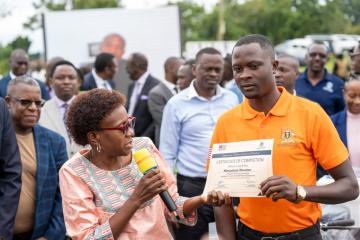


Kampala: Uganda’s ambition to transform Primary Health Care through resilient community health systems entered a decisive phase on 4 March 2026, when a cohort of 348 newly trained Community Health Extension Workers (CHEWs) was passed out in a high-profile ceremony held in Mbarara City and Rukungiri District.
The passing out event marked not only the deployment of a new cohort of frontline health workers but also a tangible milestone in the country’s long journey to fortify Primary Health Care (PHC) and accelerate progress towards Universal Health Coverage (UHC).
The latest deployment brings the national total of trained CHEWs to 5,616, with the Ministry of Health targeting 21,432 CHEWs by 2029 to ensure full parish-level coverage. Mbarara City and District produced 138 graduates, while Rukungiri District added 210. Each CHEW completed six months of competency-based training at a cost of approximately USD 2,100-2,200 per trainee.
CHEWs are now deployed in 40 districts, with expansion planned to 30 more by August 2026. WHO has pledged sustained technical support, from programme design and evaluation to role clarity, emergency preparedness, and supervision frameworks, to ensure Uganda’s community health workforce thrives.
The ceremony was officiated by the Minister of Health, Hon. Dr Jane Ruth Aceng Ocero, and attended by a high-level delegation including the WHO Representative, Dr Kasonde Mwinga; diplomats; national and local leaders; and members of the public. Their presence underscored the growing political commitment and international support for Uganda’s CHEW programme, an initiative years in the making and designed to address longstanding gaps within the existing community health system, which had previously been served only by Village Health Teams (VHTs) introduced in 2001.
Speaking at the ceremony, Minister Aceng hailed CHEWs as the “foundation of a resilient PHC system in communities, where most health challenges originate and can be resolved”, urging them to champion sanitation, hygiene, preventive health behaviours, and timely linkage and referral of community members to care; among other integrated services being offered by the CHEWs.
The newly deployed CHEWs join a programme already showing early success. Since the 2022 pilot in Mayuge, Lira, and Lira City, the CHEW model has contributed to improved immunisation coverage, antenatal care attendance, facility-based deliveries, and early detection of malnutrition compared to districts where the scale-up has not reached. These gains reflect the programme’s implementation science approach, in which district teams, researchers, and stakeholders continually refine strategies based on real-time data.
In her remarks, Dr Mwinga reaffirmed WHO’s commitment to strengthening Uganda’s Primary Health Care architecture. She underscored the role of CHEWs in expanding promotive, preventive, and basic curative services to underserved populations, thereby reducing inequities and improving health outcomes. She further emphasised that the CHEW model aligns with WHO’s global health workforce strategies, noting that Uganda’s persistent distribution gaps make community-level cadres essential to resilient health systems.
However, the CHEWs’ full integration into district and national structures remains a work in progress. The WHO called for stronger coordination platforms, better monitoring tools, and sustainable government-led financing models across all districts.
As the 348 graduates take their posts, they bring renewed hope that Uganda’s long-term vision for a strong, people-centred PHC system is becoming a reality.