
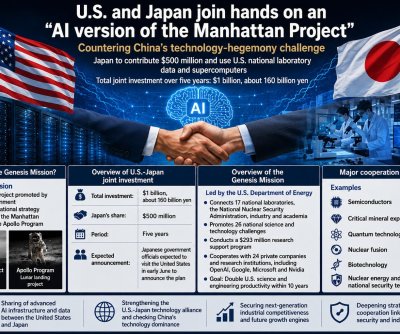


Japan will become the first overseas partner in a major U.S. national artificial intelligence project. The Yomiuri Shimbun reported Monday that the Japanese government has decided to participate in the Genesis Mission, a U.S. national project aimed at using AI to accelerate scientific discovery and technological innovation. Image generated by ChatGPT and translated by UPI
June 1 (Asia Today) — Japan plans to join a major U.S.-led artificial intelligence project as a key overseas partner, tightening technology cooperation between Washington and Tokyo as competition with China intensifies.
The Yomiuri Shimbun reported Monday that the Japanese government has decided to participate in the Genesis Mission, a U.S. national project aimed at using AI to accelerate scientific discovery and technological innovation.
The U.S. and Japanese governments plan to invest a combined $1 billion over the next five years in joint development of AI and related technologies, the report said. Japan is expected to contribute $500 million.
Senior officials from Japan’s Ministry of Education, Culture, Sports, Science and Technology and the Ministry of Economy, Trade and Industry are expected to visit the United States in early June to announce cooperation plans with U.S. Energy Department officials.
Japan is expected to cooperate with the United States in fields including quantum technology, nuclear fusion and biotechnology. For Tokyo, participation would provide access to the vast scientific data, supercomputers and AI research infrastructure accumulated by U.S. national laboratories.
The project is not simply another AI research program. Washington has positioned the Genesis Mission as a national-scale effort comparable in ambition to the Manhattan Project, which developed the atomic bomb, and the Apollo program, which put the first humans on the moon.
The U.S. Energy Department says the Genesis Mission will connect the capabilities of 17 national laboratories, the National Nuclear Security Administration, industry and academia to build an AI-driven scientific platform.
The goal is to combine advanced supercomputers, experimental facilities, AI systems and unique scientific data to shorten the time needed for experiments and calculations that previously required far longer research cycles. The department says the mission aims to double the productivity and impact of U.S. science and engineering within a decade.
The target fields are broad. The Energy Department has announced 26 initial national science and technology challenges for the project, including semiconductors, critical minerals, advanced manufacturing, biotechnology, nuclear energy, quantum information science and national security-related technologies.
In March, the department announced a $293 million funding opportunity to support research tied to the Genesis Mission.
Major U.S. technology companies are also involved. The Energy Department announced collaboration agreements with 24 organizations, including leading AI, semiconductor and cloud computing companies.
The structure brings together government research institutions, supercomputing infrastructure, private AI companies and semiconductor firms on a single national platform.
The U.S. decision to bring Japan into the project carries strong strategic significance. AI competition is no longer limited to chatbots or search services. It is becoming a foundation for national competitiveness in semiconductor design, new materials, nuclear fusion, biotechnology, drug development, critical mineral exploration and military technology.
Washington is seeking to combine allied funding, technology and research talent as China rapidly advances in strategic technologies. Japan, meanwhile, is seeking access to top-tier U.S. research infrastructure to avoid falling behind and to rebuild momentum in advanced industries.
Japan has strengths in semiconductor materials and equipment, precision machinery, quantum technology and nuclear fusion research. The United States has advantages in AI models, cloud computing, supercomputers and national laboratory data.
If the two sides combine those strengths, the effectiveness of a technology alliance aimed at countering China could grow. The move also mirrors recent U.S.-Japan cooperation in missile development and defense, showing how security and industrial policy are becoming increasingly linked.
The cooperation sends a sensitive signal to South Korea. AI, semiconductors, quantum technology, biotechnology, nuclear fusion and critical minerals are all directly tied to South Korea’s future industrial competitiveness.
If Japan becomes the first major international partner in the Genesis Mission, it would show that roles inside the U.S.-led advanced technology order are being defined quickly.
The U.S.-Japan project also shows that global AI competition is moving beyond corporate technology development into a state-level race for scientific and industrial power. As China’s technological rise accelerates, alliance-based competition around AI is likely to deepen.
For South Korea, the window for strategic choices is narrowing.
— Reported by Asia Today; translated by UPI
© Asia Today. Unauthorized reproduction or redistribution prohibited.
Original Korean report: https://www.asiatoday.co.kr/kn/view.php?key=20260601010000136