
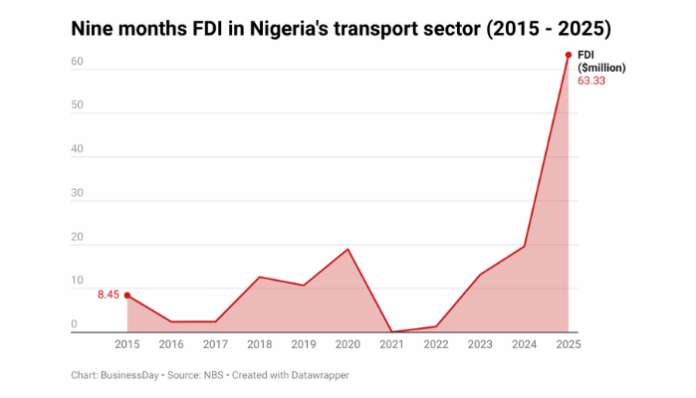


Foreign Direct Investment (FDI) in Nigeria’s transport sector surged to a record decade-high in the first nine months of 2025, according to the National Bureau of Statistics (NBS) third-quarter (Q3) Capital Importation data.
The NBS data showed that foreign investment in the sector rose to $63.3 million in the first nine months of 2025, indicating a 649.11 percent increase from the $8.45 million recorded in the corresponding period of 2015.
The sector pulled investment from various foreign investors into the country’s transport infrastructure, spanning road, rail, and inland water projects.
Who brought what?
In the first half of 2025, the federal government approved a $652 million China Exim Bank financing package for the development of critical road infrastructure, alongside continued progress on the Lagos-Calabar Coastal Highway project.
Read also: Lagos searches for private capital to fund ambitious transport policies
The Lagos state government, backed by the European Union, European Investment Bank, and French Development Agency, is advancing the €410 million Omi Eko water transport project, which aims to integrate ferry services with existing road and rail networks to deliver a seamless, multi-modal transportation system.
The Regional Maritime Development Bank also secured $150 million in financing for shipyard upgrade projects in Nigeria, following the approval of the bank’s establishment by the presidency, to support the modernisation of existing facilities and the construction of new maritime infrastructure.
Also, the planned Green Line metro in Lagos, with construction and technical involvement by Chinese and international firms, is also positioned as a major investment aimed at improving the city’s urban rail network.
Temporary spike, driven by specific deals, others
Obiora Madu, an export consultant and the director-general of the African Centre for Supply Chain, said that the 2025 surge in transport capital importation is temporary rather than structural, and it’s driven largely by specific project-based deals, fleet replacement, logistics expansion, and macroeconomic reforms such as currency stabilisation.
Madu, however, maintained that deep structural weaknesses, including policy inconsistency, regulatory instability, weak institutions, immature PPP frameworks, and massive funding gaps, continue to limit sustained foreign investment in the sector.
“The temporary spike in transport capital importation is obviously not a permanent feature. This spike should be understood only as a positive development driven by specific deals and a better macroeconomic environment.
“Currency stabilisation and macroeconomic reforms form a favourable backdrop for investment. Logistics is expanding every day in Lagos; more people are bringing in capital for it, and replacement of fleet is part of the reason for the capital importation,” he said.
Madu stressed that unless Nigeria strengthens institutional frameworks, ensures policy continuity across administrations, deploys de-risking mechanisms, and shifts toward integrated logistics corridors supported by digitisation and transparent revenue systems, the spike may not be sustainable beyond 2025.
“We need de-risking financial mechanisms and viability gap funding. Instead of standalone projects, we should focus on integrated economic corridors.
“Digitisation, including national single window systems and e-ticketing, will enhance transparency and make projects more predictable and attractive. If we can guarantee cross-administration continuity, then we will see the kind of capital flows we are looking for,” he said.
Read also: Multimodal transport crucial to fixing Nigeria’s struggling supply chain, experts say
Despite being the backbone for moving goods, services, and people, significantly influencing industrial, manufacturing, and agricultural productivity in Nigeria’s economy, the sector attracted low foreign investment compared to other sectors.
While the manufacturing and agriculture sectors consistently brought in millions in foreign investment, transport continues to receive only a marginal share, underscoring persistent gaps in the efficient movement and distribution of goods within Nigeria and across its borders.
The NBS data showed that the manufacturing and agriculture sectors attracted $261.3 million and $24.6 million, respectively, in Q3 2025, significantly higher than the $5.2 million recorded in the transport sector during the same period.
Strengthening infrastructure, other foundation, to attract investors
A research work by Benjamin Olusola Abere and Mohammed Emoabino, titled ‘Transport Infrastructure, Foreign Direct Investment and Economic Growth in Nigeria,’ noted that to attract and sustain foreign direct investment (FDI) in Nigeria’s transport sector, improving the quality of transportation infrastructure must be a top priority.
“The government should implement policies that actively encourage FDI while striking a balance between regulatory oversight, human capital development, and private sector participation,” the report stated.
It stated that rather than focusing primarily on competing with industrialised nations through investment incentives, emphasis should be placed on strengthening physical infrastructure and stabilising interest rates, foundations that can draw both foreign and domestic investors.
“By doing this, these countries would be able to draw in both foreign and domestic investment, contributing to their development,” the report stated.
Juliet Onyema
Juliet Onyema is a transport journalist who reports on Nigeria’s transport and automobile industry. She covers emerging Electric Vehicles (EVs), ranging from adoption to usage, automobile firms and transport policies which affect them, and also recurring trends affecting commuters’ mobility interstate and intrastate.
