
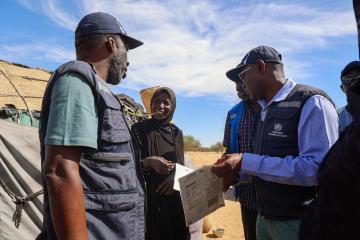


Bassiknou—Long considered a disease of the past, diphtheria continues to affect certain regions of Mauritania. Located in the east of the country, near the border with Mali, the Mbera refugee camp hosts communities particularly exposed, in a context marked by frequent population movements and sometimes difficult living conditions.
In the wilaya (region) of Hodh El Chargui, the disease circulates in an environment where access to healthcare can be limited, families often share cramped spaces and many children have not received all their vaccine doses. Combined with population movements, these factors favour its spread.
Faced with this situation, the Ministry of Health, with support from the World Health Organization (WHO), is working closely with field teams to limit transmission. WHO assists authorities in several regions, helping health workers better recognize and treat diphtheria, protect patients and staff and ensure the availability of essential medicines. It also supports the delivery of care in Fassala and in the Mbera camp, as well as vaccination activities around identified cases.
In this context, Zeinabou, 22, a student at a Quranic school in Mbera, recognized the signs of the disease early enough to seek help. “The pain started simply, then the fever rose and I immediately thought of the cases people were talking about around us,” she explains. This reflex quickly led her to the health centre—a decisive choice in a situation where rapid care saves lives.
Diphtheria is a bacterial infection that mainly affects the throat and respiratory tract. It spreads from person to person through coughing or sneezing. Without prompt treatment, it can cause serious complications or even death. Yet it can be prevented through vaccination, which remains the best protection.
At the Mbera camp health centre, Dr Ghassoum Abdoulaye Wane, chief physician, sees this increase confirmed day after day: behind the numbers, constant pressure weighs on teams and communities, despite a general downward trend in cases since early 2026.
Between 1 January 2025 and 29 March 2026, 1439 confirmed cases and 56 deaths were recorded in Mauritania. Fourteen out of 15 wilayas were affected, with a strong concentration in Hodh El Chargui, which accounted for 862 cases. The Bassiknou district, including the Mbera camp, remains particularly affected, with 602 cases reported.
In the same camp, Khadija, 46, faced the disease within her family. She was caring for her 3 year old niece Salimata when the child fell ill. “Everything happened very quickly. Her throat was swollen, she had a fever and was breathing with difficulty. I immediately took her to the health post, then to the Mbera health centre,” she recalls.
Salimata was hospitalized in a ward reserved for diphtheria patients, where care is free and monitoring is constant. “The caregivers were present day and night. They did everything to reassure us. Some had even learned a few words in our local languages to communicate better with us,” says Khadija. After a week of hospitalization, the child was discharged, fully recovered.
Behind these stories, significant work has gradually been put in place to support affected communities. “Population movements, the high number of unvaccinated children and the pressure on health facilities explain why our district has been particularly affected,” emphasizes Dr Mohamed Souleimane Elemine, chief physician of Bassiknou district.
At the Mbera camp health centre, teams had to adapt quickly. Dr Moussa Sacko, general practitioner, stresses the importance of acting without delay. “As soon as patients arrive, we quickly identify suspected cases. They are directed to dedicated wards and immediately receive the necessary care,” he explains. Despite limited resources, his team treated 602 diphtheria patients between 2025 and March 2026.
Several actions have helped reduce the spread of the disease: better case monitoring, faster treatment, availability of essential medicines such as azithromycin and diphtheria antitoxin, improved protection for caregivers and vaccination of at risk individuals around identified cases. These efforts, supported by WHO, have strengthened the organization of the response on the ground.
According to Dr Charlotte Ndiaye, WHO Representative in Mauritania, these elements are crucial to limiting spread. “The circulation of diphtheria is favored by insufficient vaccination coverage, the presence of ‘zero dose’ children, and frequent population movements. Detecting cases quickly, treating them well and strengthening vaccination helps prevent severe forms and deaths,” she emphasizes.
These efforts have already improved the situation in several districts. In Adel Bagrou, for example, strengthened case surveillance and vaccination campaigns have greatly limited transmission, with only four cases recorded in the past three months. In Bassiknou, more than 23 000 people were vaccinated during a campaign conducted in January 2026.
For Zeinabou, this experience changed her view of prevention: “Before, I didn’t know there was a vaccine against this disease. Today, I talk about it to my family and friends. I tell them to be careful and protect themselves.”
Meanwhile, Khadija often thinks back to the anxious moments at the hospital before seeing her niece running and playing again: “I realized this disease can be serious, especially for children. But I also saw that going quickly to the health centre and following treatment can really make a difference and save our children.”