
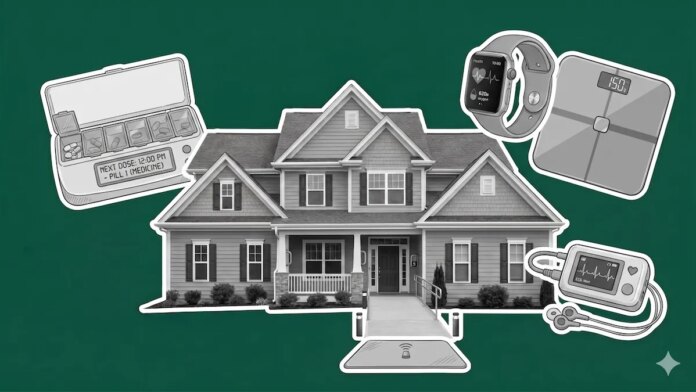


A rapidly aging U.S. population is accelerating demand for smart home technology that allows older adults to remain in their homes longer. Financing options, including the tapping of home equity, are emerging to help pay for it.
Roughly 11,000 Americans turn 65 each day and about one in four U.S. residents is now at least 60 years old — with most people over 50 expressing a preference to stay in their homes, according to AARP.
That is helping fuel the growth of “age tech,” a category that includes smart home systems, health monitoring devices and artificial intelligence tools designed to support independent living, according to a report from The New York Times.
Industry groups told the Times recently that hundreds of companies have entered the space in recent years, raising significant investment as demand grows.
At the same time, housing and health care professionals say that financing these upgrades remains a central challenge — one that could increasingly be addressed through housing wealth.
Experts say that retrofitting a home for aging in place can range from relatively simple modifications to costly installations of connected health systems and monitoring devices. For many homeowners, especially retirees, home equity represents their largest untapped financial resource.
Proceeds from a reverse mortgage or similar equity-based products can be used to install smart home systems, improve accessibility or even move into a more suitable home equipped with these features.
Room for improvement
Dr. Jing Wang, dean of the Florida State University College of Nursing, last year told HousingWire‘s Reverse Mortgage Daily that the U.S. is still catching up when it comes to integrating housing, health care and technology for seniors.
“That number never goes down. It always goes up. Who doesn’t want to stay in their own home and age in their own home?” Wang said of the desire to age in place.
But she emphasized that needs vary widely across age groups and health conditions — and the housing stock is not fully prepared for more advanced care scenarios.
“I think, overall, the U.S. is really underdeveloped to reach the senior care needs for aging in place, which is a spectrum,” she said.
While builders are experimenting with smart home features in new construction, Wang noted that most adoption is still happening through retrofits — often after homeowners move in.
Smart home systems are increasingly stepping in where human caregiving is limited or unavailable.
These tools range from relatively simple devices — such as smart speakers, connected thermostats and video calling platforms — to more advanced systems that monitor health and detect behavioral changes.
About 25% of caregivers now use remote monitoring tools like apps, cameras or wearable devices — nearly double the share from five years ago, according to AARP.
Artificial intelligence is also expanding what these systems can do — from identifying subtle changes in speech or movement to prompting users about medications, hydration or daily routines, the Times said.
Personal stories of independence supported by tech
For many families, these technologies are already making a tangible difference.
Dr. Megan Jack, a neurosurgeon in Cleveland, told the Times that she relies on a suite of smart tools to help care for her 76-year-old mother, who has Alzheimer’s disease and lives in a separate unit on her property.
With a demanding work schedule that often keeps her in surgery for hours, remote access is essential.
“It’s been invaluable that I can both make sure she’s safe and make sure everything is going well, but also give her the independence and the freedom that she still deserves,” Jack told the Times.
Her setup includes a smart pill dispenser, app-controlled television, digital messaging systems and monitoring cameras — all designed to balance safety with autonomy.
Similarly, families are turning to companion technologies for emotional as well as physical support.
Devices like tabletop robots and even robotic pets can provide interaction, reminders and routine — particularly for seniors living alone or with cognitive decline.
In one case, a robotic dog helped an 80-year-old woman with dementia maintain a sense of purpose.
For many older Americans, the combination of home equity and smart technology may ultimately determine whether aging in place is not just a preference — but a practical reality.