
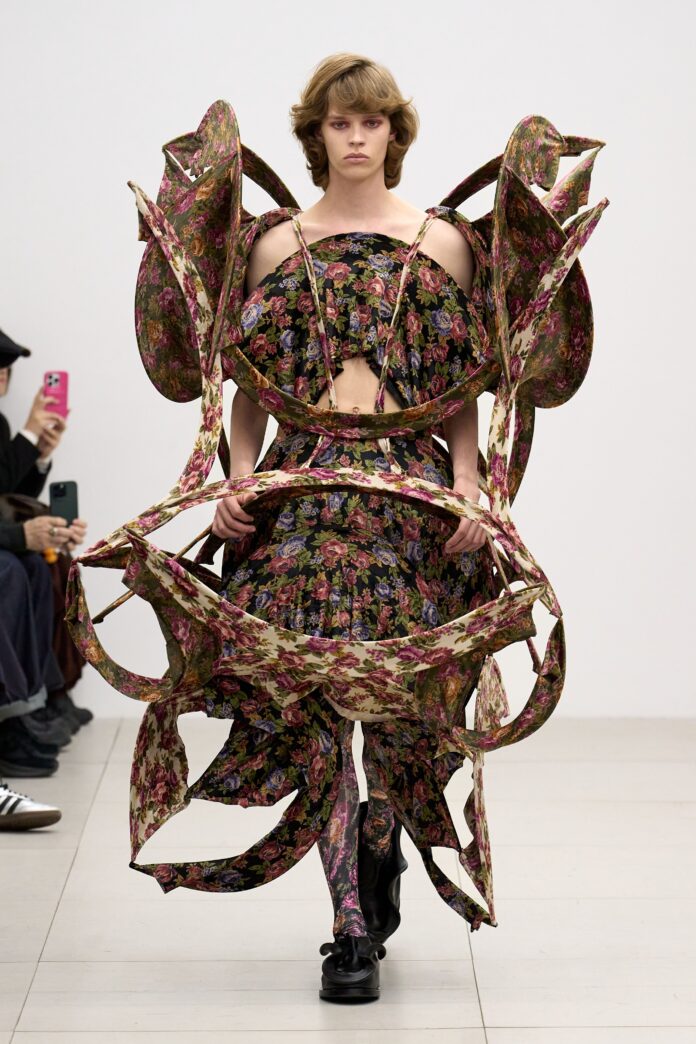


Fresh off an exhibition dedicated to his work at London’s V&A, Ryunosuke Okazaki is back on the runway.
Witnessed in real life rather than in a lookbook, and worn by real people rather than mannequins, the artist-designer’s extraordinary exoskeletons have a visceral, androgynous grandeur to them. The sweeping curves and spikes sometimes appear like armor, but they also convey tenderness; the alien joints jutting out across bare skin expose the softness and fragility of the human form beneath. They also interact with the body in a way that feels genuinely new; notice how the models’ limbs curve or wrap to become part of the sculptures. ‘Wear’ doesn’t quite cover it.
Even so, Okazaki—whose business currently relies on art collectors—has been shifting towards more realistically wearable pieces in recent months. Building on the bags and shoes that made an appearance last time, this season marked his first real foray into ready-to-wear: the green turtleneck sweater with removable boning at the shoulders, and a tube dress with a scythe-like shape across the torso.
The prints were also new. Python and leopard brought in the animal kingdom, a reference to the animism and worship of nature that the designer expresses through his work; while the heritage patterns of tweed and pinstripes evoked the fabrics of traditional garments a whole universe away from what Okazaki makes. The floral pattern in the penultimate look was something he initially found old-fashioned and unappealing. “It felt somewhat nostalgic, like the pattern on my grandmother’s futon,” said Okazaki. “There’s something very human about [florals], like a person trying to print nature onto something.” He spoke of “cherishing” that feeling of rejection. “When I actually made it, it became one of my favorite pieces from this collection, and I felt that hatred could transform into life and then into love,” he said.
Okazaki, who grew up in Hiroshima, describes his work as a prayer for peace. By working more with the body this season, he unlocked a new level of depth on that front. “It’s like I moved from a transcendent, conceptual idea of prayer to something more personal; a prayer inherent in everyday life, as a way of getting closer to people,” he said.
The accompanying music oscillated from dark and foreboding to meditative, inspired by the Japanese concept of ‘kidoairaku’, an idiom that describes the range of human emotion in four parts: joy, anger, sadness, and pleasure. “I want to be honest about what I create,” he said. “And my expression, stemming from a prayer for peace, remains constant whether in fashion or art.” In dark times, his cosmic talent taps into something kidoairaku doesn’t account for: hope.