


Part of the Series
The Road to Abolition
Did you know that Truthout is a nonprofit and independently funded by readers like you? If you value what we do, please support our work with a donation.
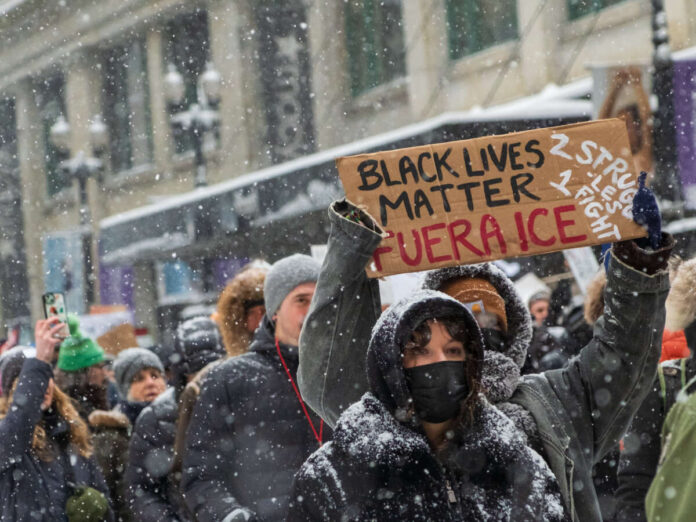
Under Donald Trump, U.S. Immigration and Customs Enforcement (ICE) has started appearing ever more like a private militia, unleashing brutal violence against families and displaying sycophantic loyalty to Trump as he mandates the dehumanizing treatment of immigrants.
In the days since January, when federal immigration agents in Minneapolis, Minnesota, killed 37-year-old Alex Pretti and 37-year-old Renee Nicole Good, it’s not surprising that ICE has begun drawing even more frequent comparison to Hitler’s fascist Brownshirts, the paramilitary wing of the Nazi Party.
As I’ve borne witness to these tragedies, I’ve often thought about how Black people meet this moment with an already-acute sense of what it means to live and die under the U.S.’s fascistic logics. For Black people, there were no killers in brown shirts, but there were plenty of killers in white sheets sanctioned through the support, encouragement, and participation of white law enforcement officers. The depth and complexity of what I’m feeling and thinking about this brutal historical resonance cries out for clarity and truth-telling. It is for this reason that I reached out to Robin D. G. Kelley, who is the Gary B. Nash Endowed Chair in U.S. History at the University of California, Los Angeles (UCLA), and author of several renowned books, including his newest and forthcoming book, Making a Killing: Capitalism, Cops, and the War on Black Life.
George Yancy: Robin, it is always an honor. As you said to Amy Goodman, “Jim Crow itself is a system of fascism, when you think about the denial of basic rights for whole groups of people, the way in which race is operating as a kind of nationalism against some kind of enemy threat, the corralling of human beings in ghettos. I mean, this is what we’ve been facing for a long time.” The point here is that this isn’t new. And we mustn’t forget. In The Black Antifascist Tradition: Fighting Back from Anti-Lynching to Abolition, Jeanelle K. Hope and Bill V. Mullen write, “On December 17, 1951, the US Civil Rights Congress, headed by Communist attorney William Patterson, presented a 240-page petition to the United Nations general assembly, entitled ‘We Charge Genocide.’” The charge of genocide was necessary, as it continues to be, because of the terror of anti-Blackness in this country, a form of terror that renders Black life fundamentally precarious and vulnerable to the forces of gratuitous state violence. I often fail to find the discourse to frame the ongoing history of anti-Blackness in this country. We’re not just talking about anti-Black beliefs and attitudes; it’s anti-Black fascism. I would like for you to talk about how war is an apt concept for critically thinking about the meaning and reality of anti-Blackness in the past and in the present.
Robin D. G. Kelley: Absolutely! No question! Anti-Blackness is foundational to U.S. fascism, which as you acknowledged, not only precedes the so-called “classical” fascism in Italy and Germany, but for Hitler and the Third Reich, a model for the racist and antisemitic Nuremberg laws. By the way, Robyn Maynard, a brilliant scholar/organizer, has an essay coming out in the Boston Review that maps out the history of anti-Blackness in U.S. immigration policies.
“Anti-Blackness is foundational to U.S. fascism.”
To your question, there are so many examples. Beginning in the present, we must never forget that the primary target of the Department of Homeland Security’s “Operation Metro Surge” in Minneapolis and St. Paul was the Somali population, Africans. It didn’t matter that the vast majority were U.S. citizens. Trump denigrated the entire community as “garbage” and declared: “I don’t want them in our country.” If we lived in a country where laws matter, the surge of nearly 3,000 ICE and Customs and Border Protection agents would be a direct violation of the civil rights of the Somali community.
Let’s also remember that the core anti-immigrant dog whistle that both Trump and JD Vance exploited in the run-up to the elections targeted Haitians in Springfield, Ohio, who had temporary protected status. The racist lies that Haitians were eating their (white) neighbors’ dogs (a literal dog whistle!) was strategic and, apparently, it worked.
“We must never forget that the primary target of the Department of Homeland Security’s ‘Operation Metro Surge’ in Minneapolis and St. Paul was the Somali population.”
But we can’t put all of this on Trump. Besides the long, long history of political, economic, military, and discursive war against the Haitian people, I can never erase the image of Haitian asylum seekers who had taken shelter under a bridge in Del Rio, Texas, being violently herded and brutalized by ICE agents on horses, as if they were fugitive slaves. It was the Biden-Harris administration, let’s not forget, that denied Haitians asylum and deported them in record numbers. More Haitians were deported under Joe Biden and Kamala Harris in their first few weeks in office than under Trump during his entire first term. Now, some might argue that Biden and Harris expanded the Haitian Family Reunification Parole Program, which grants “parole” to eligible migrants waiting for visas (dig the carceral language), but all this means is that they were granted temporary protections that forced them into low-wage, precarious work since their status was contingent on having a job, any job.
Let’s come back to the present. We all learned of the horrific murder of 43-year-old Keith Porter Jr. here in Southern California on New Year’s Eve. In case readers don’t know the story, Porter stepped outside his apartment and did what a lot of people do: fired off a few celebratory rounds from his rifle into the sky. Brian Palacios, an off-duty ICE agent who had recently moved into the same complex, wasn’t having it, so he put on his tactical gear, grabbed his weapons, went outside without identifying himself, and fatally shot Porter. The LAPD [Los Angeles Police Department] officers dispatched to the scene never asked Palacios to surrender his weapon, never gave him a sobriety test, didn’t investigate anything, really. The Department of Homeland Security’s liar-in-chief, Tricia McLaughlin, spun the incident as a “brave officer” taking out an “active shooter” after an exchange of gunfire. It just wasn’t true; every eyewitness confirmed there was no “exchange” of fire or hostilities. It was murder.
“If we lived in a country where laws matter, the surge of nearly 3,000 ICE and Customs and Border Protection agents would be a direct violation of the civil rights of the Somali community.”
This happened a week before Renee Nicole Good’s death, and yet Porter’s name is not mentioned among the martyrs of the anti-ICE resistance, except when Black folks complain about it. Not to take anything away from the extraordinary sacrifice made by Good and Pretti, but Porter was not white and he was not killed in the act of trying to stop ICE and protect his neighbors. Whereas Porter, much like George Floyd, was rendered a victim whose worthiness was constantly called into question, Good and Pretti were martyrs with whom it is impossible not to empathize.
Porter’s family and friends were pressed to do what Black families always do when they lose a loved one to state violence: reclaim his character by showing that he was a loving, doting father who called his mother every day, worked hard, and made everyone laugh. They had to make him human, to inform the (white) world that his life had as much value as that of Good and Pretti. It’s tired and should be unnecessary, and to her credit, even Renee Good’s sister, Annie Ganger, felt the need to remind people that the violence that took her sister’s life “isn’t new” and that it was unfair that “the way someone looks garners more or less attention. And I’m so sorry that this is the reality.” Meanwhile, the “brave” ICE agent (whose name the LAPD initially refused to release), it turned out, had a reputation for anti-Black and anti-Latinx racism, [allegations of perpetrating] child abuse, and had once showed up at a youth sporting event armed.
“The movement demanding justice for Keith Porter not only called out the complicity between the LAPD and ICE but also refused to treat federal agents as exceptional.”
The point I’m trying to make here isn’t simply that Keith Porter needs to be acknowledged but rather the violence that stole him from his family not only “isn’t new,” it is routine. As a Black man who was native to Compton, California, he had an invisible target on his back. He knew what it is like to live in a police state. Premature death at the hands of armed agents of the state is merely a hazard of being Black in America. This is why the movement demanding justice for Keith Porter not only called out the complicity between the LAPD and ICE but also refused to treat federal agents as exceptional, insisting that they are part of a larger matrix of state violence encompassing all law enforcement and the military. It’s not enough to “abolish ICE”; we have to abolish the police force and replace it with a radically different form of public safety. With regards to Keith Porter, of course randomly shooting a gun in the air is not safe and should not be permitted, but we have to address the reasons he even owns a gun. He and so many other folks like him just don’t feel safe, and U.S. settler culture is rooted in violence as a first response and guns as the chief instrument of violence. Police simply don’t help. Abolition requires changing the culture, not just eliminating the instruments of the culture.
Assuming that war is an apt concept, what does this mean in terms of how we ought to respond? I ask you this question with sincerity. There are those who will say, “Oh, Yancy must believe in armed struggle on the streets of America.” This would be a non sequitur. There is too much of my mother’s Christian sensibilities in me to hold this position. Indeed, I try, I struggle, to manifest agape (the sense of unconditional neighborly love) toward all human beings. But I love my children as you love your daughter. Indeed, for me, that love refuses a form of hospitality that facilitates their harm. I can’t possibly stand by when the Brownshirts come hammering at the door with fascistic bloodlust in their eyes. Here I’m reminded of Claude McKay’s poem, “If We Must Die.” Toward the end he writes:
O kinsmen! we must meet the common foe!
Though far outnumbered let us show us brave,
And for their thousand blows deal one death-blow!
What though before us lies the open grave?
Like men we’ll face the murderous, cowardly pack,
Pressed to the wall, dying, but fighting back!
I appreciate your invocation of Claude McKay. As you know, that poem is almost always cited as an expression of the so-called New Negro, the spirit of defiance that suddenly erupts in the wake of World War I and the “Red Summer” of 1919. But this is a misnomer since Black communities had been practicing armed self-defense since they were dragged to these shores. Armed self-defense is the tradition; nonviolent civil disobedience is the rupture, the break with the past. The historical record is clear and unambiguous, as we’ve seen in the writings (memoirs and scholarship) of Robert and Mabel Williams, Akinyele Umoja, Charles E. Cobb Jr., Kellie Carter Jackson, Lance Hill, Jasmin Young, Nicholas Johnson, Simon Wendt, and many others. These writers have shown us, time and time again, that African Americans have a very long and surprisingly successful tradition of armed self-defense against mob violence. Armed self-defense has saved countless lives.
“It’s not enough to ‘abolish ICE’; we have to abolish the police force and replace it with a radically different form of public safety.”
To be fair, militant nonviolent civil disobedience also courageously faces “the murderous, cowardly pack” and is undeniably “fighting back.” But Dr. Martin Luther King Jr.’s first impulse to keep a pistol by his bedside during the Montgomery bus boycott to protect his family against organized, state-sanctioned mob violence made perfect sense. You can’t win the racist mob or the brownshirts over with love, certainly not in the midst of war. This is why I find those commercials featuring an ICE agent who comes home to his kids and has his conscience suddenly pricked by a child’s query so frustrating, naïve, and ineffectual. If conscience mattered, the faces and screams of the people they brutalized, the lives they took, and the loved ones who had to bear witness would have convinced most of these dudes to quit their jobs long ago.
This kind of terror is not new; ICE and Border Patrol agents have been behaving like this for decades. Stephen Miller didn’t have to tell them what to do. Restraint must come before reeducation and redemption, and imposing restraint is impossible without consequences and accountability. As Dr. King said repeatedly in various speeches, “It may be true that the law cannot make a man love me, but it can restrain him from lynching me, and I think that’s pretty important also.”
War is certainly an apt concept here. It is how I frame the assault on Black people in my forthcoming book, Making a Killing: Capitalism, Cops, and the War on Black Life. As I write in the book, “Policing is war by another name…. Whether we call it a war on crime, a war on militants, a war on drugs, law enforcement at every level has turned many Black neighborhoods into killing fields and open-air prisons, stripping vulnerable residents of equal protection, habeas corpus, freedom of movement, even protection from torture.” But as the anthropologist Orisanmi Burton put it in his book, Tip of the Spear: Black Radicalism, Prison Repression, and the Long Attica Revolt, this is not a war we chose. He refers to sites of incarceration as “sites of counter-war,” which can be extended to virtually all Black and Black-led resistance to injustice, mob rule, criminalization, state violence, exploitation, and the very conditions that make Black people vulnerable to premature death. This counter-war holds out the possibility of freeing everyone, including those recruited to maintain systems of domination.
That said, I think the debate over whether we’re ready to go to war is a false debate because we’re already at war. We were at war before Trump came into office, before the neoliberal turn, before Jim Crow, before all of that. It begins with the kidnapping and trafficking of our African ancestors, and the violent dispossession of our Indigenous ancestors. Both processes fall under the category of genocide. John Brown was right to call American slavery “a most barbarous, unprovoked, and unjustifiable war of one portion of its citizens upon another portion.” These wars are fundamentally about turning flesh and earth into property, and whole peoples into combatants and commodities.
“Revolutionary pessimism is accompanied by what surrealist André Breton termed ‘anticipatory optimism’ — the commitment to struggle in dark times and preparing to prevail.”
We have to consider the centuries of continuous, protracted war. Once we acknowledge the reality of protracted war and counter-war, then we have to stretch our definition of “armed struggle.” In this asymmetrical war, guns are not the only weapons. Arson has been a weapon of the enslaved in their own counter-war against Christians holding them in bondage. Minneapolis is where they burned down the police station. Civil resistance has taken on so many forms that don’t fall neatly under traditional categories of “violence” or nonviolence, and have revealed the wide arsenal of “arms” people have deployed in struggle.
Again, in Making a Killing, which is as much if not more about collective resistance (counter-war) than acts of state violence (war), I write about rebellion in Cincinnati, Chicago, Louisville, St. Louis, New York, and elsewhere, and building on the work of Akinyele Umoja, who wrote We Will Shoot Back, I chart the tradition of armed self-defense in Mississippi in light of the police-perpetrated killing of Jonathan Sanders in 2015. Once we acknowledge the long war and redefine armed struggle, we’ll recognize that we’re already in it. We have to figure out what to do, how to strategize, and what it means when casualties of war are white people — which, of course, is not a new thing. It’s a rare thing and ebbs and flows, depending on the extent to which white people see this as their fight.
Your book Freedom Dreams: The Black Radical Imagination was published in 2002. That was 24 years ago. For many, it is no doubt hard to dream, and I mean this both literally and figuratively. There are times when I try to fall asleep at night and I become obsessed with a singular nightmare: the creation of private militias that have state approval to throw me in jail for writing something or for refusing to embrace Trump’s fascism or our having this discussion. I see hordes of Black people being shot in the streets with impunity. I see so many people being disappeared. I see American-style gulags. I see the complete disregard and overthrow of the Constitution where there are no checks and balances, where there is no longer a two-party system, where due process is nonexistent, and there are literally no exits out of this country. I see my neighbor turning me in because I expressed hatred toward white supremacy and shouted, “Love First!” over “America First!” In this case, perhaps all of those who care about freedom, community, their neighbors, and the importance of democracy “will find out,” as Trump said about Chicago, “why it’s called the Department of WAR.” I believe in the power of movements, but Trump is malicious and I have no doubt that he would, if given the opportunity (perhaps I should say, when given the opportunity), unleash the full might of the Department of War on us. How do we continue to dream, Robin, to have freedom dreams, when the U.S. continues to amplify the reality of dystopic nightmares?
I feel you. I also know we’ve been through worse. A “private militia” (read: mob and police) with “state approval to throw me in jail for writing something” or challenging the status quo by, say, trying to vote, or “hordes of Black people being shot in the streets with impunity,” and “American-style gulags” (keeping in mind how many gulags were actually modeled on U.S. convict labor camps) — and now we’re talking about Meridian, Mississippi (1871), Colfax, Louisiana (1873), Wilmington, North Carolina (1898), New Orleans, Louisiana (1900), Atlanta, Georgia (1906), Springfield, Illinois (1908), East St. Louis, Illinois (1917), Elaine, Arkansas (1919), and, as you and I discussed at length back in 2021, Tulsa, Oklahoma (1921). We have been here. But I understand that to say what’s happening now has happened before, sometimes worse, gives us little comfort.
I do want to make a case for the value of “freedom dreams” in times like these. I’m always reminding readers that what I called the Black radical imagination is not wishful thinking, not an escape from reality, not some kind of dream state conjured and nurtured independent of the day-to-day struggles on the ground. The main point of the book is that the radical visions animating social movements are forged in collective resistance and a critical, clear-eyed analysis of the social order. In fact, in the 20th-anniversary edition which came out in 2022, I underscore this point, writing, “The book does not prioritize ‘freedom dreams’ to the exclusion of ‘fascist nightmares.’ If anything, I show that freedom dreams are born of fascist nightmares, or, better yet, born against fascist nightmares.” The context in which I wrote it, the early Bush years, was decidedly an era of dystopic nightmares: a wave of police killings, culminating in the massive response to the murder of Amadou Diallo, 9/11, wars in Afghanistan and Iraq, accelerating neoliberalism, and so forth. Moreover, the movements I explore imagined freedom in the darkest of times: Black Exodus out of an Egyptland of lynching, disfranchisement, new forms of slavery, and segregation; Black embrace of socialist revolution at the height of fascism, global economic crisis, and anti-communism; and Black radical feminism in a moment of heightened sexual violence, femicide, carceral expansion, and an increasingly masculinist Black freedom movement.
In other words, all of these movements were fueled not by false optimism but by a deep understanding of the death-dealing structures of gendered racial capitalism. Freedom dreaming, as it were, is not a luxury; our survival as a people depends on envisioning a radically different future for all and fighting to bring it into existence. The fight or the struggle is precisely how visions of the future are forged, clarified, revised, or discarded.
I just mentioned the power of movements. Coming back to Freedom Dreams, you argue that that there is more that is needed to fight for freedom than organized protest, marches, sit-ins, strikes, and slowdowns. For you, surrealism is also necessary. You write, “Surrealism recognizes that any revolution must begin with thought, with how we imagine a New World, with how we reconstruct our social and individual relationships, with unleashing our desire and building a new future on the basis of love and creativity rather than rationality (which is like rationalization, the same word they use for improving capitalist production and limiting people’s needs).” When I read that passage again, I thought of the power of poiesis — that sense of creation or that sense of bringing something that is radically new into being. Speak to how surrealism continues to inform your understanding of liberation and perhaps even hope amid so much fear, pain, anger, and perhaps, like for me, nightmarishness.
Really great question, one I continued to ponder after writing Freedom Dreams. A critical argument I make in that chapter and elsewhere is that the Africans across the diaspora had been practicing or living surrealism long before Europeans named it. I gave examples, one being the blues. I left it undeveloped in the book, but since then have been thinking about the blues alongside Amiri Baraka, Toni Morrison, Hazel Carby, Fred Moten, Daphne Brooks, the brilliant geographer Clyde Woods, and French surrealist whom I don’t mention in Freedom Dreams, Pierre Naville. The blues, not just as music but epistemology, can be defined as a clear-eyed way of knowing and revealing the world that recognizes the tragedy and humor in everyday life, as well as the capacity of people to survive, think, and resist in the face of adversity — or, in your words, so much fear, pain, anger, and nightmarishness. True, rising nationalism, xenophobia, authoritarianism, militarism, neoliberalism, and the relative weakness of contemporary mass movements offers little reassurance that a liberated future is on the horizon. But the blues, as with the Black radical imagination, resists fatalism and inevitability. It demands and narrates action.
“We need to be abolition communist feminists. We are not only demolishers of worlds, we are builders.”
This is where I find Pierre Naville helpful. A founding member of the Paris Surrealist group and one of the first to join the Communist Party, in 1926 he published a pamphlet titled “The Revolution and Intellectuals,” which argued, among other things, that pessimism was not a reason for despair, withdrawal, melancholy, or bitterness. What he called the “richness of a genuine pessimism” (which he traced to Hegel’s philosophy and “Marx’s revolutionary method”) requires action and must take political form. Naville’s revolutionary pessimism was a critique of the optimism of Stalinist assertions about the inevitable triumph of socialism in the Soviet Union and the imminent fall of capitalism. It was also a critique of the “shallow optimism” of social democrats who believed that they could eventually vote their way into creating a socialist commonwealth. His revolutionary pessimism was not fatalistic resignation or an obsession with the “decline” of elites or nations or Western civilization. Rather, it was a call for collective revolutionary action by, and on behalf of, the oppressed classes. Revolutions are not inevitable, nor do they correspond with particular objective conditions. People just don’t have the luxury to wait for the “right conditions.” Instead, movements must interrupt historical processes leading to catastrophe, by any means necessary. It is not enough to “hope,” we must be determined.
Revolutionary pessimism, therefore, is accompanied by what surrealist André Breton termed “anticipatory optimism” — the commitment to struggle in dark times and preparing to prevail. I am hesitant to say “win” because, as I’ve written elsewhere, assessing movements only in terms of wins and losses obscures the power of movements to inform and transform us. Here is the power of poiesis, of making new worlds and new relationships — not from nothing but from love — rather than reforming or bandaging old systems. So we come full circle. It is not enough to be anti-capitalist and/or anti-prisons and police, to beat back a half-millennium of catastrophe. We need to be abolition communist feminists. We are not only demolishers of worlds, we are builders. As Ruth Wilson Gilmore once told an interviewer, “Abolition is figuring out how to work with people to make something rather than figuring out how to erase something…. Abolition is a theory of change, it’s a theory of social life. It’s about making things.”
A terrifying moment. We appeal for your support.
In the last weeks, we have witnessed an authoritarian assault on communities in Minnesota and across the nation.
The need for truthful, grassroots reporting is urgent at this cataclysmic historical moment. Yet, Trump-aligned billionaires and other allies have taken over many legacy media outlets — the culmination of a decades-long campaign to place control of the narrative into the hands of the political right.
We refuse to let Trump’s blatant propaganda machine go unchecked. Untethered to corporate ownership or advertisers, Truthout remains fearless in our reporting and our determination to use journalism as a tool for justice.
But we need your help just to fund our basic expenses. Over 80 percent of Truthout’s funding comes from small individual donations from our community of readers, and over a third of our total budget is supported by recurring monthly donors.
Truthout’s fundraiser ends tonight! We have a goal to add 130 new monthly donors before midnight. Whether you can make a small monthly donation or a larger one-time gift, Truthout only works with your support.