
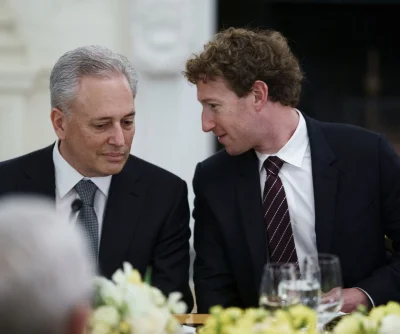


1 of 5 | White House crypto czar David Sacks and Meta CEO Mark Zuckerberg (R) attend a dinner hosted by President Donald Trump with tech leaders at the White House in September. Zuckerberg testified Wednesday in a trial that will decide if his platforms intentionally addict kids. File Photo by Will Oliver/UPI | License Photo
Feb. 18 (UPI) — Meta CEO Mark Zuckerberg said he consulted different stakeholders about well-being when making decisions about social media, but ultimately decided that banning beauty filters would be “paternalistic.”
Zuckerberg testified Wednesday in a lawsuit in Los Angeles filed by a 20-year-old woman called KGM in the suit and her mother, Karen Glenn, who claim the platforms damaged her mental health as a child. It’s the first in a group of lawsuits brought by 1,600 parents, teens and school districts who allege that when teens are addicted to the platforms, they suffer from depression, self-harm, eating disorders and more.
KGM, also known as Kaley in the suit, began using YouTube at age 6 and Instagram at 9, said her lawyer, Mark Lanier. Despite her mother’s efforts to mitigate her social media use, Kaley sometimes used Instagram for “several hours a day.” The app’s addictive features led her to develop anxiety, body dysmorphia and suicidal thoughts, she alleges. She was also the victim of bullying and sextortion.
“We get feedback from a handful of different stakeholders, including people who study well-being,” CNN reported Zuckerberg said. “I took into account all of that info and I think I navigated this in a reasonable way.”
When Zuckerberg was pressed about the use of beauty filters, he agreed with Lanier that he likely said that banning them “feels a little overbearing,” CNBC reported.
When asked about a study by the University of Chicago in which 18 experts said that beauty filters cause harm to teenage girls, Zuckerberg said it came down to free expression.
He also argued against the idea that the company wanted people to spend more time on the app.
The lawyers mentioned evidence from Instagram chief Adam Mosseri that included goals to boost user engagement time to 40 minutes in 2023 and 46 minutes in 2026.
Zuckerberg responded that the company uses milestones to measure against its competition and “deliver the results we want to see.”
He said the company builds services to help people connect.
Zuckerberg said that children younger than 13 are not allowed on the platform, despite the plaintiffs’ allegations that she became a member at age 9.
But Lanier presented an internal document from 2015 that estimated more than 4 million users were under 13, which it said was “30% of all 10- 12-year-olds in the U.S.”
Instagram began asking new users to confirm they were 13 or older in December 2019, Lanier said.
During a break, Julianna Arnold told reporters it was “surreal” to see Zuckerberg testify, after years of asking the company to make changes. Arnold believes Instagram caused the death of her daughter Coco, 17.
“The intention of the company was to prey on teens … exploit them so they can make greater profits,” Arnold said. “That was done intentionally, not by accident.”
A Meta representative said earlier that the company strongly disagrees with the allegations brought in the lawsuit.
“The question for the jury in Los Angeles is whether Instagram was a substantial factor in the plaintiff’s mental health struggles,” CNN reported a Meta representative said in a statement. “The evidence will show she faced many significant, difficult challenges well before she ever used social media.”
The company said it is “confident the evidence will show our longstanding commitment to supporting young people.”
Plaintiffs’ lawyers in the cases say internal documents at the companies stress the goal of making apps difficult to put down like infinite scroll, auto-play, likes, beauty filters and push notifications.
“These companies built machines designed to addict the brains of children,” lawyer Mark Lanier said in his opening statements, NPR reported. “And they did it on purpose.”
The trial is in state court, which means there only needs to be nine of the 12 jurors in agreement. If Kaley and her mother win, it could lead to settlements in the other cases.