
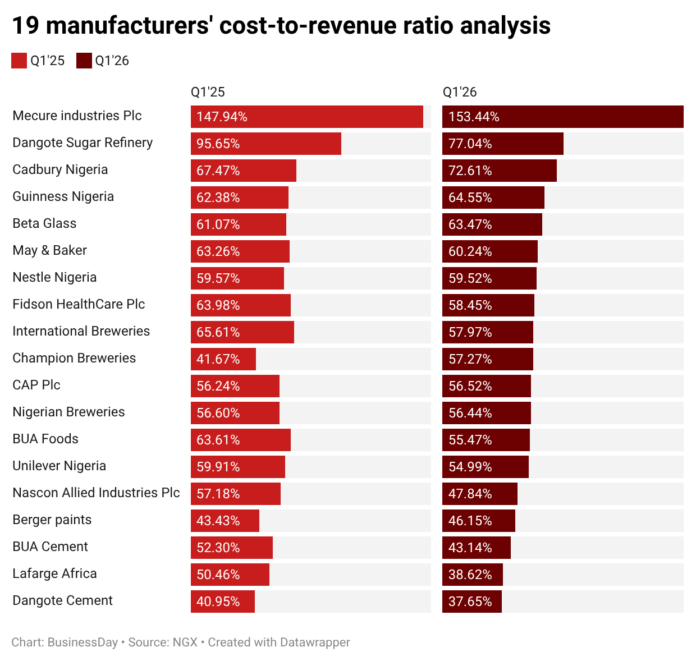


Manufacturers in Nigeria saw a temporary easing in cost pressures in the first quarter of 2026, offering a modest reprieve after months of elevated production expenses.
But the relief may prove short-lived as rising energy prices and renewed inflationary pressures begin to squeeze input costs again, raising fresh concerns over pricing, profitability, and consumer demand in the months ahead.
An analysis of 19 companies’ first-quarter financial statements shows that the combined cost-to-revenue ratio declined to 46.68 percent in Q1 2026 from 52.50 percent in Q1 2025, indicating that firms spent less of every naira earned on production, despite a difficult operating environment.
The firms are Dangote Cement, Lafarge Africa, BUA Cement, Nestle Nigeria, Unilever Nigeria, Cadbury Nigeria, BUA Foods, Nascon Allied Industries Plc, Dangote Sugar Refinery, and Nigerian Breweries.
Others include International Breweries, Champion Breweries, Guinness Nigeria, CAP Plc, Berger Paints, Beta Glass, Fidson HealthCare Plc, Mecure Industries Plc, and May & Baker.
In absolute terms, the companies’ combined production costs rose to N2.32 trillion from N2.23 trillion, while revenue increased to N4.97 trillion from N4.4 trillion, bringing the combined profit to N1.24 trillion from N795 billion, lifting the aggregate net profit margin to 24.95 percent from 18.07 percent.
Read also: Africa’s most coveted asset attracts $2bn in private placement demand
The cost-to-revenue ratio measures how much of a company’s revenue is consumed by production costs. Using the aggregate figures, the 19 firms spent 46.68 kobo to generate every N1 of revenue in Q1 2026, compared to 52.50 kobo to generate every N1 of revenue in Q1 2025.
But a rising inflation that surged for the second consecutive time to 15.69 percent in April 2026, up from 15.38 percent in March, may begin to pose a threat to manufacturers’ input costs and, by extension, fuelling more inflationary pressures as producers resort to aggressive pricing.
The uptick, though modest on paper, carries significant weight in an economy still grappling with the aftershocks of sweeping reforms, volatile energy costs, and weakening household purchasing power.
The escalation in tensions involving Iran and the United States has also heightened concerns over oil prices, shipping disruptions, and freight costs, all of which could affect second-quarter production costs.
Segun Ajayi-Kadir, secretary-general of the Pan-African Manufacturers Association (PAMA), said manufacturers now need stronger working capital discipline, revenue diversification, cautious debt exposure, and supply chain flexibility to navigate prolonged macroeconomic uncertainty.
“Q1 has delivered a transition phase, and for African manufacturers, the verdict is clear: the companies that move earliest and most deliberately from passive endurance to active strategy will be the ones that emerge from this period with market share, margin, and competitive distance from rivals still waiting for conditions to improve,” he said.
Firms with a lower production burden
Across the 19 firms surveyed, Dangote Cement recorded the highest production cost, spending N448 billion in Q1 2026, up from N407 billion in Q1 2025. However, the company maintained the lowest cost-to-revenue ratio among the large manufacturers at 37.65 percent, improving from 40.95 percent a year earlier.
This means the company spent less than 38 kobo of every N1 generated on production. Its net profit margin rose to 26.97 percent from 21.03 percent.
BUA Foods, despite reducing production cost to N218.9 billion from N281.2 billion, reported a stronger profit performance. Revenue declined to N394.6 billion from N442.1 billion, but profit rose to N142.3 billion from N125.2 billion. Its cost-to-revenue ratio improved to 55.47 percent from 63.61 percent, while net profit margin rose to 36.06 percent from 28.32 percent.
Read also: Nigerian banks lose N2.5tn in annual earnings to CBN’s high CRR
Dangote Sugar Refinery also recorded a sharp reduction in production cost to N144.6 billion from N204.6 billion. Revenue declined to N187.7 billion from N213.9 billion, but the company returned to profit with N19.1 billion, compared with a N23.6 billion loss in the prior year period. Its cost-to-revenue ratio improved to 77.04 percent from 95.65 percent, while net profit margin moved to 10.18 percent from negative 11.03 percent.
Among smaller firms, Berger Paints maintained one of the lowest production cost burdens, with its cost-to-revenue ratio rising slightly to 46.15 percent from 43.43 percent.
Its net profit margin improved to 13.49 percent from 10.40 percent, showing that profit growth outpaced cost increases.
Lafarge Africa, posted the strongest efficiency improvements, with its cost-to-revenue ratio dropping to 38.62 percent from 50.46 percent.
Its net profit margin increased to 29.15 percent from 19.57 percent, reflecting stronger cost control relative to sales growth.
BUA Cement also recorded a major efficiency gain, reducing its cost-to-revenue ratio to 43.14 percent from 52.30 percent.
This translated into one of the highest profitability outcomes, with net profit margin rising to 49.68 percent from 27.89 percent.
Firms where production costs remained elevated
At the opposite end, Mecure Industries posted the highest production burden, with its cost-to-revenue ratio rising to 153.44 percent from 147.94 percent, indicating production costs exceeded revenue.
Despite this, its net profit margin improved to 10.23 percent from 6.32 percent, suggesting gains from non-production income lines.
Cadbury Nigeria saw pressure intensify, with its cost-to-revenue ratio worsening to 72.61 percent from 67.47 percent.
Its net profit margin declined to 9.12 percent from 16.05 percent.
Brewers show mixed cost performance
Among brewers, performance diverged.
Nigerian Breweries maintained a stable cost structure, with its cost-to-revenue ratio at 56.44 percent from 56.60 percent, while net profit margin improved to 13.54 percent from 11.60 percent.
International Breweries improved cost efficiency, reducing its cost-to-revenue ratio to 57.97 percent from 65.61 percent, but net profit margin fell to 10.97 percent from 16.88 percent.
Guinness Nigeria moved in the opposite direction, with its cost-to-revenue ratio increasing to 64.55 percent from 62.38 percent, although net profit margin improved to 8.39 percent from 5.93 percent.
Champion Breweries saw production pressure rise sharply, with its cost-to-revenue ratio increasing to 57.27 percent from 41.67 percent, while net profit margin recovered to 6.16 percent from negative 2.52 percent.
Consumer goods and healthcare firms record mixed outcomes
Nestle Nigeria’s cost-to-revenue ratio remained stable at 59.52 percent from 59.57 percent, while net profit margin improved to 11.93 percent from 10.21 percent.
Unilever Nigeria improved efficiency, with its cost-to-revenue ratio declining to 54.99 percent from 59.91 percent, while net profit margin remained largely unchanged at 11.88 percent from 11.83 percent.
Nascon Allied Industries improved to 47.84 percent from 57.18 percent, with net profit margin rising to 25.14 percent from 18.11 percent.
Fidson Healthcare improved its cost-to-revenue ratio to 58.45 percent from 63.98 percent, while net profit margin increased to 10.70 percent from 9.28 percent.
May & Baker reduced its cost-to-revenue ratio to 60.24 percent from 63.26 percent, with net profit margin rising to 15.12 percent from 12.00 percent.
Q2 numbers to reflect the global tension impact
Ajayi-Kadir, PAMA’s secretary-general, has expressed concern about the future of manufacturing in Nigeria and across Africa amid escalating global tensions and attendant disruptions to production and costs.
While he had hoped that Q2 would deliver respite and recovery, the current reality falls far short of expectations.
Across the continent, the convergence of persistent supply chain disruptions, elevated borrowing costs, volatile exchange rates and suppressed consumer demand is forcing industry players to decide whether to continue absorbing shocks or begin building new systems to circumvent them.
“The operating environment offers little comfort. Global manufacturing activity remains subdued, with purchasing managers’ indices hovering around the 50-point threshold that separates expansion from contraction. The World Trade Organisation (WTO) projects global trade growth of just 1.9 percent for the year, weighed down by energy price uncertainty and geopolitical tensions,” he said.
Against this backdrop, African manufacturers are facing domestic challenges of their own, he said.
Revealing that West Africa remains the most acutely pressured subregion, he said the inflation decline in Nigeria and Ghana masks the structural persistence of high factory-floor costs.
Currency depreciation across markets has driven up the cost of imported raw materials, machinery, and capital goods, a burden Ajayi-Kadir said falls hardest on manufacturers with deep import dependence and limited FX access.
“High interest rates are compounding the challenge. Kenya held rates broadly within the 8.75 to 9 percent range through Q1, while Egypt implemented a modest reduction from 20 to 19 percent.
“Despite the adjustments, borrowing costs across the continent remain elevated, constraining access to credit and curtailing the capital investment that growth in manufacturing output would ordinarily require,” he said.
Chinwe Michael
Chinwe Michael is a financial inclusion advocate and economy journalist who uses compelling storytelling to drive awareness. With a background in Banking and Finance and experience across accounting, media, and education, she applies sharp analysis and attention to detail to every piece. She simplifies complex financial and economy concepts into engaging content for Africa and global audience. Chinwe also doubles as a speaker with global recognition for her expertise.
