

Wednesday, January 14, 2026

Select a plan

Support Independent African Journalism – Become a Donor Member

Monthly plan

$
10
$
0
billed monthly

Yearly plan

$
$
0
billed yearly

As a supporter, you’ll get:

  • Priority Support
  • Unlimited Access
  • Exclusive Content
  • Stay Informed
  • Member Perks
  • Subscriber Benefits
  • Recognition
  • Member Shout-Outs
  • Exclusive Deals & Offers

Search for an article

HomeWorld NewsKey Insights of the DMEC Market Report on Innovative Offshore Renewable Energy...

Key Insights of the DMEC Market Report on Innovative Offshore Renewable Energy Technologies

Published on

Home News Key Insights of the DMEC Market Report on Innovative Offshore Renewable Energy Technologies

August 22, 2025,
posted by

Offshore-Energy.biz

DMEC’s 2024/2025 Market Report Chapter 1 on Innovative Offshore Renewable Energy Technologies offers a unique and comprehensive overview of the latest innovations and their global developments. It includes insights on the key following offshore renewable energy technologies: tidal, wave, offshore solar, offshore floating wind energy (and salinity gradient & ocean thermal energy conversion (OTEC)).

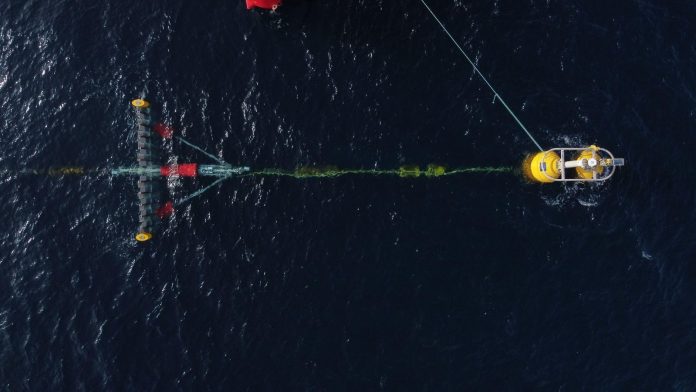
Photo by Wavepiston

The report is designed to guide strategic decisions across the sector, for project developers and utility companies, supply chain companies, innovators, as well as policy makers. Topics covered in the report include an overview of the status of global markets on ORE technologies, 8-10 key innovators per technology, as well as scenarios provided through DMEC’s models on how technology-, market developments and costs can develop until 2025.

Offshore solar
With rapid development in the last 2 to 3 years, global capacity of offshore solar energy is expected to grow to 40MW in 2030. The market is dominated by some European as well as a few Asian countries. Following DMEC’s modelling forecast, the LCoE is expected to reach a commercially viable level of EUR 100/Mwh between 2030 – 2032, at a learning curve of 17%. The biggest challenge in the sector is the proof of a cost efficient design in combination with survivability in the harsh offshore climate.

Tidal energy
With steadfast support of France and the UK, tidal energy has been pushed towards commercial feasibility. The first CfD in the UK for 122 MW has reached a price of EUR 176/Mwh to be deployed by 2029. Additional allocated capex support by France and the EU putting direct subsidies in place, has led to DMEC’s forecasted 320 MW of tidal energy deployment by 2030. Reaching this capacity could bring the LCoE around EUR 120/Mwh. Continuous support over the next 5 years and Europe remaining in the lead of most promising innovations, could see the growth of a multi-billion dollar EU industry.

Wave energy
After a long domination of Europe, the US started to invest heavily in wave energy projects with a budget of more than $112 Mil launched in 2024. Wave energy also gained significant traction in specialised markets like water desalination, powering of oil & gas platforms and charging of underwater vehicles. These can be a beachhead market for the larger utility scale. 2024 was a record year with more than € 60 Mil invested into wave energy. If this positive trend continues and stronger national support of additional champion countries manifests, DMEC’s modelling forecast leads to 30 GW of deployments by 2050 and a LCoE below € 100/MWh by 2036.

Floating wind energy
For floating wind, the UK, Japan, France, Ireland, Spain, Italy and Greece appear this year as the most supportive countries. China meanwhile commissioned the so-far-largest capacity installed on one floater. DMEC’s market forecast based on bottom-fixed offshore wind historic data keeps matching the market data relatively well predicting 2 GW of floating offshore wind in 2030 and up to 50 GW by 2040. Those capacities would lead to a LCoE of 121-170 €/MWh and 60-90 €/MWh respectively.

This chapter on Offshore Renewable Energy Technologies, as well as the upcoming chapters on System Integration and Nature+ Solutions, are complimentary for clients in DMEC’s Partnership Program. The chapter is also for sale via the DMEC website here. For more information on the Partnership Program and the market report, please contact DMEC’s Business Development Manager Claudia Stolk via [email protected]

Note: The opinions, beliefs, and viewpoints expressed in this article do not necessarily reflect the opinions of Offshore-Energy.biz

Latest articles

No power, no phone, no radio: why comms dropped out during the central Victorian fires

Australia has entered an era of climate instability, where communications during bushfires and extreme weather must perform under increasingly severe conditions. Digital services such as the VicEmergency app and mobile fire alerts have become central to how people receive bushfire warnings. They work well in everyday conditions, but rely on mobile phone coverage and household

This TikTok star sharing Australian animal stories doesn’t exist – it’s AI Blakface

The self-described “Bush Legend” on TikTok, Facebook and Instagram is growing in popularity. These short and sharp videos feature an Aboriginal man – sometimes painted up in ochre, other times in an all khaki outfit – as he introduces different native animals and facts about them. These videos are paired with miscellaneous yidaki (didgeridoo) tunes

Prioritising protein? What the new US dietary guidelines get right – and wrong – according to 2 nutrition experts

Last week, United States health secretary Robert F. Kennedy Jr released the government’s revamped dietary guidelines for 2025 to 2030. These recommendations on healthy eating are updated every five years and help shape food policy and education for millions of Americans. Under the slogan “eat real food”, the new guidelines recommend people “prioritise protein at

Trump wants to cap credit card interest to 10% for a year. Should Australia consider it?

US President Donald Trump has called for a one year cap on credit card interest rate charges at 10% – around half of the average current US rate – starting from January 20. Vanderbilt University analysis from September last year found there were “astronomical profit margins in the [US] credit card market”. It concluded a

More like this

No power, no phone, no radio: why comms dropped out during the central Victorian fires

Australia has entered an era of climate instability, where communications during bushfires and extreme weather must perform under increasingly severe conditions. Digital services such as the VicEmergency app and mobile fire alerts have become central to how people receive bushfire warnings. They work well in everyday conditions, but rely on mobile phone coverage and household

This TikTok star sharing Australian animal stories doesn’t exist – it’s AI Blakface

The self-described “Bush Legend” on TikTok, Facebook and Instagram is growing in popularity. These short and sharp videos feature an Aboriginal man – sometimes painted up in ochre, other times in an all khaki outfit – as he introduces different native animals and facts about them. These videos are paired with miscellaneous yidaki (didgeridoo) tunes

Prioritising protein? What the new US dietary guidelines get right – and wrong – according to 2 nutrition experts

Last week, United States health secretary Robert F. Kennedy Jr released the government’s revamped dietary guidelines for 2025 to 2030. These recommendations on healthy eating are updated every five years and help shape food policy and education for millions of Americans. Under the slogan “eat real food”, the new guidelines recommend people “prioritise protein at
Exit mobile version
Share via
Send this to a friend