
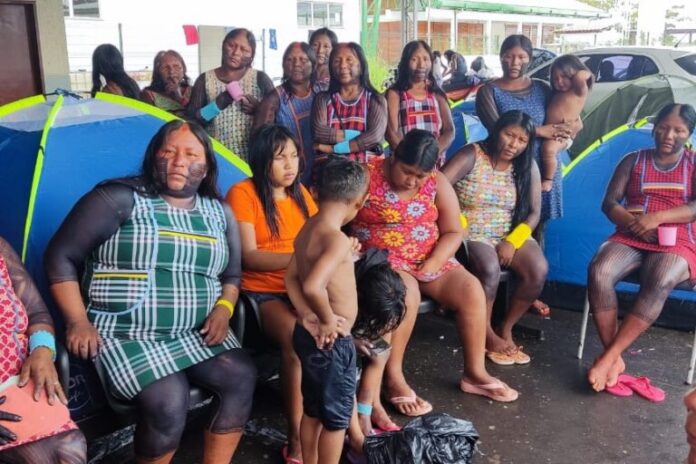


More than 120 Indigenous protesters have occupied a federal building in Altamira in the Brazilian Amazon since Feb. 23. They are demanding that authorities block a Canadian mining company’s license to open one of the country’s largest open-air gold mines on the Xingu River.
Led by a movement of Indigenous women, the protest follows a Feb. 13 court ruling reinstating an installation license, suspended since 2017, for Canadian mining multinational Belo Sun’s (TSE:BSX) Volta Grande project.
“Belo Sun is a foreign company that intends to plunder the riches of the Volta Grande do Xingu, a sacred territory of Indigenous and traditional peoples,” the Middle Xingu Indigenous Women’s Movement, wrote in a statement.
“The dozens of women and men who have remained camped in struggle for their rights for more than 20 days are not doing so for leisure, but because they understand the danger that the mining venture represents for the region,” the statement continued.
The protest targets the local branch of Funai, Brazil’s federal Indigenous affairs agency, in the neighboring municipality of Altamira, Pará state. On March 16, protesters briefly blocked access to Altamira’s airport. Indigenous leaders say Funai is not adequately representing them and signed off on the project’s Indigenous impacts despite a lack of consent from the affected communities.
In December 2025, 10 Indigenous associations formally annulled a prior consultation process and suspended all negotiations with the company.
The Feb. 13 ruling allowing the project to move forward is the latest in a dispute dating back 14 years. The ruling was immediately appealed by the Federal Public Prosecutor’s Office, citing a lack of due diligence regarding Indigenous consent. Belo Sun said it is now authorized to proceed with construction and installation activities.
“What drives us is not letting [Belo Sun] destroy our river, because our water sources here have already been greatly devastated,” Sol Juruna, one of the leaders of the occupation, told Mongabay in an audio message. “We know that if Belo Sun goes ahead, it will finish destroying our Xingu River. There are people in the future, our children, grandchildren and great grandchildren, who will lose everything.”
Indigenous leaders say the proposed gold mine would compound environmental damage already inflicted by the Belo Monte hydroelectric dam on the Indigenous and riverine communities of the Xingu region. The dam, which began operating in 2016, diverted a significant amount of the river’s natural flow.
“We are already suffering with the impacts of the Belo Monte [dam], with river levels dropping fast, harming fish migration and navigation,” Eliete Pakissamba, president of the Juruna Indigenous association AIKOJUPA, told Brazilian news outlet Pública. “If another project of this size comes along, the Volta Grande region won’t withstand it.”
In a statement, Belo Sun wrote that the project will be developed in accordance with best international mining practices and the highest social standards.
Banner image: Occupation of Funai’s Altamira branch. Image courtesy of the Medio Xingu Indigenous Women’s Movement.
Credits
