
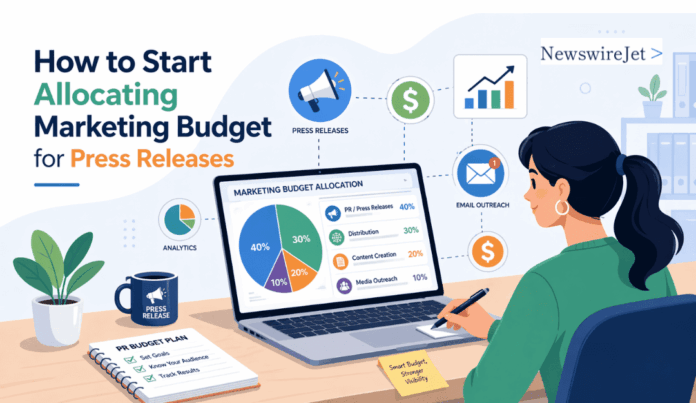


A press release budget is money taken from your marketing funds and assigned to a specific task.
What do you want for that money? Media mentions, more people knowing your name, and leads that could turn into sales.
A solid release can touch customers from first hearing about you to finally buying, and it can affect what you end up paying to get them.
Done right, it makes your social posts and email blasts work harder, drawing more of the right people in.
The rest of this shows how those budget calls lead to actual outcomes.
Press Release Budget Snapshot
Allocating marketing budget for press releases works best when spending is planned, measurable, and aligned with overall marketing efforts. Here are the main points to remember.
- Press releases often account for 5–10% of a company’s marketing budget, especially for B2B companies and startups focused on brand awareness.
- Distribution usually takes 40–60% of press release spending, since journalist databases and syndication networks help increase visibility.
- Effective budget allocation relies on measurable metrics such as conversion rate, cost per lead, and media pickups tracked through analytics tools.
How Much Should We Allocate to Press Releases?
Most marketing teams have a line item for press releases. It’s usually 5% to 10% of the total budget. That share jumps when there’s news, a launch, an investment, or a problem that needs explaining.
A press release isn’t really its own category. It’s part content, part SEO play, and part old-fashioned media pitch. Data from Cision suggests firms with a dedicated media strategy are the ones who actually budget for it properly.
Small business owners often start with a tiny test. Maybe $500 for a local announcement. You run it, see if any customers mention it, check if your website traffic bumps, and then decide if it’s worth more.
Many founders begin this process while figuring out PR budgeting for a small business and how much early publicity is worth before scaling campaigns.
Growth changes the math. The budget gets divided, some for social ads, some for search, some for video. The press release allocation has to compete with those now. It needs to show it’s pulling its weight.
Here’s a practical look at what companies actually spend:
| Where the company is | Typical slice of the marketing budget | What that might buy |
| Early days | 5–10% | $500–$2,000 |
| Scaling up | 7–12% | $2,000–$5,000 |
| Established player | 10%+ | $5,000–$10,000+ |
This helps a marketing manager argue for PR funds instead of putting it all into Google Ads.
What does a campaign actually cost?
- A typical professional release runs $1,000 to $5,000 all-in.
- A startup might trial PR with about 10% of its quarterly marketing spend.
- At the corporate level, a campaign with video assets and wide distribution can blow past $10,000.
For earlier-stage companies trying to plan their first announcements, understanding the typical PR costs for startups helps set realistic expectations before launching a campaign.
This snapshot is for planning. It answers the question of how a press release fits with the money you’re already spending on social posts and email blasts.
What Are the Core Components of a Press Release Budget?
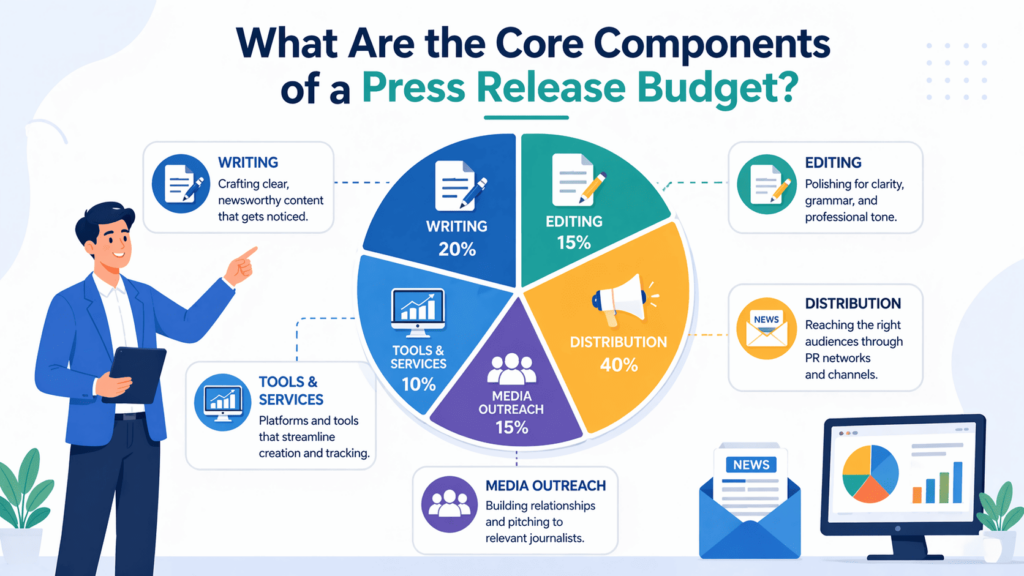
Most people are surprised to learn that writing the release is one of the smaller costs. The real expense is getting anyone to see it.
Take a typical $5,000 campaign. Here’s where that money actually goes.
Writing it down: $1,000 to $1,500
You pay someone to craft the message. It has to be factual and easy to scan, because editors are sorting through a mountain of pitches every day. A lot of companies hire freelance writers just for this.
This is the same budgeting conversation many founders face when deciding how much they should spend on PR compared with other marketing channels.
Getting it out there: $2,000 to $3,000
This is the big one. Services like PR Newswire charge this fee to blast your release to their databases of journalists and news sites. If you skip this, your release basically sits in a drawer. You’re paying for the chance to be seen.
According to Research from PLoS One,
“Consequent budget cuts have led to layoffs and a higher workload for remaining editorial staff… Journalists’ reliance on public relations material is extensive, as shown in a two-week study of British news.” – PLoS One
Spreading the word yourself: $800 to $1,500
After the official distribution, you still have to promote it. That means scheduling social posts, adding it to your email newsletter, maybe even asking employees to share it on LinkedIn.
Checking the scoreboard: $250 to $500
Finally, you set aside a few hundred dollars for analytics. You’ll plug tools like Google Analytics into your website to see if the release actually drove any traffic or leads.
So why is distribution so expensive? Because it’s the bridge between your news and the public.
That fee connects your release to the broader marketing machine, your ad planning, your media research, the whole strategy. Without it, the other pieces don’t have much to work with.
Why Does Distribution Consume the Largest Share of PR Budgets?
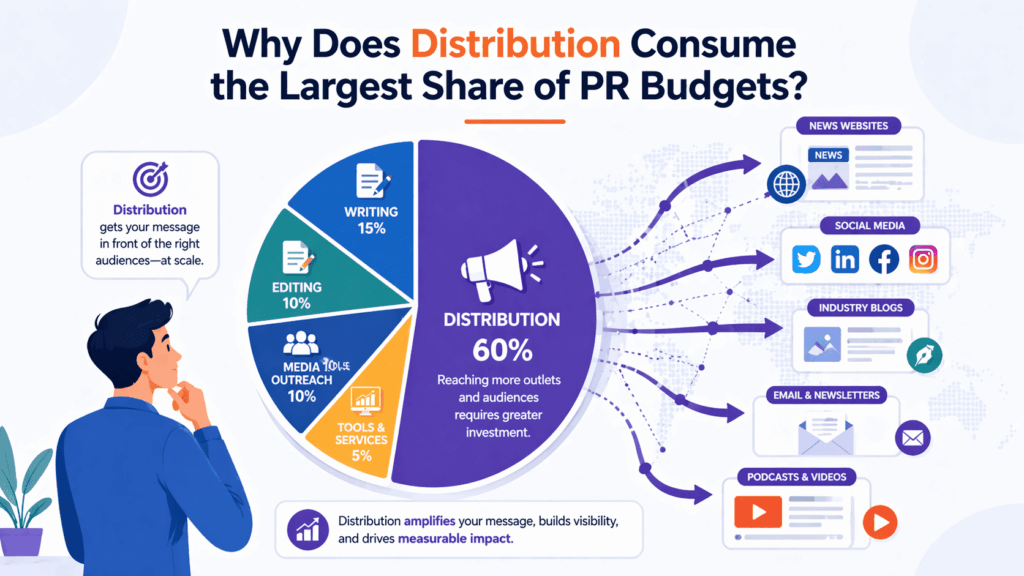
Most of a press release budget goes to distribution. You have to pay to get it seen. Using a service to send your news to journalists, bloggers, and editors is the main cost.
Business Wire points out that a serious distribution package, especially with video or geographic targeting, frequently costs over $1,500 for one release.
What drives that price?
- Access to current media contact lists.
- Choosing specific cities, states, or countries.
- Including video or image files.
- Getting the release onto online news wires and industry sites.
This spending does more than get a single day’s coverage. The resulting articles create backlinks, which help your website’s search engine ranking. That supports free, organic traffic over time.
When you combine this with paid ads on platforms like Google or Meta, the announcement reaches beyond traditional news outlets.
The real benefit is longer-term. A well-distributed story shapes what potential customers think. It builds general awareness and can bring in inquiries on its own. This kind of inbound lead helps lower the cost of finding new customers later.
How Should Startups Allocate a Small Press Release Budget?
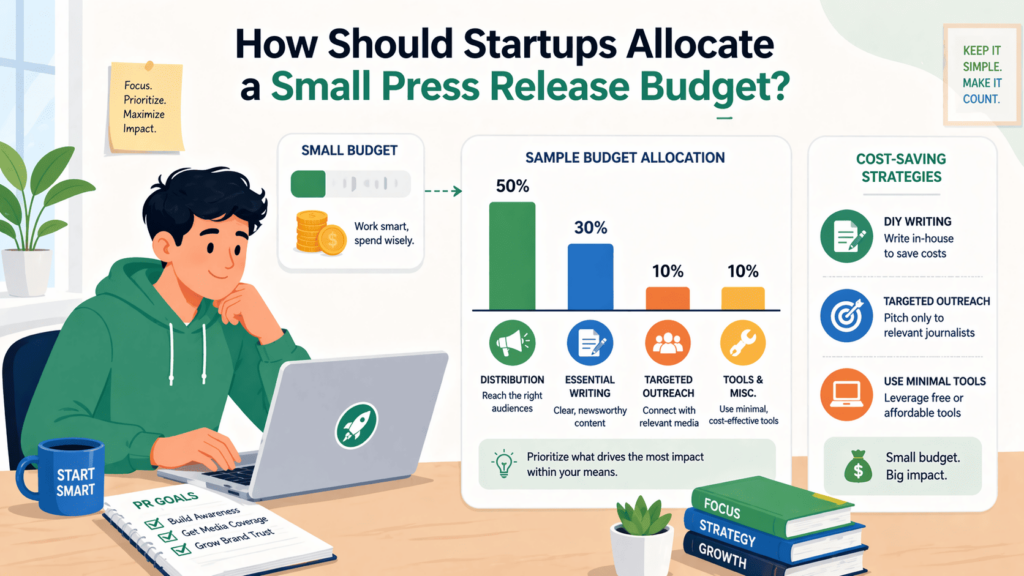
You get a better return by focusing on a specific audience and promoting your message smartly.
Early-stage companies are always balancing a press release with other marketing. You’re probably also spending on content, social ads, and paid search. The trick is figuring out the right mix.
According to IOSR Journal of Business and Management,
“This shift has also given rise to influencer marketing, where PR strategies overlap with endorsements… A 2024 global survey by Statista found that 22.4% of marketing agencies and brands allocated 10 to 20% of their marketing budget to influencer marketing.” – IOSR Journal of Business and Management
So, you have a thousand dollars for a press release. How should you actually spend it?
- First, pay someone to write it well. That’s about $300. A bad release won’t get picked up, and it makes you look amateurish.
- Next, distribution. Maybe $400. This is getting it to the right places, not just every place.
- Then, promotion. Another $200. You can’t just send it out and hope. You need to actively push it on social media, especially LinkedIn.
- Finally, $100 for analytics. You have to track what happens.
To see if it worked, use Google Analytics to watch your traffic. See if new leads in your CRM mention the article. Did any other websites link to it? Did your sign-up rate change?
Good tactics are simple:
- Find a few industry blogs your ideal customers read. Send the release directly to them.
- Use LinkedIn Ads to boost the published article.
- Email the news to your existing contacts.
- Look for a traffic spike, new links, and changes in conversions.
This is about answering a real business question. Is this press release bringing in leads at a lower cost than other channels? Is it creating a stream of inbound interest?
If the data shows traction, real visitors, real leads, then you can spend more on PR next time. It becomes part of your campaign plan, not just a one-off task.
How Can Companies Measure ROI From Press Release Spending?
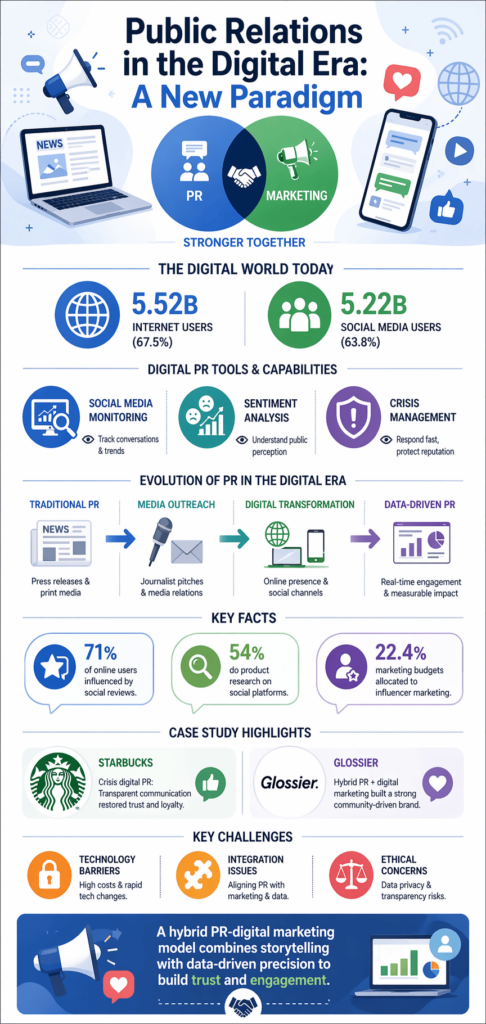
You can measure a press release’s real impact by looking at what happens after it goes out. Forget just sending it and hoping.
You need to see if it gets picked up by reporters, drives people to your website, earns you links from good sites, gets your name talked about, and actually brings in potential customers.
We use tools like Google Analytics to connect the dots. It shows us if someone read a news article about us and then visited our site or filled out a contact form.
It’s a good time for this. Research from Pew shows more people are getting their news online than ever. Getting covered by a solid news site is one of the best ways to be seen as a trustworthy source.
Here’s what a practical measurement plan looks like. You set targets for a few key things:
- Media pickups: Getting the story placed in at least 10 different outlets is a solid goal.
- Website traffic: A good release should bump up your site visitors by around 20%.
- Backlinks: The goal is links from respected news organizations, not just any site.
- Leads: You want to see new leads coming in within a month or two of publishing.
The work happens in four steps:
- Track exactly where your website visitors are coming from.
- Compare your traffic from the week before the release to the weeks after.
- Set up alerts so you know every time your company is mentioned online.
- In your sales system, tag new leads that came from the press release campaign.
Using a mix of testing tools, automated marketing, and your customer database lets you tie news coverage directly to sales.
This whole approach stops you from just celebrating a high number of “views” and instead shows you what the coverage was really worth.
What Mistakes Cause Companies to Waste Their Press Release Budget?
Credits: James Dooley
Companies often blow their press release budget. They pay for mass distribution, but the message doesn’t reach the right people. It’s a simple disconnect.
The issue is clear. You buy a big distribution package, but your press release isn’t crafted for your real customers. It’s generic. That rarely works.
Marketing teams chase vanity metrics, total impressions, click counts. Those numbers feel good, but they don’t mean sales.
The real questions are: how much does each lead cost? How many converts? Does this help keep customers?
Budgets get drained in a few predictable ways:
- Paying for huge distribution lists instead of pitching specific, relevant journalists.
- Overlooking niche publications that your core audience reads every day.
- Publishing a release and then just… stopping. No social push, no ads.
- Measuring only impressions, never following the trail from lead to sale.
We see it in audits all the time. A company spends $1,000+ on distribution. The result? Zero qualified leads. The money just evaporates.
Journalists ignore promotional fluff. Harvard’s Nieman Lab research shows they prioritize original insights, new data, and expert quotes.
Your release must have something novel: a unique angle, solid stats, and a direct link to current industry conversations. That’s what gets picked up.
FAQ
How should a small business set a marketing budget for press releases?
A small business should start by defining clear business goals and identifying the target audience. When allocating marketing budget for press releases, business owners should review overall marketing expenses, expected reach, and available resources.
Press relations expenses should support a broader marketing plan that includes digital marketing, content marketing, and social media marketing to strengthen brand awareness and support long-term growth.
How do press releases support a broader marketing plan?
Press releases help marketing teams support marketing efforts across several marketing channels. A well-timed release can reinforce content marketing, social media marketing, and email marketing campaigns while directing attention to a specific announcement.
When aligned with a clear business strategy and customer journey, press releases help reach the target customer, strengthen brand awareness, and expand the company’s customer base.
What metrics should marketing teams track after publishing a press release?
Marketing teams should measure clear performance metrics after publishing a press release. Useful indicators include conversion rate, cost per lead, inbound leads, and engagement across digital media channels.
Analytics tools such as web analytics platforms and Google Analytics help track traffic and user behavior. These insights help teams understand how press relations expenses affect Customer Acquisition Cost and organic revenue growth.
Can press releases work together with paid advertising campaigns?
Press releases can support paid advertising by strengthening credibility and reinforcing campaign messaging. When a release is shared alongside Paid Search, social media advertising, or video advertising campaigns, it can increase visibility and improve audience trust.
Marketing teams often coordinate press releases with digital marketing activities such as Facebook Ads, LinkedIn Ads, and search engine marketing for stronger campaign results.
How often should businesses allocate budget for press releases?
Businesses should allocate a budget for press releases based on their growth stage, annual revenue, and overall marketing strategy. Both B2B companies and B2C companies often plan releases around product launches, partnerships, or important company updates.
A structured marketing budget plan helps marketing teams schedule releases that support ongoing marketing efforts and contribute to measurable brand awareness and audience engagement.
Turn Budget Discipline Into Media Visibility
When you plan a press release budget, the pressure is real. You want coverage that actually moves the needle, but wasted spend on broad distribution or weak writing adds up fast. It gets frustrating when a release goes out and nothing meaningful comes back. Results matter.
A simple next step is using a platform that keeps spending focused while still reaching real media outlets. NewswireJet gives businesses an easier path to distribute press releases, reach outlets like NBC or Google News, and track performance without agency level costs. If you want visibility that fits your budget, it’s a smart place to start.
Related Articles
- https://newswirejet.com/pr-budgeting-for-small-business/
- https://newswirejet.com/how-much-should-small-business-spend-on-pr/
- https://newswirejet.com/typical-costs-of-pr-for-startups/
References
- https://pmc.ncbi.nlm.nih.gov/articles/PMC6561540/
- https://www.iosrjournals.org/iosr-jbm/papers/Vol27-issue2/Ser-2/E2702022229.pdf