




Home Nuclear HD Hyundai, Bill Gates-founded TerraPower advance nuclear supply chain cooperation
August 22, 2025,
by
Naida Hakirevic Prevljak
Leaders of the South Korean conglomerate HD Hyundai and the US-based nuclear reactor design and development engineering company TerraPower have met to review nuclear supply chain expansion and commercialization progress.


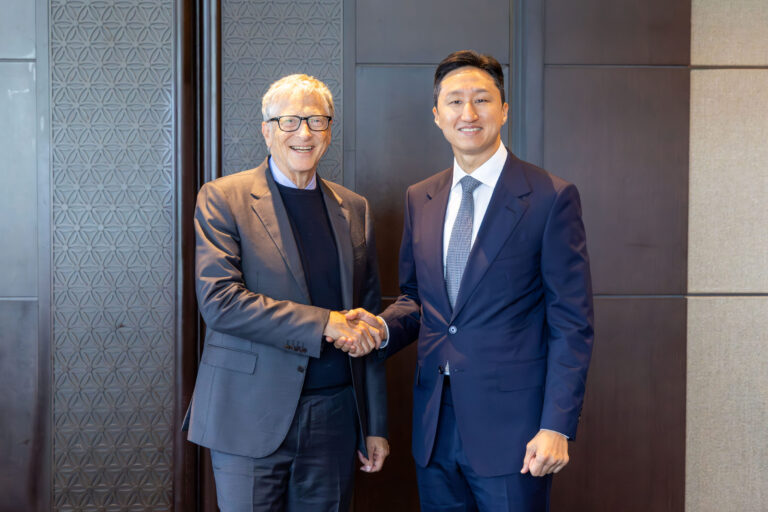
On August 22, Executive Vice Chairman Chung Kisun met with TerraPower leadership, including Chairman and Founder Bill Gates, in Seoul, Korea.
The group reviewed progress on supply chain expansion and the commercialization of Natrium reactors, as well as discussed future cooperation opportunities. The meeting between the company leaders marked a first reunion in five months since initial talks in the United States last March.
During the previous meeting, HD Hyundai and TerraPower signed a memorandum of understanding (MOU) to expand the global manufacturing supply chain for the commercialization of Natrium reactors.
TerraPower’s Natrium reactors are a Generation IV small modular reactor (SMR) sodium-cooled fast reactor (SFR) design with built-in energy storage. Leveraging its expertise and manufacturing capabilities in SMRs, HD Hyundai has signed a contract to supply TerraPower with the reactor vessels for the first Natrium reactor. The existing MOU allows companies to explore expanding the supply chain for Natrium reactors to support the global commercialization of the Natrium technology.
“Next-generation SMR technology is a core solution for realizing sustainable future energy. Our partnership with TerraPower will serve as a turning point in building a global nuclear supply chain and advancing the transition in the energy paradigm,” Kisun commented.
“HD Hyundai is not only a … globally recognized shipbuilder but also a key supply chain partner with deep manufacturing expertise which will play an important role in the global nuclear industry. Through our collaboration, we aim to accelerate the commercialization of Natrium reactors and continue creating global opportunities in the market,” Chris Levesque, President and CEO of TerraPower, stated.
Meanwhile, HD Hyundai is also stepping up efforts to develop nuclear-powered vessels, including its work with TerraPower on molten salt reactor (MSR) technologies for potential applications in the shipbuilding sector.
Back in November, HD Korea Shipbuilding & Offshore Engineering (KSOE), a sub-holding company of HD Hyundai’s shipbuilding and offshore business, made an initial investment of $30 million in TerraPower.
The following year, the shipbuilder revealed the design of an SMR-powered ship.
Since February 2024, HD KSOE has been conducting joint research with TerraPower on next-generation SMRs. In December of the same year, the company secured an order to manufacture the main equipment for TerraPower’s Natrium reactor.
Earlier this year, HD KSOE unveiled a nuclear-powered containership model utilizing SMR technology to accelerate the development of nuclear-powered vessels. The model builds on the 15,000 TEU containership design applying SMR technology which had previously received approval in principle from the American Bureau of Shipping (ABS).
In related news, ABS Chairman and CEO, Christopher J. Wiernicki, recently emphasized that new nuclear reactor technology may represent a one-in-generation opportunity for US industrial policy.
Vessels propelled by advanced SMRs could act as a catalyst for the revitalization of US shipbuilding at a time when the country is seeking ways to improve its shipbuilding industry prospects.
Last month, South Korea pledged $150 billion into a dedicated United States shipbuilding rejuvenation fund, as part of a much larger, $350 billion bilateral trade agreement with Washington. The aim is to ‘breathe new life’ into the American vessel construction industry and curb China’s dominance in shipbuilding globally.
Read more
- KSOE bolstering efforts on nuclear propulsion for ships
- Major breakthrough in molten salt reactor tech for maritime use
- HD KSOE, Kepco win ABS’ AiP for floating nuclear power barge