
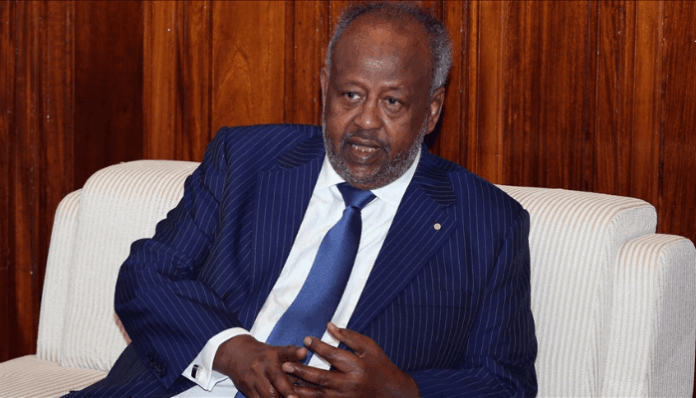


Ismail Omar Guelleh, Djibouti president, has secured a sixth term in office after winning 97.8 percent of the vote in a tightly controlled election that has again highlighted the dominance of one man over the small but strategically vital Horn of Africa state.
Preliminary results released by the state news agency showed Guelleh, 78, far ahead of his only challenger, Mohamed Farah Samatar, who took just over two per cent of the vote. Turnout was reported at more than 80 percent, with about 256,000 registered voters in a country of roughly one million people.
Read also: Djibouti lifts presidential age cap, clearing path for Guelleh to seek sixth term
“Re-elected,” Guelleh wrote on X as early results came in, signalling confidence even before the final tally was confirmed.
The vote took place against the backdrop of a largely absent opposition. Most major opposition figures boycotted the poll, continuing a stance they have held since 2016. Samatar, whose Unified Democratic Centre has no seats in parliament, struggled to build visibility during the campaign.
“I don’t even know what his opponent looks like,” one voter, Deka Aden Mohamed, told AFP, underscoring the imbalance in public exposure between the candidates.
Read also: Djibouti’s Mahmoud Ali Youssouf elected new African Union Commission Chair
Guelleh has been in power since 1999, making him one of Africa’s longest serving leaders. His latest run followed constitutional changes that removed the upper age limit of 75 for presidential candidates, allowing him to stand again after earlier signals that he might step aside.
Speaking after casting his vote at City Hall in the capital, Guelleh struck a confident tone. “By the grace of God, we have arrived here, and we hope that this will end in victory,” he said.
Read also: Nigeria: Lessons from Djibouti’s ‘friendly mosquito’ approach to knockout malaria
His campaign leaned heavily on a message of stability. Djibouti sits at the Bab al-Mandeb strait, a critical chokepoint linking the Red Sea to the Gulf of Aden and a gateway to the Suez Canal, one of the busiest shipping routes in the world. The country hosts military bases from the United States, China, France, Italy and Japan, giving it outsized geopolitical importance despite its small size.
Supporters argue that Guelleh has kept the country stable in a volatile region that includes Eritrea, Ethiopia and Somalia, all of which have faced periods of conflict and political upheaval.
Critics, however, point to the steady erosion of democratic competition. Term limits were scrapped in 2010, and presidential terms were reduced from six to five years. The recent removal of the age cap has further cemented Guelleh’s hold on power.
The contrast on the campaign trail was stark. Thousands attended Guelleh’s rallies, and his posters dominated the capital. Samatar’s events, by comparison, drew only small crowds, according to reports by AFP.
Still, the opposition candidate attempted to carry a message of change, campaigning in regions such as Tadjourah and Obock under the slogan “another Djibouti is possible”.
For now, however, the election result suggests continuity rather than change.
Guelleh remains firmly in control of a country whose strategic location ensures it will continue to command attention far beyond its borders.