


Can National Crisis Communication Hub Respond at the Speed of the Lie?
By Shuaib S. Agaka
Nigeria’s information disorder no longer begins with whispers in markets or speculative radio chatter. It erupts in livestreams, trends through algorithm-driven feeds, and mutates through artificial intelligence systems capable of fabricating audio, images, and video within seconds. In this altered reality, the question before policymakers is no longer whether misinformation poses a threat. It is whether the state can respond at the speed of the lie.
Against this backdrop, the Federal Government appears to be recalibrating its posture. Crisis communication—long treated as a reactive exercise confined to press briefings and damage control—is being reframed as a technology-driven national security priority.
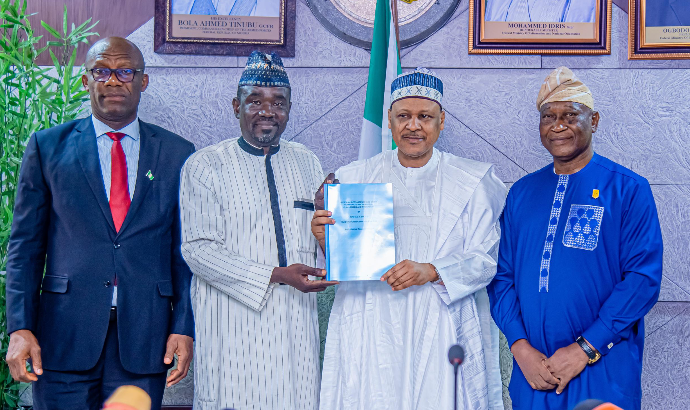
The renewed endorsement of the proposed National Crisis Communication Hub (NCCH) signals a growing institutional consensus that Nigeria must modernise how it anticipates, manages, and neutralises digital threats. The latest backing came from the Minister of Information and National Orientation, Mallam Mohammed Idris, during a high-level engagement in Abuja where Major General Chris Olukolade (Rtd) presented the report of the National Symposium on Digital Innovation in Crisis Communication.
At the core of the proposal is the establishment of an independent, multi-stakeholder National Crisis Communication Hub designed to shift Nigeria from fragmented, after-the-fact responses to a coordinated, real-time monitoring and response system. The Hub would track fake news, hate speech, and organised misinformation campaigns as they emerge, while synchronising communication across ministries, departments, and agencies during national emergencies.
This coordination is more than cosmetic. In previous crises, conflicting official narratives have sometimes intensified uncertainty and amplified public anxiety. The proposed Hub aims to close that gap by aligning operational realities with public messaging in real time.
More significantly, the framework integrates artificial intelligence for predictive analysis. Rather than chasing viral falsehoods after they have shaped public perception, authorities hope to identify early digital signals, detect patterns, and anticipate flashpoints before they escalate. It is an attempt to institutionalise foresight in an era defined by velocity.
Beyond monitoring and coordination, the reform agenda introduces an accountability mechanism: a proposed Crisis Communication Perception Index to measure institutional performance during emergencies. By assessing preparedness, responsiveness, transparency, and digital resilience, the index would transform crisis communication from a public relations afterthought into a measurable governance benchmark.
Minister Idris described the initiative as timely, noting that government alone cannot navigate today’s information ecosystem. He emphasised the need for responsible deployment of artificial intelligence while safeguarding national values and public trust. His caution reflects a global dilemma: how to harness powerful technologies without eroding civil liberties or democratic accountability.
A key moment in the engagement was the presentation of a specialised research study titled “Artificial Intelligence and Crisis Communication in Nigeria: Challenges and Prospects.” Authored by Yushau A. Shuaib, consultant to the Centre and publisher of PRNigeria, the study outlines a strategic roadmap for the Ministry and the National Information Technology Development Agency (NITDA) to modernise Nigeria’s communication architecture in line with global best practices.
Momentum behind the NCCH initiative has further strengthened with the endorsement of NITDA’s Director-General, Kashifu Inuwa. At a separate meeting with Centre leadership, Inuwa underscored the urgency of coordinated digital response mechanisms.
His diagnosis was candid. Misinformation, he argued, spreads faster than verified information because of its “novelty factor.” Social media platforms have disrupted traditional gatekeeping structures, enabling harmful content to circulate widely before facts can catch up. “There is a direct correlation between novelty and virality,” he observed, warning that AI-driven tools such as deepfakes are rapidly becoming instruments of political and social manipulation.
As Nigeria approaches the 2027 political cycle, these concerns are not theoretical. AI-generated propaganda, synthetic media, and automated influence campaigns are already reshaping elections globally. Inuwa stressed that Nigeria cannot afford to be reactive.
In response to a 12-point resolution presented by the Centre for Crisis Communication, NITDA outlined practical measures, including strengthening digital literacy through platforms such as the Cisco Networking Academy, equipping journalists and security spokespersons with AI detection skills, and deepening engagement with global technology companies to accelerate harmful content moderation. Plans are also underway to expand crisis communication engagements across the six geopolitical zones and integrate cyber units into a multi-layered defence strategy.
What is emerging is not merely another committee or policy document. It is an effort to recalibrate Nigeria’s communication architecture for a digital era in which perception can move markets, influence elections, and inflame tensions within minutes.
The ultimate question is not whether misinformation exists. It is whether institutions can respond with coherence, credibility, and speed.
If implemented with transparency, professional safeguards, and cross-sector collaboration, the National Crisis Communication Hub could become a foundational pillar of Nigeria’s digital governance framework. But its success will depend not only on the sophistication of its tools, but on the trust it commands.
In a volatile information ecosystem where authority competes with algorithms, credibility may prove to be the most valuable infrastructure of all.
Shuaib S. Agaka is a tech journalist based in Kano.