
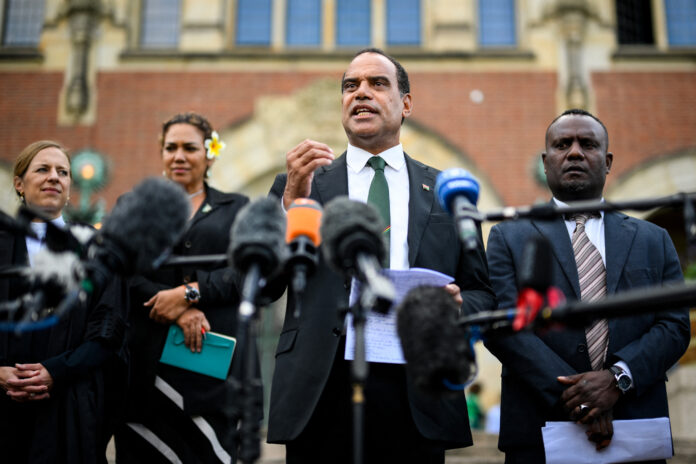


Led by the South Pacific island nation of Vanuatu, a coalition of countries are introducing a resolution at the United Nations General Assembly that could reinforce countries’ legal obligations under international climate laws and treaties.
The resolution would back a July 2025 climate advisory opinion from the International Court of Justice that frames climate commitments as requirements rather than political suggestions and would recommend a U.N. process to document climate-related losses and damage experienced by vulnerable countries and communities.
Overall, experts described the measure as a step toward strengthening the legal framework for climate accountability. The original request for the advisory opinion was passed unanimously by the U.N. General Assembly. In the past week, more than 100 countries have participated in negotiations on the new resolution, and proponents of the measure said they’re aiming to enlist 150 countries as supporters.
As the new draft started circulating, several legal analysts said the resolution could help global efforts to equitably grapple with the climate crisis. They also discussed the challenges of building a broad consensus after a year when global environmental governance, including climate talks, faltered, according to a recent report from the International Institute for Sustainable Development.
During discussions on the first draft, a coalition of states—including Russia, Saudi Arabia and the United States—opposed anything resembling binding language to phase out fossil fuels, or terms that could suggest any financial liability for climate harms.
Such climate obstructionism is documented in research showing persistent efforts to slow and disrupt the growing consensus on the need to shift from oil and gas to renewable energy sources.
Climate justice advocate Mary Robinson, the former president of Ireland, argued that supporting the court’s advisory opinion would demonstrate that states still value a rules-based system, and lauded the courage of Pacific island youth activists for launching the legal campaign that ultimately led to the advisory opinion.
“This didn’t begin in the corridors of power,” Robinson said. “Young Pacific voices asked a simple but profound question: What does international law require of states when their actions threaten the survival of others? When the law becomes clear, excuses become harder to sustain.”
Robinson warned that some powerful countries are trying to pressure smaller states to weaken the follow-up resolution, and said, “People will be watching this. They know that the United States has tried to bully. Can people resist a bully? I hope so.”
The Associated Press reported on Feb. 13 that the U.S. has been stating its opposition to the resolution to other governments through diplomatic channels. The State Department did not immediately respond to questions, but has stated it opposes measures that could harm U.S. industries.
Legal Turning Point?
Modern climate policy is built on the premise that global problems require shared rules.
European governments have occasionally fought over the details and delayed compliance, but they have generally accepted that climate commitments carry legal weight. European Union Climate Law makes the bloc’s goal of reaching climate neutrality by 2050 legally binding and allows courts to enforce emissions targets.
Nearly every country in the world has signed on to the Paris Agreement, a still-operative global framework for reducing greenhouse gas emissions and reporting progress. Only one country, the U.S., has ever formally withdrawn from the pact. Similar cooperation underpins a wide range of U.N. conventions that set shared rules for protecting ecosystems, limiting pollution and managing the global commons.
Supporters say the proposed resolution would further encourage countries to align their climate policies with the legal principles outlined by the court and to embed those findings in all environmental negotiations, as well as in national policies and human rights frameworks.
Margaretha Wewerinke-Singh, an associate professor of sustainability law at the University of Amsterdam who represented Vanuatu in the ICJ proceedings, said the vote will test whether governments are still willing to defend the international legal order.
The court’s opinion and the follow-up resolution could also help galvanize broader support for climate action at a time when global cooperation has faltered. Significant support for the resolution would signal that countries remain committed to rules-based cooperation on climate change, she said.
Nicole Ponce, an environmental and human rights lawyer-advocate from the Philippines who volunteers with World Youth for Climate Justice, said the measure represents the next step in translating the court’s legal findings into real-world action and could become a rallying point for the climate movement.
“The advisory opinion has clarified the law,” she said. “The question now is what states will do next.”
Ponce said advocates are also trying to build momentum beyond the resolution by mobilizing youth networks and communities hit by climate impacts.
But Ponce cautioned that legal rulings alone cannot shield vulnerable communities from the accelerating impacts of climate change. “Legal clarity alone does not protect a single village from rising seas,” she said.
About This Story
Perhaps you noticed: This story, like all the news we publish, is free to read. That’s because Inside Climate News is a 501c3 nonprofit organization. We do not charge a subscription fee, lock our news behind a paywall, or clutter our website with ads. We make our news on climate and the environment freely available to you and anyone who wants it.
That’s not all. We also share our news for free with scores of other media organizations around the country. Many of them can’t afford to do environmental journalism of their own. We’ve built bureaus from coast to coast to report local stories, collaborate with local newsrooms and co-publish articles so that this vital work is shared as widely as possible.
Two of us launched ICN in 2007. Six years later we earned a Pulitzer Prize for National Reporting, and now we run the oldest and largest dedicated climate newsroom in the nation. We tell the story in all its complexity. We hold polluters accountable. We expose environmental injustice. We debunk misinformation. We scrutinize solutions and inspire action.
Donations from readers like you fund every aspect of what we do. If you don’t already, will you support our ongoing work, our reporting on the biggest crisis facing our planet, and help us reach even more readers in more places?
Please take a moment to make a tax-deductible donation. Every one of them makes a difference.
Thank you,

Bob Berwyn
Reporter, Austria
Bob Berwyn is an Austria-based reporter who has covered climate science and international climate policy for more than a decade. Previously, he reported on the environment, endangered species and public lands for several Colorado newspapers, and also worked as editor and assistant editor at community newspapers in the Colorado Rockies.