


It should have ended in Rabat. A goal in extra time, a trophy lift, and another chapter closed at the 2025 Africa Cup of Nations final.
Instead, weeks later, the story is still unfolding, this time in statements, appeals, and symbolic acts—drawing in the Confederation of African Football and, potentially, the Court of Arbitration for Sport.
What happened next didn’t just stretch the timeline of a football match. It changed its meaning.
January 18, 2026 : The win that came with a pause
For most of the night, the final was tight, tense, and goalless.
Then came the moment that now defines everything: Morocco were awarded a stoppage-time penalty. Senegal’s players didn’t crowd the referee, they walked off.Play stopped for about 15 minutes. Long enough to feel like something had broken.
When the game resumed, Brahim Díaz missed from the spot. Extra time followed. Then Pape Gueye scored.
Senegal won 1–0. On the night, that was the story.
March 17, 2026 : When the result changed after the fact
Then CAF stepped in.
Citing rules around teams leaving the pitch without authorisation, its Appeal Board ruled that Senegal had breached tournament regulations. The consequence was not a fine or a warning. It was a reversal.
Senegal were deemed to have forfeited the match. The scoreline was adjusted to 3–0. Morocco were declared champions.
March 18, 2026: Taking the fight beyond CAF
Senegal’s response was immediate: they would not accept the ruling.
The federation announced plans to appeal to the Court of Arbitration for Sport, framing the issue as one of rights and fairness.
At that point, this was no longer just about a controversial penalty or a protest. It had become a question of who ultimately controls the outcome of a game, the players on the pitch or the institutions above it
March 26, 2026: A trophy, a message, and a “crusade”
Then came a shift in tone.
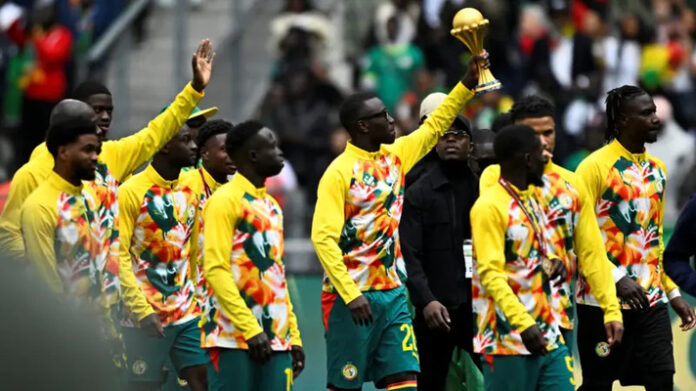
Ahead of a friendly against Peru in Paris, Senegal paraded the AFCON trophy anyway. Not quietly, not subtly.
The federation’s leadership described the pushback against CAF’s decision as a “crusade.”
It was part protest, part performance, and entirely deliberate.
March 29, 2026: CAF leadership calls for calm
Amid the growing tension, CAF president Patrice Motsepe addressed the situation on the sidelines of an Executive Committee meeting.
His message was measured and conciliatory:
CAF, he said, must “turn the page” and continue developing football across the continent. He emphasised unity, noting that both Senegal and Morocco were part of the same African football community. He also acknowledged Senegal’s appeal to CAS, stating clearly that CAF would respect whatever decision emerges from the arbitration process.
March 30, 2026: A leadership resignation adds to the turbulence
The same period also saw a significant development within CAF’s leadership.
Veron Mosengo-Omba, the organization’s general secretary, resigned, citing retirement.
However, his departure came at a time of mounting pressure, amid the fallout from the AFCON decision and broader concerns within African football governance, including calls for accountability and scrutiny of alleged irregularities.
March 31, 2026: Holding on to the title, publicly
Days later, they did it again.
Another match with Gambia, another public display of the trophy. The repeated displays underscored the federation’s position that the outcome on the pitch remains valid, regardless of CAF’s administrative decision.
The final in Rabat ended at full-time. But the real contest, over legitimacy, authority, and who gets to define a win, is still very much in play.