
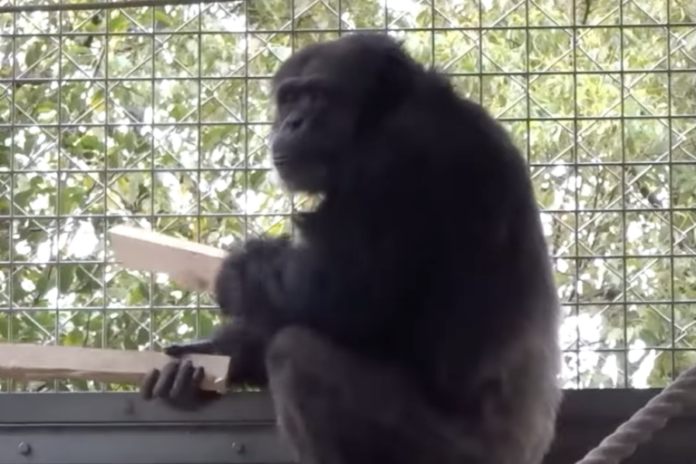


- A captive chimpanzee in Japan spontaneously ripped floorboards from a walkway and used them as instruments to perform structured, rhythmic drumming displays while vocalizing
- Researchers recorded 89 performances and found the drumming wasn’t random and followed a structured, rhythmic pattern similar to chimpanzee vocal calls.
- The chimp displayed play faces and what appeared to be laughter while drumming, suggesting the behavior was emotionally rewarding, not just a social display.
- The findings support the hypothesis that instrumental music may have evolved from vocal emotional expression, though the study is limited to a single individual in a captive setting.
Drumming and singing at the same time is impressive, whether you’re Karen Carpenter, Ringo Starr or a chimpanzee. Japanese researchers report that Ayumu, a 26-year-old male chimpanzee and alpha of his group at Kyoto University’s Institute for the Evolutionary Origins of Human Behavior (EHUB), has been spontaneously tearing floorboards from a walkway, fashioning them into instruments and performing extended drumming displays while vocalizing.
“I was surprised,” primatologist Yuko Hattori told Mongabay. “Chimpanzee drumming-like behavior has been reported before, for example when they throw stones or hit old tree trunks. However, behavior like this — using a stick in a way that closely resembled playing a drum — has not been reported before.”
Over two years beginning in February 2023, Hattori and her team recorded 89 of Ayumu’s spontaneous performances across 37 days. Their study, published in the Annals of the New York Academy of Sciences, found that Ayumu’s drumming was rhythmically structured, not random, and bore a striking resemblance to the vocal calls chimpanzees use to communicate across long distances.
Wild chimpanzees (Pan troglodytes) are known to drum on the buttress roots of trees, producing low-frequency booms that can be heard more than a kilometer away. A 2025 study in Current Biology analyzed more than 370 drumming bouts across 11 wild chimpanzee communities and found that this percussion is rhythmic and varies by subspecies. Western chimpanzees drum with evenly spaced beats, while eastern chimpanzees alternate between shorter and longer intervals.
Ayumu didn’t just drum, he pried loose floorboards from his enclosure’s walkway to use as instruments, an act researchers classify as “detachment,” a hallmark of early-stage tool-making. His performances incorporated up to 14 distinct components, including tool-assisted drumming, object dragging and object throwing, strung together into sequences lasting several minutes.

When the team statistically analyzed the order in which Ayumu combined these actions, they found the transitions were not random. Drumming tended to lead to dragging, which often led to throwing, a progression from slower, louder sounds to a final climactic gesture. The pattern closely mirrors the structure of pant-hoot vocalizations, in which chimpanzees build from soft introductory pants to a screaming climax.
“By analyzing the order of the different drumming actions, we found that the behavior was not just a series of random movements,” Hattori said. “Certain patterns appeared repeatedly, suggesting that the sequence had an underlying structure.”
The study also measured the timing between individual drum strikes and found that Ayumu’s rhythms were predominantly evenly spaced, like a metronome. Drumming with tools produced a more stable rhythm than drumming with hands or feet, echoing findings in a human study showing that drumsticks help produce steadier beats than bare fingers.
“One especially interesting aspect of this observation was that Ayumu sometimes appeared to be laughing while drumming,” Hattori told Mongabay. “This suggests that the drumming may have been more than just a display directed at others — it may also have been enjoyable for Ayumu himself. In that sense, I think it has something in common with human musical performance.”
One leading hypothesis about the evolution of music holds that instrumental expression grew out of vocal emotion; that the feelings once conveyed only through the voice gradually became externalized through tools and objects. Hattori said her findings are consistent with that idea.
“As far as I know, non-human animals are not known to use tools to express emotion in this way,” she told Mongabay. “This study suggests that chimpanzees may also have the ability to express their emotional state through tool use, somewhat like humans do through musical instruments.”

“We really need this kind of studies … to go further into the origins of musicality,” Valérie Dufour, an animal cognition biologist at the French national research agency CNRS, who was not involved in the Hattori study, told Science magazine.
The study has limitations. It documents a single individual, and Ayumu’s behavior appears to be unique within his group. No other chimpanzee at EHUB has consistently replicated his floorboard drumming. Ayumu is the alpha male of his group and has a long history with cognitive experiments. He’s tapped on electronic keyboards and heard complex rhythmic sounds. That background may have primed him for this behavior. And life in captivity, without predators and with plenty of objects to bang on, likely gave him the freedom to drum longer and more elaborately than wild chimpanzees typically do.
Looking ahead, Hattori said her team plans to study how the other chimpanzees at EHUB respond to Ayumu’s performances. Early observations suggest some group members sway their bodies in reaction. “We would like to analyze those responses in more detail to better understand what communicative function Ayumu’s display may have,” she said.
Banner image of chimpanzee drumming in Kyoto University’s Institute for the Evolutionary Origins of Human Behavior (EHUB). Photo courtesy of Yuko Hattori
Liz Kimbrough is a staff writer for Mongabay and holds a Ph.D. in ecology and evolutionary biology from Tulane University, where she studied the microbiomes of trees. View more of her reporting here.
A bonobo named Kanzi could play pretend, challenging ideas about animal imaginations
Citations:
Hattori, Y., Voinov, P., & Uchikoshi, M. (2026). Combinatorial Instrumental Sound-Making in a Captive Chimpanzee: Evolution of Vocal Externalization. Annals of the New York Academy of Sciences, 1557(1), e70239. doi:10.1111/nyas.70239
Eleuteri, V., van der Werff, J., Wilhelm, W., Soldati, A., Crockford, C., Desai, N., … & Hobaiter, C. (2025). Chimpanzee drumming shows rhythmicity and subspecies variation. Current Biology, 35(10), 2448-2456. doi: 10.1016/j.cub.2025.04.019
FEEDBACK: Use this form to send a message directly to the author of this post. If you want to post a public comment, you can do that at the bottom of the page.
Credits
