



- In a new study, researchers analyzed the link between increased shipping traffic in South African waters and collisions between whales and ships.
- The research covers six whale species occurring in near- and offshore waters and shows significant spatial overlap between whale habitats and shipping traffic, making action urgent.
- The South African government, the International Maritime Organization and scientists are working together to develop measures aimed at reducing whale strikes.
- Currently, rerouting vessel traffic is not possible as too much data are missing to map the spatial distribution of whales that occur farther offshore.
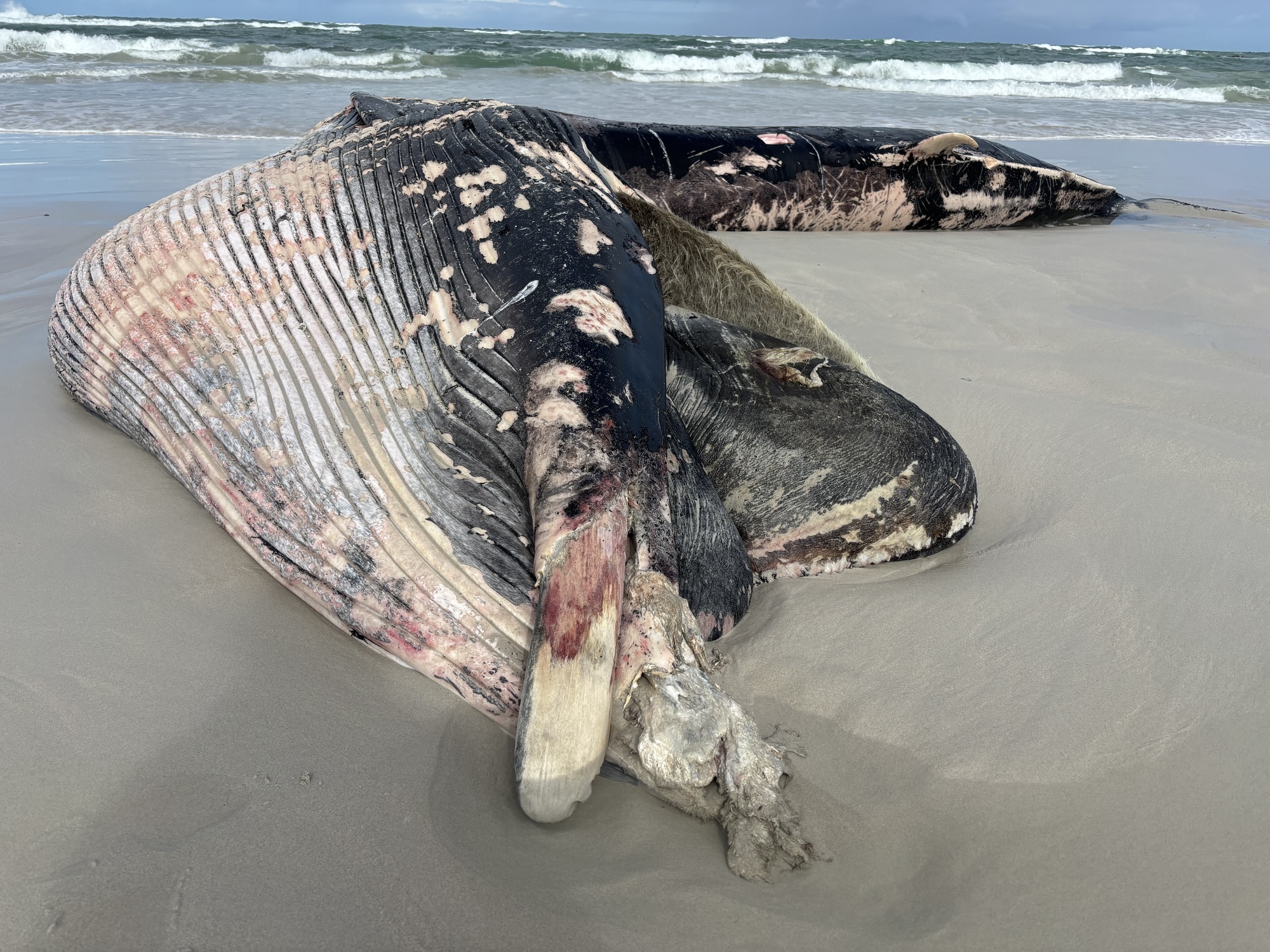
In April this year, two Bryde’s whales washed-up dead-on Dyer Island, a small nature reserve located a few kilometers off the coast of Gansbaai in South Africa’s Western Cape province. Both whales carried severe injuries; their vertebrae had been shattered.
“It was very clear that it was [vessel] strikes, because both those whales were snapped in half, and you can also see the propeller marks,” Loraine Shuttleworth, head of research at the Dyer Island Conservation Trust, told Mongabay.
Two whale strandings linked to ship strikes in one month alone is an unusually high number, Shuttleworth said. A new risk assessment has linked the increase in risk of ships striking whales to the rerouting of maritime traffic around South African coast.
Due to the Houthi rebels attacks on ships traversing the Red Sea, which started in 2023, and the more recent fallout from the blockade of the Strait of Hormuz, many cargo companies have rerouted their vessels around the Cape of Good Hope.
With greater shipping traffic comes a growing threat to marine species inhabiting the region: collisions with large, fast-moving vessels.
Between December 2023 and December 2024, the number of large vessels traveling through South African waters at average speeds above 15 knots (28 kilometers per hour) has quadrupled, satellite data show.
The scale of the increased maritime traffic struck scientist Els Vermeulen from the University of Pretoria’s Mammal Research Institute Whale Unit, on a flight into Cape Town in 2025.
“It was a beautiful day, and there were just so many ships. I thought: we really need to look into this,” she told Mongabay by phone.

‘Action is needed’
Vermeulen has since become a leading actor in connecting experts and taking steps toward the development of guidelines for ships traversing South African waters to prevent the kind of tragedies that befell the Bryde’s whales of Dyer Island.
The first task was to confirm the problem. Vermeulen connected with colleagues, authorities, and conservation organizations to understand what the increase in shipping traffic could mean for whales inhabiting South African waters.
Drawing on vessel-tracking data provided by Global Fishing Watch, a U.S.-based NGO that tracks fishing activity, Vermeulen’s team combined ship movement records with species distribution models. They focused on six baleen whale species, including Bryde’s whales (Balaenoptera edeni), and mapped out where shipping traffic and these whales’ habitats overlap.
In April this year, Vermeulen presented the preliminary study to the International Whaling Commission (IWC), an international body responsible for managing whale populations and their conservation. Vermeulen said it was not necessary to know the exact number of whales struck by ships to conclude that risk increases when more vessels frequent whale habitat. “If we have an increased presence of vessels in areas where we have large whales, it’s all we need to know that there’s a problem,” she said.
Her presentation was aimed at sparking a broader discussion about guidelines for ships operating in South African waters, even if those measures are initially voluntary.
Vermeulen is now working with the South African government and other stakeholders to push for the development of national guidelines for shipping companies based on international best practices, including those developed by the International Maritime Organization, and in dialogue with international experts. “There are mitigation measures in place, especially in the busy areas in the Northern Hemisphere which will be adapted to the region and the species,” Vermeulen said. Most of them, she added, are slower speeds and alternative routes.
One of the most important measures would be speed restrictions, she said, like the 10-knot (18.5 km/h) limit in force along the U.S. East Coast to reduce strikes with North Atlantic right whales (Eubalaena glacialis).
Currently, there are no mandatory speed limits or any guidelines in place to mitigate the problem in South Africa. The faster a ship is traveling, the more likely that a collision will be fatal for the whale.
Speed limits could be implemented immediately, while more detailed research is needed to identify safer routes, according to Vermeulen.
The study highlights that the problem of human-wildlife conflict is complex. The increase in shipping traffic, for instance, also coincides with the recovery of some whale populations after decades of protection from commercial whaling.
Forty years after a global whaling moratorium was introduced, humpback whale populations have increased in South African waters. During the Southern Hemisphere spring, particularly between October and November, so-called supergroups — aggregations of between 20 and hundreds of whales feeding together — gather in the Benguela Upwelling System, one of the world’s most productive ocean ecosystems. Stretching along the southwestern coast of Africa, from Cape Point in South Africa to northern Namibia, the combination of winds and currents brings cold, nutrient-rich ocean waters to the surface.
With more whales and more ships occupying the same waters, the risk of collisions rises, and recovering whale species are increasingly vulnerable. If a ship strikes a supergroup, it may injure or kill multiple whales rather than a single animal.
At the same time, species that have not yet recovered, such as coastal southern right whales (Eubalaena australis), as well as those that occur farther offshore, like fin whales (Balaenoptera physalus) and blue whales (Balaenoptera musculus), remain especially vulnerable. “Those are more rare and we are seeing an increase in human-wildlife conflict,” Vermeulen said.
‘Really quite horrifying’
Another factor is the way sound travels underwater. Vermeulen said whales can’t accurately detect approaching vessels, especially fast ones, because the engine noise comes from the rear of the vessel, while the most dangerous part, the bow of the ship, can be hundreds of meters ahead.
When a whale surfaces in front of a moving vessel, it’s almost impossible for the animal to locate that ship, she said. “This is due to the hull masking the noise and the distance between the front of the vessel and the back where the engine is,” Vermeulen said.
On the other hand, ship crews are mostly unaware of collisions, she said.
“They just move through the water and have absolutely no idea that they’ve hit a whale,” said Shuttleworth from the Dyer Island Conservation Trust.
Strandings like the ones seen on Dyer Island represent only a tiny fraction of total whale mortality. Most ship-related deaths remain undocumented, meaning carcasses are never detected or formally recorded. Scientists call this cryptic mortality. Shuttleworth added that even animals that do wash ashore are often discovered by members of the public who may not realize the incidents should be reported to organizations like the Dyer Island Conservation Trust.
Vermeulen and her team recently collated 50 years of stranding data and found that fewer than 1% of recorded strandings were officially attributed to ship strikes.
Shuttleworth told Mongabay that shipping traffic doesn’t only affect whales, but other marine species, including the critically endangered African penguin (Spheniscus demersus).
The trust’s African Penguin and Seabird Sanctuary in Kleinbaai, just onshore from Dyer Island, recently received a penguin with a severe head injury believed to have resulted from a ship strike, leaving the bird permanently blind. Together with the whales killed in collisions, Shuttleworth described the situation as “really quite horrifying.”
Shuttleworth said the recent incidents suggest that collisions are becoming more frequent. In addition to speed restrictions, she said stationing marine mammal observers on board these vessels could be another internationally recognized measure that shipping companies can implement to reduce strike risk.
Vermeulen’s study also modelled alternative shipping routes that could reduce relative strike risk by between 20% and 50% across all studied whale species without substantially increasing travel distances.
However, she said the current data remain incomplete, making it impossible for scientists to suggest alternative routes at this time. The whale distribution models are based largely on opportunistic sightings rather than systematic surveys, meaning the true distribution of offshore species such as fin, blue and sperm whales (Physeter macrocephalus) remains poorly understood.
According to Vermeulen, the South African government has been supportive of efforts to find solutions, and discussions with industry stakeholders are ongoing.
She added many shipping companies appear willing to comply with voluntary measures.
“It’s about developing guidelines for the shipping industry when operating in our waters that they can realistically adhere to,” she said. “We need to start implementing them now, and improve the science as we go.”
The Department of Forestry, Fisheries and the Environment (DFFE) confirmed in an emailed response to Mongabay that conversations are taking place. “Els Vermeulen and officials from the DFFE are working closely on various whale research issues,” spokesperson Zolile Nqayi said, adding that ship strikes were discussed at the annual IWC science commission meeting in Slovenia in late April.
He referred Mongabay to South Africa’s Department of Transport for more details about steps being taken regarding the development of voluntary guidelines. The Department of Transport had not responded to Mongabay by the time this story was published.
Banner image: A stranded Bryde’s whale at Dyer Island. The 90-degree bend of the body suggests broken vertebrae as a result of a ship strike, according to Loraine Shuttleworth. Image courtesy of Loraine Shuttleworth/Dyer Island Conservation Trust.
Commuter traffic stops for whales on Australia’s humpback highway
FEEDBACK: Use this form to send a message to the author of this post. If you want to post a public comment, you can do that at the bottom of the page.
Credits
