


Civil Society, Environment, Headlines, Latin America & the Caribbean, Multimedia, TerraViva United Nations, Video
Environment
NITERÓI, Brazil, Jan 9 2026 (IPS) – “We moved from a context of socio-environmental exclusion to one of environmental justice,” said Dionê Castro, coordinator of the Sustainable Oceanic Region Program which led Brazil’s largest nature-based solutions project.
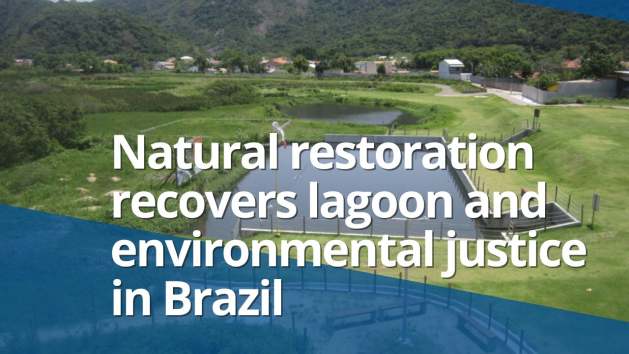
Having won national and global awards, the Orla Piratininga Park (POP) built 35,000 square meters of filtering gardens and improved the water quality of the Piratininga lagoon, in the oceanic south of Niterói, a municipality in metropolitan Rio de Janeiro, across the Guanabara Bay.
The project, named after the late Brazilian environmentalist Alfredo Sirkis, began in 2020, and aims to environmentally restore an area of 680,000 square meters on the lagoon’s shores whose waters cover an area of 2.87 square kilometers.
At the heart of the project are the treatment systems for the waters of the Cafubá, Arrozal, and Jacaré rivers, which flow into the lagoon. Sedimentation and pollution were deteriorating the water resource and the quality of life in the surrounding area.
A weir, which receives the river flow, a sedimentation pond, which removes solid waste, and the filtering gardens make up the chain that partially cleans the water before releasing it into the lagoon, reducing environmental impacts, in a process called phytoremediation.
The gardens are small reservoirs where aquatic plants called macrophytes are planted, which feed on the nutrients from the pollution, explained Heloisa Osanai, the biologist specialized in environmental management of the Sustainable Oceanic Region Program (PRO Sustainable).
Three polluted water treatment stations are in the neighborhoods crossed by the rivers, based on natural resources, “without the use of electrical energy, chemicals, or concrete,” explained Castro, the coordinator of PRO Sustainable.
Furthermore, some macrophytes produce abundant flowers. Only native Brazilian species are planted, with priority given to biodiversity, added Osanai.
Along with these water treatment systems, 10.8 kilometers of bike paths, 17 recreation centers, a 2,800-square-meter Eco-Cultural Center, and other environmental works with social goals were built.
The bike path, generally along a pedestrian sidewalk, caters to physical and leisure activities but is also a factor in protecting the lagoon shoreline by blocking urban occupation and real estate invasions, explain the officials.
The area where the water system was built at the mouth of the Cafubá river was highly degraded by an open-air dump and flooding. A reformed “belt channel,” in some sections also reinforced by macrophyte islands, corrected the waterlogging.
On the other side of the lagoon, 3.2 kilometers of bioswales improve the drainage of rainwater. They are trenches with pipes, stones, and other materials, plus vegetation, that accelerate drainage and prevent pollutants from reaching the lagoon.
The main result, according to Castro, reconciled the local population with the lagoon. The old houses that “turned their backs on the lagoon” are joined by new buildings facing the water, some with balconies overlooking the new landscape, said Mariah Bessa, the engineer in charge of hydraulic aspects of the project.
The local population was highly involved in the design and construction of the new environmental and social facilities that transformed the lagoon shoreline. This led to new attitudes, such as not littering on the ground or in the water and preventing others from doing so, according to Castro.
The Ecocultural Center promotes permanent environmental education, with films, children’s games, audiovisual resources, and a large space for visits and classes.
“We moved from a context of socio-environmental exclusion to one of environmental justice,” said the coordinator of PRO Sustainable.