
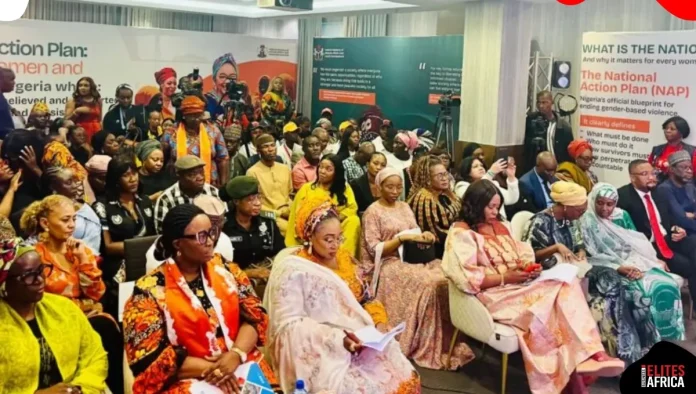



The Federal Government is set to establish an Emergency Gender-Based Violence (GBV) Response Fund to close Nigeria’s widening financing gap in prevention, protection, and survivor support services.
Minister of Women Affairs, Hajiya Imaan Sulaiman-Ibrahim, announced the initiative in Abuja during a high-level event marking the 16 Days of Activism Against Gender-Based Violence, organised in partnership with Women for Women International.
Funding Gap Hampers National Response
Sulaiman-Ibrahim said the fund had become urgent, noting that less than 0.5% of Nigeria’s national budget currently goes to GBV prevention and response programmes. As a result, shelters, safe spaces, and survivor support centres across the country remain grossly underfunded.
She condemned the rise in violent attacks targeting women and girls, including the recent kidnappings of schoolchildren in Kebbi and Niger states and the abduction of six female directors, describing the situation as “a national emergency that exposes the deep vulnerability of women in Nigeria.”
Citing data from the National Demographic and Health Survey, the minister said 28% of Nigerian women aged 15 to 49 have experienced physical violence, while 40% have faced emotional abuse. Despite an increase in reporting, the national conviction rate for GBV cases remains below 5%.
The Emergency GBV Response Fund will form part of the Ministry of Women Affairs’ 9-Pillar Renewed Hope Social Impact Intervention Programme.
According to the minister, the new framework will strengthen institutions, improve justice delivery, establish specialised gender desks and courts in all states, and expand safe spaces for survivors.
She said the government aims to raise the national GBV conviction rate from 5% to 25% by 2026 and is working to create comprehensive survivor support centres in each senatorial district.
Sulaiman-Ibrahim commended recent landmark court rulings and called for a compassionate review of Ochanya’s case to ensure justice for the late teenage victim.
UN Women Calls for Stronger Enforcement
UN Women Representative to Nigeria, Ms. Beatrice Eyong, said that while Nigeria has ratified several major treaties and enacted key laws such as the VAPP Act and the Child Rights Act, enforcement remains weak.
She stressed the need for tougher implementation, greater accountability for perpetrators, and more community education to help Nigerians recognise and prevent GBV. Eyong highlighted the one-stop centres created under the Spotlight Initiative, which provide survivors with legal aid, medical care, psychosocial support, and economic assistance.
Civil Society Pushes for Holistic Action
CEO of Women for Women International, Thelma Ekiyor, outlined the organisation’s 12-month “Stronger Women, Stronger Nations” programme, which focuses on leadership training, economic empowerment, and community engagement for GBV survivors.
Drawing from work in 14 conflict-affected countries, she highlighted five core pillars for reducing GBV: survivor protection, public awareness, stronger legal enforcement, provision of shelters, and meaningful engagement of men.
Ekiyor said the organisation is ready to partner with the Ministry of Women Affairs to deepen interventions, scale support systems, and position Nigeria as a regional leader in GBV prevention and response.