
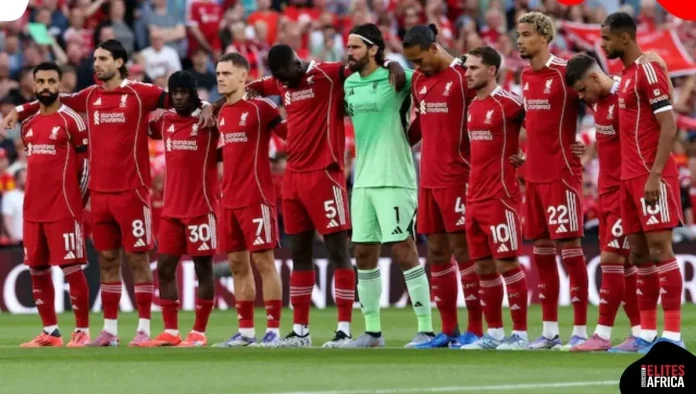



Liverpool are going through one of their toughest periods in recent years, and for many people around the club, the pain goes far beyond football.
The tragic death of Diogo Jota last summer has left a deep emotional wound, and manager Arne Slot has now openly admitted that the loss of the Portuguese forward still hangs heavily over the team.
Jota died at just 28 years old in a car accident, a shock that hit players, staff, and fans across the world. But according to Slot, the effect of losing him goes beyond emotion, it has affected the team on the pitch too.
The Emotional Weight Inside the Dressing Room
Earlier this week, Andy Robertson revealed he was “in bits” before Scotland’s dramatic win over Denmark, showing just how raw the grief still feels, even months after Jota’s passing.
Slot, who watched the interview live, said he completely understood Robertson’s reaction.
For him, the greatest pain is thinking about Jota’s wife and children, whose loss is far heavier than anything happening in football. But as he stated clearly, Liverpool did not just lose a player — they lost a friend, a personality, and a source of energy in the dressing room.
Liverpool’s struggles reflect a team still finding its balance
Liverpool have lost four of their past five Premier League games, including a painful 3–0 defeat to Manchester City right before the international break. They now sit eighth on the table, far from where a club of their ambition expects to be.
The drop in form has raised many questions, but Slot made it clear that Jota’s absence is part of the story. Liverpool not only miss his goals and versatility, but also the calmness, humour, and spark he brought to the squad.
Jota was a player who changed games instantly
Slot gave a strong example: in last season’s match against Nottingham Forest, Jota came on and scored within seconds. A moment like that is hard to replace. With Forest visiting Anfield this weekend, the memory of that goal reminds everyone just how valuable he was.
He was the type of forward who didn’t need time to “warm up”, he was always sharp, always fearless, and always ready to make a difference.
Injuries have not helped Liverpool either
Aside from Jota’s absence, Liverpool have also been battling other fitness problems. Alisson Becker is only just returning after six weeks out with a hamstring injury.
Conor Bradley and Florian Wirtz will miss the Forest game due to fresh injuries, stretching the squad even more at a time when consistency is badly needed.
Is Jota’s death the reason Liverpool are struggling?
The honest answer is: not the only reason, but a major one. Football teams are made of human beings, and grief does not disappear quickly. Losing Jota affected morale, chemistry, and on-field performance.
His goals, movement, and intelligence were crucial parts of Liverpool’s attack and his personality made him even more important behind the scenes.
When you combine that emotional gap with injuries, tactical adjustments under a new manager, and strong competition in the league, it becomes clear why Liverpool are not at their best.
Arne Slot put it perfectly: Liverpool miss the player, but they also miss the person. Jota’s death is something the club will carry for a long time. And while football continues, some voids are simply impossible to fill.
Liverpool may recover their form over time, but the memory of Jota, his talent, his smile, his goals, will always be part of the club’s story.