
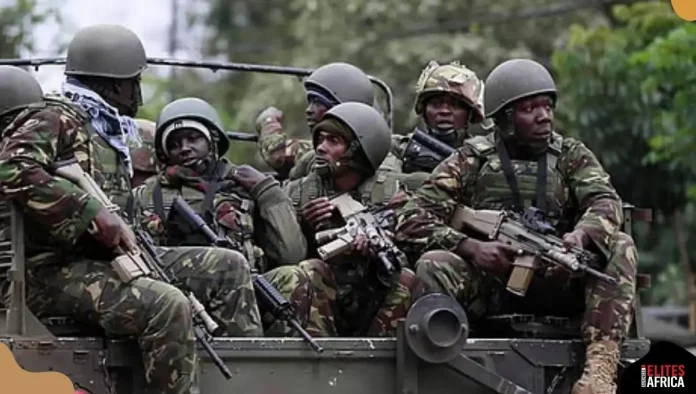



Nigeria’s spending on arms and ammunition has climbed sharply in the last five years, rising in direct response to the country’s worsening security challenges.
New figures from the National Bureau of Statistics (NBS) show that between 2020 and the first half of 2025, Nigeria spent about N776.9 billion on importing weapons needed for military and security operations.
The data, captured in the NBS Foreign Trade Report for Q2 2025, paints a clear picture: every year came with a fresh rise in insecurity, and every rise came with a new bill.
Nigeria’s Year-by-Year Arms Spending
The figures show how fast spending grew within a short period. In 2020, Nigeria spent N29.24 billion on arms and ammunition. By 2021, the bill more than doubled to N72.50 billion. There was a temporary dip in 2022, when spending fell slightly to N28.24 billion, but that drop did not last long.
By 2023, the cost shot up again to N127.16 billion, reflecting the heavier pressure on the military from banditry, terrorism, kidnapping, and insurgency.
The biggest jump came in 2024. That year alone, Nigeria imported N520.02 billion worth of arms, the highest in five years and the largest share of the total spending. It was the year insecurity deepened the most, especially with renewed attacks in the North and rising unrest in the South.
For 2025, the available data only covers the first half of the year, but Nigeria has already spent N26.95 billion on weapons.
Why did spending rise so sharply?
The trend closely follows Nigeria’s security realities. The country has been dealing with:
- Boko Haram and ISWAP attacks in the Northeast
- Banditry and mass kidnappings in the Northwest
- Farmer–herder conflicts in the Middle Belt
- Separatist tensions in the Southeast
These challenges pushed the government to increase procurement of weapons, aircraft parts, armoured vehicles, and ammunition to strengthen both the military and paramilitary forces.
The 2025 Security Budget
Beyond arms imports, Nigeria’s overall security budget for 2025 shows how heavily the government is investing in defence.
According to BudgIT, the 2025 Security and Defence Budget is N6.57 trillion. The bulk of this money is going into personnel costs, salaries, allowances, and welfare which take N4.07 trillion.
Capital projects, including purchase of equipment and construction of military facilities, take N1.50 trillion, while N642.55 billion is allocated for overheads.
The distribution to key agencies shows where government priority lies:
- Defence – N3.10 trillion
- Ministry of Police Affairs – N1.31 trillion
- Interior Ministry (Immigration, Civil Defence, Prisons, etc.) – N1.11 trillion
- Office of the National Security Adviser – N690.84 billion
- Service-wide Votes – N638.34 billion
- Police Service Commission – N2.56 billion
This structure shows a strong emphasis on manpower and operations, not just weapons.
Can Spending Alone Solve the Problem?
Not everyone believes constant spending on weapons is the solution. Retired General Ishola Williams has argued that Nigeria’s insecurity can be drastically reduced in six months, but only with proper reforms.
According to him, Nigeria doesn’t need to keep buying new weapons every year. Instead, the country must reorganise its security agencies, maintain existing equipment, and improve coordination among the military, police, and intelligence units.