
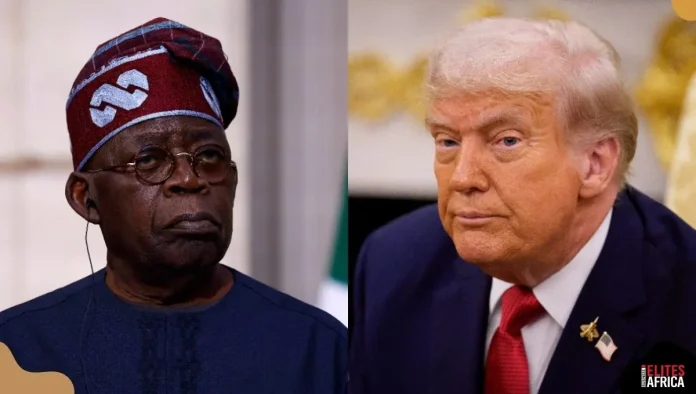



Nigeria’s long-standing trade relationship with the United States has entered one of its most uncertain moments in recent years.
Once one of Nigeria’s most reliable economic partners, the U.S. has now fallen to sixth place among the country’s top trade partners, according to new data from the National Bureau of Statistics (NBS).
And for many observers, this shift is coming at a time when political tension between Washington and Abuja is once again rising fueled by President Donald Trump’s controversial comments about Nigeria.
Trump’s threat
In late October 2025, President Trump threatened to suspend aid to Nigeria over alleged killings of Christians in the northern region.
The warning, delivered in his typical blunt style, has unsettled diplomatic and economic circles alike. It’s not the first time Trump has taken a hard stance on African nations, but this latest move against one of America’s strongest partners on the continent is raising new questions about the stability of U.S.–Nigeria relations.
Despite these tensions, trade between the two nations has remained active. In the second quarter of 2025, the U.S. accounted for ₦1.4 trillion in Nigerian exports, mostly crude oil.
Oil still dominates the trade mix, making up roughly 68 percent of all shipments to the U.S., while non-oil exports such as agricultural produce, textiles, and manufactured goods represent just 1.9 percent.
Europe and Asia take the lead
While America’s presence in Nigeria’s trade chart fades, other regions are tightening their grip. Spain has overtaken all others as Nigeria’s top export destination, importing nearly ₦2.5 trillion worth of crude oil and liquefied natural gas.
India, long a dependable energy buyer, has increased its intake as part of its effort to diversify away from Middle Eastern sources. France, the Netherlands, and Canada also now feature prominently in Nigeria’s top five trade partners, a sign that Abuja is successfully expanding its reach beyond traditional Western allies.
This growing European and Asian dominance reflects a broader shift in Nigeria’s trade strategy under President Bola Tinubu’s government. Amid Washington’s unpredictability, Nigeria appears to be doubling down on relationships with nations that promise consistency in energy and manufacturing demand.
Trump’s rhetoric adds fuel to economic uncertainty
Although the U.S. still represents about 6 percent of Nigeria’s total exports, its share has declined over the past decade, largely due to the American shale oil boom, which reduced the U.S.’s need for imported crude.
Trump’s fiery rhetoric including a decision to redesignate Nigeria as a “Country of Particular Concern” (CPC) has deepened unease among investors.
Dr. Muda Yusuf, Director of the Centre for the Promotion of Private Enterprise (CPPE), cautioned that such remarks could worsen Nigeria’s economic perception abroad.
“Trump’s threat, if sustained, could weaken investor confidence and heighten Nigeria’s risk profile,” he said. “It sends a negative signal at a time when the economy is already battling weak reserves and rising debt.”
This sentiment appears to be reflected in market behavior. Nigeria’s dollar bonds recently took a hit, suggesting that global investors are closely watching how this diplomatic friction unfolds.
America’s Influence May Be Fading, But It Still Matters
Despite the slide, the U.S. remains a vital trade and security partner for Nigeria. Bilateral trade between both nations totaled about $13 billion in 2024, and the flow of investment particularly in technology, defense, and education continues to anchor their partnership.’
However, as Nigeria looks increasingly toward Europe and Asia for trade growth, Washington’s leverage appears to be weakening. Analysts believe that even if Trump were to enforce aid cuts or impose new trade restrictions, the short-term impact might be minimal, thanks to Nigeria’s stronger global diversification.
Still, the political cost could be heavy. The image of the U.S. as a trusted ally is under strain, and any prolonged hostility could reduce cooperation in other key areas like counterterrorism, energy transition, and digital innovation.
The U.S. slipping to sixth place among Nigeria’s top trade partners is not just about numbers, it’s a signal of changing global dynamics.
For Nigeria, it’s an opportunity to strengthen trade independence. For the U.S., it’s a warning that political posturing has real economic consequences